
Verwandte Artikel zu Modern Times Revised Edition: World from the Twenties...
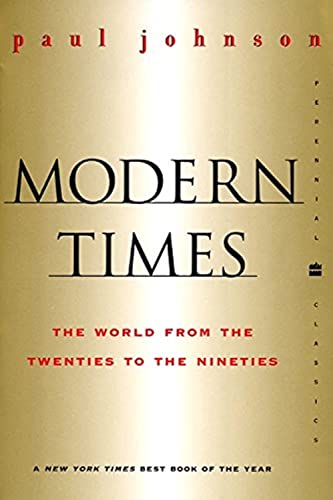
Modern Times Revised Edition: World from the Twenties to the Nineties, The (Perennial Classics) - Softcover
Inhaltsangabe
The modern world began on May 29, 1919.
In this provocative and sweeping chronicle of 20th century history, acclaimed historian Paul Johnson argues that the confirmation of Einstein’s theory of relativity set in motion a chain of events that replaced moral absolutes with a destructive new era of moral relativism.
This powerful work of intellectual history traces how the ideas of Marx, Freud, and Einstein were tragically twisted into justifications for the terrifying rise of totalitarianism. Johnson uncovers the horrifying consequences of social engineering, from Lenin's and Stalin’s brutal experiments to the collectivist ideologies that swept the globe.
Spanning the decades from the 1920s to the 1990s, Modern Times Revised Edition is a monumental work of modern history that challenges our understanding of a century shaped by gangster-statesmen and secular ideologies.
This monumental work of political and intellectual history offers a stunning re-evaluation of our era, revealing:
- A Relativistic World: How the confirmation of Einstein’s theories in 1919 shattered old certainties and accidentally unleashed an age of moral relativism that shaped the century.
- The First Despotic Utopias: A stunning analysis of Lenin, Mussolini, and the rise of the first “gangster-statesmen” who sought to build heaven on earth through the hell of the police state.
- Legitimacy in Decadence: An examination of the fragile democracies of the 1920s and ’30s, and how their internal weaknesses―and the emergence of Hitler―paved the way for catastrophe.
- Experimenting with Half Mankind: The disastrous consequences of large-scale social engineering, from Stalin’s collectivization to the collectivist ideologies that swept the post-colonial world.
- The Recovery of Freedom: A sweeping account of the post-war world, the failures of the collectivist seventies, and the resurgence of individual liberty in the final decades of the 20th century.
Die Inhaltsangabe kann sich auf eine andere Ausgabe dieses Titels beziehen.
Über die Autorin bzw. den Autor
Paul Johnson is a historian whose work ranges over the millennia and the whole gamut of human activities. He regularly writes book reviews for several UK magazines and newspapers, such as the Literary Review and The Spectator, and he lectures around the world. He lives in London, England.
Von der hinteren Coverseite
The classic world history of the events, ideas, and personalities of the twentieth century.
Auszug. © Genehmigter Nachdruck. Alle Rechte vorbehalten.
Modern Timesrevised Edition
World from the Twenties to the Nineties, theBy Johnson, PaulPerennial
Copyright ©2004 Paul M. JohnsonAll right reserved.
ISBN: 0060935502
Chapter One
A Relativistic World
The modern world began on 29 May 1919 when photographs of a solar eclipse, taken on the island of Principe off West Africa and at Sobral in Brazil, confirmed the truth of a new theory of the universe. It had been apparent for half a century that the Newtonian cosmology, based upon the straight lines of Euclidean geometry and Galileo's notions of absolute time, was in need of serious modification. It had stood for more than two hundred years. It was the framework within which the European Enlightenment, the Industrial Revolution, and the vast expansion of human knowledge, freedom and prosperity which characterized the nineteenth century, had taken place. But increasingly powerful telescopes were revealing anomalies. In particular, the motions of the planet Mercury deviated by forty-three seconds of arc a century from its predictable behaviour under Newtonian laws of physics. Why?
In 1905, a twenty-six-year-old German Jew, Albert Einstein, then working in the Swiss patent office in Berne, had published a paper, "On the electrodynamics of moving bodies", which became known as the Special Theory of Relativity. Einstein's observations on the way in which, in certain circumstances, lengths appeared to contract and clocks to slow down, are analogous to the effects of perspective in painting. In fact the discovery that space and time are relative rather than absolute terms of measurement is comparable, in its effect on our perception of the world, to the first use of perspective in art, which occurred in Greece in the two decades c.500-480 BC.
The originality of Einstein, amounting to a form of genius, and the curious elegance of his lines of argument, which colleagues compared to a kind of art, aroused growing, world-wide interest. In 1907 he published a demonstration that all mass has energy, encapsulated in the equation E = mc2, which a later age saw as the starting point in the race for the A-bomb. Not even the onset of the European war prevented scientists from following his quest for an all-embracing General Theory of Relativity which would cover gravitational fields and provide a comprehensive revision of Newtonian physics. In 1915 news reached London that he had done it. The following spring, as the British were preparing their vast and catastrophic offensive on the Somme, the key paper was smuggled through the Netherlands and reached Cambridge, where it was received by Arthur Eddington, Professor of Astronomy and Secretary of the Royal Astronomical Society.
Eddington publicized Einstein's achievement in a 1918 paper for the Physical Society called "Gravitation and the Principle of Relativity". But it was of the essence of Einstein's methodology that he insisted his equations must be verified by empirical observation and he himself devised three specific tests for this purpose. The key one was that a ray of light just grazing the surface of the sun must be bent by 1.745 seconds of arc -- twice the amount of gravitational deflection provided for by classical Newtonian theory. The experiment involved photographing a solar eclipse. The next was due on 29 May 1919. Before the end of the war, the Astronomer Royal, Sir Frank Dyson, had secured from a harassed government the promise of 1,000 to finance an expedition to take observations from Principe and Sobral.
Early in March 1919, the evening before the expedition sailed, the astronomers talked late into the night in Dyson's study at the Royal Observatory, Greenwich, designed by Wren in 1675-6, while Newton was still working on his general theory of gravitation. E.T. Cottingham, Eddington's assistant, who was to accompany him, asked the awful question: what would happen if measurement of the eclipse photographs showed not Newton's, nor Einstein's, but twice Einstein's deflection? Dyson said, "Then Eddington will go mad and you will have to come home alone." Eddington's notebook records that on the morning of 29 May there was a tremendous thunderstorm in Principe. The clouds cleared just in time for the eclipse at 1.30 pm. Eddington had only eight minutes in which to operate. "I did not see the eclipse, being too busy changing plates...We took sixteen photographs." Thereafter, for six nights he developed the plates at the rate of two a night. On the evening of 3 June, having spent the whole day measuring the developed prints, he turned to his colleague, "Cottingham, you won't have to go home alone." Einstein had been right.
The expedition satisfied two of Einstein's tests, which were reconfirmed by W.W. Campbell during the September 1922 eclipse. It was a measure of Einstein's scientific rigour that he refused to accept that his own theory was valid until the third test (the "red shift") was met. "If it were proved that this effect does not exist in nature", he wrote to Eddington on 15 December 1919, "then the whole theory would have to be abandoned". In fact the "red shift" was confirmed by the Mount Wilson observatory in 1923, and thereafter empirical proof of relativity theory accumulated steadily, one of the most striking instances being the gravitational lensing system of quasars, identified in 1979-80. At the time, Einstein's professional heroism did not go unappreciated. To the young philosopher Karl Popper and his friends at Vienna University, "it was a great experience for us, and one which had a lasting influence on my intellectual development". "What impressed me most", Popper wrote later, "was Einstein's own clear statement that he would regard his theory as untenable if it should fail in certain tests.... Here was an attitude utterly different from the dogmatism of Marx, Freud, Adler and even more so that of their followers. Einstein was looking for crucial experiments whose agreement with his predictions would by no means establish his theory; while a disagreement, as he was the first to stress, would show his theory to be untenable. This, I felt, was the true scientific attitude..."
Continues...Excerpted from Modern Timesrevised Editionby Johnson, Paul Copyright ©2004 by Paul M. Johnson. Excerpted by permission.
All rights reserved. No part of this excerpt may be reproduced or reprinted without permission in writing from the publisher.
Excerpts are provided by Dial-A-Book Inc. solely for the personal use of visitors to this web site.
„Über diesen Titel“ kann sich auf eine andere Ausgabe dieses Titels beziehen.
Suchergebnisse für Modern Times Revised Edition: World from the Twenties...

Beispielbild für diese ISBN
Modern Times Revised Edition: World from the Twenties to the Nineties, the
Verlag:
HarperCollins Publishers Inc, 2001
ISBN 10: 0060935502
ISBN 13: 9780060935504
Gebraucht
Paperback
Anbieter: World of Books (was SecondSale), Montgomery, IL, USA
Verkäuferbewertung 5 von 5 Sternen

Paperback. Zustand: Fair. The modern world began on May 29, 1919. In this provocative and sweeping chronicle of 20th century history, acclaimed historian Paul Johnson argues that the confirmation of Einstein's theory of relativity set in motion a chain of events that replaced moral absolutes with a destructive new era of moral relativism. This powerful work of intellectual history traces how the ideas of Marx, Freud, and Einstein were tragically twisted into justifications for the terrifying rise of totalitarianism. Johnson uncovers the horrifying consequences of social engineering, from Lenin's and Stalin's brutal experiments to the collectivist ideologies that swept the globe. Spanning the decades from the 1920s to the 1990s, Modern Times Revised Edition is a monumental work of modern history that challenges our understanding of a century shaped by gangster-statesmen and secular ideologies. This monumental work of political and intellectual history offers a stunning re-evaluation of our era, revealing: A Relativistic World: How the confirmation of Einstein's theories in 1919 shattered old certainties and accidentally unleashed an age of moral relativism that shaped the century. The First Despotic Utopias: A stunning analysis of Lenin, Mussolini, and the rise of the first "gangster-statesmen" who sought to build heaven on earth through the hell of the police state. Legitimacy in Decadence: An examination of the fragile democracies of the 1920s and '30s, and how their internal weaknesses--and the emergence of Hitler--paved the way for catastrophe. Experimenting with Half Mankind: The disastrous consequences of large-scale social engineering, from Stalin's collectivization to the collectivist ideologies that swept the post-colonial world. The Recovery of Freedom: A sweeping account of the post-war world, the failures of the collectivist seventies, and the resurgence of individual liberty in the final decades of the 20th century. Artikel-Nr. 00109719052
Gebraucht kaufen
EUR 4,05
Versand gratis
Versand innerhalb von USA
Versand innerhalb von USA
Anzahl: 4 verfügbar
Beispielbild für diese ISBN
Modern Times Revised Edition: World from the Twenties to the Nineties, the
Verlag:
HarperCollins Publishers Inc, 2001
ISBN 10: 0060935502
ISBN 13: 9780060935504
Gebraucht
Paperback
Anbieter: World of Books (was SecondSale), Montgomery, IL, USA
Verkäuferbewertung 5 von 5 Sternen
Paperback. Zustand: Good. The modern world began on May 29, 1919. In this provocative and sweeping chronicle of 20th century history, acclaimed historian Paul Johnson argues that the confirmation of Einstein's theory of relativity set in motion a chain of events that replaced moral absolutes with a destructive new era of moral relativism. This powerful work of intellectual history traces how the ideas of Marx, Freud, and Einstein were tragically twisted into justifications for the terrifying rise of totalitarianism. Johnson uncovers the horrifying consequences of social engineering, from Lenin's and Stalin's brutal experiments to the collectivist ideologies that swept the globe. Spanning the decades from the 1920s to the 1990s, Modern Times Revised Edition is a monumental work of modern history that challenges our understanding of a century shaped by gangster-statesmen and secular ideologies. This monumental work of political and intellectual history offers a stunning re-evaluation of our era, revealing: A Relativistic World: How the confirmation of Einstein's theories in 1919 shattered old certainties and accidentally unleashed an age of moral relativism that shaped the century. The First Despotic Utopias: A stunning analysis of Lenin, Mussolini, and the rise of the first "gangster-statesmen" who sought to build heaven on earth through the hell of the police state. Legitimacy in Decadence: An examination of the fragile democracies of the 1920s and '30s, and how their internal weaknesses--and the emergence of Hitler--paved the way for catastrophe. Experimenting with Half Mankind: The disastrous consequences of large-scale social engineering, from Stalin's collectivization to the collectivist ideologies that swept the post-colonial world. The Recovery of Freedom: A sweeping account of the post-war world, the failures of the collectivist seventies, and the resurgence of individual liberty in the final decades of the 20th century. Artikel-Nr. 00109499177
Gebraucht kaufen
EUR 4,05
Versand gratis
Versand innerhalb von USA
Versand innerhalb von USA
Anzahl: 9 verfügbar
Beispielbild für diese ISBN
Modern Times Revised Edition: World from the Twenties to the Nineties, the
Verlag:
HarperCollins Publishers Inc, 2001
ISBN 10: 0060935502
ISBN 13: 9780060935504
Gebraucht
Paperback
Anbieter: World of Books (was SecondSale), Montgomery, IL, USA
Verkäuferbewertung 5 von 5 Sternen
Paperback. Zustand: Very Good. The modern world began on May 29, 1919. In this provocative and sweeping chronicle of 20th century history, acclaimed historian Paul Johnson argues that the confirmation of Einstein's theory of relativity set in motion a chain of events that replaced moral absolutes with a destructive new era of moral relativism. This powerful work of intellectual history traces how the ideas of Marx, Freud, and Einstein were tragically twisted into justifications for the terrifying rise of totalitarianism. Johnson uncovers the horrifying consequences of social engineering, from Lenin's and Stalin's brutal experiments to the collectivist ideologies that swept the globe. Spanning the decades from the 1920s to the 1990s, Modern Times Revised Edition is a monumental work of modern history that challenges our understanding of a century shaped by gangster-statesmen and secular ideologies. This monumental work of political and intellectual history offers a stunning re-evaluation of our era, revealing: A Relativistic World: How the confirmation of Einstein's theories in 1919 shattered old certainties and accidentally unleashed an age of moral relativism that shaped the century. The First Despotic Utopias: A stunning analysis of Lenin, Mussolini, and the rise of the first "gangster-statesmen" who sought to build heaven on earth through the hell of the police state. Legitimacy in Decadence: An examination of the fragile democracies of the 1920s and '30s, and how their internal weaknesses--and the emergence of Hitler--paved the way for catastrophe. Experimenting with Half Mankind: The disastrous consequences of large-scale social engineering, from Stalin's collectivization to the collectivist ideologies that swept the post-colonial world. The Recovery of Freedom: A sweeping account of the post-war world, the failures of the collectivist seventies, and the resurgence of individual liberty in the final decades of the 20th century. Artikel-Nr. CIN0060935502VG
Gebraucht kaufen
EUR 4,05
Versand gratis
Versand innerhalb von USA
Versand innerhalb von USA
Anzahl: 1 verfügbar
Foto des Verkäufers
Modern Times Revised Edition: The World from the Twenties to the Nineties (Perennial Classics)
Verlag:
Harper Perennial Modern Classics, 2001
ISBN 10: 0060935502
ISBN 13: 9780060935504
Gebraucht
Softcover
Anbieter: Dream Books Co., Denver, CO, USA
Verkäuferbewertung 5 von 5 Sternen
Zustand: acceptable. This copy has clearly been enjoyedâ"expect noticeable shelf wear and some minor creases to the cover. Binding is strong, and all pages are legible. May contain previous library markings or stamps. Artikel-Nr. DBV.0060935502.A
Gebraucht kaufen
EUR 4,06
Versand gratis
Versand innerhalb von USA
Versand innerhalb von USA
Anzahl: 1 verfügbar
Beispielbild für diese ISBN
Modern Times Revised Edition: The World from the Twenties to the Nineties (Perennial Classics)
Verlag:
Harper Perennial Modern Classics (edition Revised), 2001
ISBN 10: 0060935502
ISBN 13: 9780060935504
Gebraucht
Paperback
Anbieter: BooksRun, Philadelphia, PA, USA
Verkäuferbewertung 5 von 5 Sternen
Paperback. Zustand: Fair. Revised. The item might be beaten up but readable. May contain markings or highlighting, as well as stains, bent corners, or any other major defect, but the text is not obscured in any way. Artikel-Nr. 0060935502-7-18
Gebraucht kaufen
EUR 6,05
Versand gratis
Versand innerhalb von USA
Versand innerhalb von USA
Anzahl: 1 verfügbar
Beispielbild für diese ISBN
Modern Times Revised Edition: World from the Twenties to the Nineties, the
Anbieter: ThriftBooks-Phoenix, Phoenix, AZ, USA
Verkäuferbewertung 5 von 5 Sternen
Paperback. Zustand: Very Good. No Jacket. May have limited writing in cover pages. Pages are unmarked. ~ ThriftBooks: Read More, Spend Less. Artikel-Nr. G0060935502I4N00
Gebraucht kaufen
EUR 6,10
Versand gratis
Versand innerhalb von USA
Versand innerhalb von USA
Anzahl: 1 verfügbar
Beispielbild für diese ISBN
Modern Times Revised Edition: World from the Twenties to the Nineties, the
Anbieter: ThriftBooks-Dallas, Dallas, TX, USA
Verkäuferbewertung 5 von 5 Sternen
Paperback. Zustand: Fair. No Jacket. Former library book; Readable copy. Pages may have considerable notes/highlighting. ~ ThriftBooks: Read More, Spend Less. Artikel-Nr. G0060935502I5N10
Gebraucht kaufen
EUR 6,10
Versand gratis
Versand innerhalb von USA
Versand innerhalb von USA
Anzahl: 1 verfügbar
Beispielbild für diese ISBN
Modern Times Revised Edition: World from the Twenties to the Nineties, the
Anbieter: ThriftBooks-Dallas, Dallas, TX, USA
Verkäuferbewertung 5 von 5 Sternen
Paperback. Zustand: Good. No Jacket. Pages can have notes/highlighting. Spine may show signs of wear. ~ ThriftBooks: Read More, Spend Less. Artikel-Nr. G0060935502I3N00
Gebraucht kaufen
EUR 6,10
Versand gratis
Versand innerhalb von USA
Versand innerhalb von USA
Anzahl: 3 verfügbar
Beispielbild für diese ISBN
Modern Times Revised Edition: World from the Twenties to the Nineties, the
Anbieter: ThriftBooks-Dallas, Dallas, TX, USA
Verkäuferbewertung 5 von 5 Sternen
Paperback. Zustand: Fair. No Jacket. Readable copy. Pages may have considerable notes/highlighting. ~ ThriftBooks: Read More, Spend Less. Artikel-Nr. G0060935502I5N00
Gebraucht kaufen
EUR 6,10
Versand gratis
Versand innerhalb von USA
Versand innerhalb von USA
Anzahl: 2 verfügbar
Beispielbild für diese ISBN
Modern Times Revised Edition: World from the Twenties to the Nineties, the
Anbieter: ThriftBooks-Phoenix, Phoenix, AZ, USA
Verkäuferbewertung 5 von 5 Sternen
Paperback. Zustand: Good. No Jacket. Pages can have notes/highlighting. Spine may show signs of wear. ~ ThriftBooks: Read More, Spend Less. Artikel-Nr. G0060935502I3N00
Gebraucht kaufen
EUR 6,10
Versand gratis
Versand innerhalb von USA
Versand innerhalb von USA
Anzahl: 2 verfügbar