
Verwandte Artikel zu The Second Brain: A Groundbreaking New Understanding...
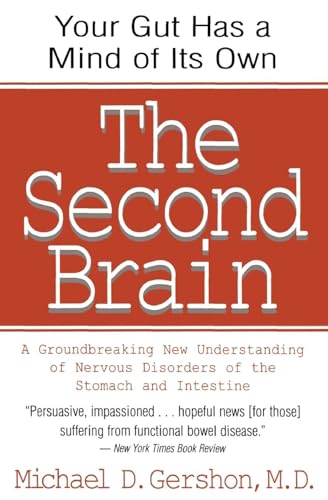
The Second Brain: A Groundbreaking New Understanding of Nervous Disorders of the Stomach and Intestine - Softcover
Inhaltsangabe
“Persuasive, impassioned. . . hopeful news [for those] suffering from functional bowel disease.” — New York Times Book Review
Dr. Michael Gershon’s groundbreaking book fills the gap between what you need to know—and what your doctor has time to tell you.
Dr. Michael Gershon has devoted his career to understanding the human bowel (the stomach, esophagus, small intestine, and colon). His thirty years of research have led to an extraordinary rediscovery: nerve cells in the gut that act as a brain. This "second brain" can control our gut all by itself. Our two brains—the one in our head and the one in our bowel—must cooperate. If they do not, then there is chaos in the gut and misery in the head—everything from "butterflies" to cramps, from diarrhea to constipation. Dr. Gershon's work has led to radical new understandings about a wide range of gastrointestinal problems including gastroenteritis, nervous stomach, and irritable bowel syndrome.
The Second Brain represents a quantum leap in medical knowledge and is already benefiting patients whose symptoms were previously dismissed as neurotic or "it's all in your head."
Die Inhaltsangabe kann sich auf eine andere Ausgabe dieses Titels beziehen.
Über die Autorin bzw. den Autor
Michael D. Gershon M.D., is chairman of the Department of Anatomy and Cell Biology at Columbia University's College of Physicians and Surgeons at the Columbia-Presbyterian Medical Center in New York City.
Von der hinteren Coverseite
Dr. Michael Gershon has devoted his career to understanding the human bowel (the stomach, esophagus, small intestine, and colon). His thirty years of research have led to an extraordinary rediscovery: nerve cells in the gut that act as a brain. This "second brain" can control our gut all by itself. Our two brains -- the one in our head and the one in our bowel -- must cooperate. If they do not, then there is chaos in the gut and misery in the head -- everything from "butterflies" to cramps, from diarrhea to constipation. Dr. Gershon's work has led to radical new understandings about a wide range of gastrointestinal problems including gastroenteritis, nervous stomach, and irritable bowel syndrome. The Second Brain represents a quantum leap in medical knowledge and is already benefiting patients whose symptoms were previously dismissed as neurotic or "it's all in your head."
Aus dem Klappentext
Dr. Michael Gershon has devoted his career to understanding the human bowel (the stomach, esophagus, small intestine, and colon). His thirty years of research have led to an extraordinary rediscovery: nerve cells in the gut that act as a brain. This second brain can control our gut all by itself. Our two brains -- the one in our head and the one in our bowel -- must cooperate. If they do not, then there is chaos in the gut and misery in the head -- everything from butterflies to cramps, from diarrhea to constipation. Dr. Gershon's work has led to radical new understandings about a wide range of gastrointestinal problems including gastroenteritis, nervous stomach, and irritable bowel syndrome. The Second Brain represents a quantum leap in medical knowledge and is already benefiting patients whose symptoms were previously dismissed as neurotic or it's all in your head.
--Jacqueline Boone, The New York Times Book ReviewAuszug. © Genehmigter Nachdruck. Alle Rechte vorbehalten.
The Second Brain
The Scientific Basis of Gut Instinct & a Groundbreaking New Understanding of Nervous Disorders of the Stomach & IntestBy Gershon, Michael D.HarperCollins Publishers
Copyright © 2004 Michael GershonAll right reserved.
ISBN: 0060930721
Chapter One
The Discovery Of The Second Brain
Those Of Us Who deal in science, even the most enlightened of us have a strong and objectionable tendency to hubris. Hubris for scientists comes from an inadequate knowledge and appreciation of the past. Discoveries are thus made and claimed that are really rediscoveries -- not new advances at all, but history lessons.
Neurogastroenterology: A Rediscovery
Brings Hope for the Future
Not long ago, the New York Times ran an article about the second brain in its science section. David Wingate, a gastroenterologist with an academic practice in London, was cited as a source for a comment that identified me as the father of the new field of neurogastroenterology. I admit to being the father only of three children. Clearly, David did not insult me by attributing to me the fatherhood of a field. In fact, I would love to be able to just send him a note saying something nice, like "David, you've noticed." Unfortunately for my ego, however, I know better.
I have made discoveries in my scientific career, but the basic principles on which my work is based are about to celebrate their one hundredth anniversary. That bit of information is very good for putting down my own particular brand of hubris. I am not really disappointed, because
I have to conceded priority to people who came before me. Rediscovery is every bit as good as discovery, if what is rediscovered is important and was forgotten. It is better still when the rediscovered information has the capacity to improve the fives of those around us.
Neurogastroenterology began when the first investigators determined that there really is a second brain in the bowel. The seminal discovery that established its existence was the demonstration that the gut contains nerve cells that can "go it alone"; that is, they can operate the organ without instructions from the brain or spinal cord. Those of us who qualify as neurogastroenterological fathers in David Wingate's estimation are really children. None of us discovered the existence of the second brain. That discovery had passed, however, like the Roman Empire, into oblivion. What I have done, with a great deal of help from colleagues around the world, is to find it again and return it to scientific consciousness. To me, that accomplishment, which will soon provide relief to millions of people suffering from the misbehavior of an ill-tempered bowel, is sufficient. Dayenu.
Ecclesiastes Was Right: There Really Is Nothing New Under the Sun
Neurogastroenterology really started with Bayliss and Starling, two investigators whose work in nineteenth-century England established them as immortals in the Pantheon of Physiology. I love to envision what life must have been like in the laboratories of England at the turn of the century. It was a time when notorious fogs descended on London and mixed with the smoke of thousands of coal stoves to clog lungs and blot out the view. This was the time of Jack the Ripper, David Copperfield, and Ebenezer Scrooge. I had experienced an update of an English laboratory in 1965-1966, when I was a postdoctoral fellow at Oxford. One needs to read Dickens to appreciate the conditions under which English scientists work.
Winters in England are not usually very cold. Certainly, New York is colder than Oxford or London. The trouble with England is that there is very little difference in most of the country between the indoor and the outdoor temperatures. I worked at my laboratory bench with my scarf on, and I wore gloves with the fingertips cut off so that I could feel what I touched. The benches tended to be high, and we sat on backless wooden stools. Since these laboratories were the result of half a century of progress, the working conditions faced by Bayliss and Starling must have been almost penal. Whatever their laboratories were like, the accomplishments of Bayliss and Starling were quite startling. In fact, until Margaret Thatcher became prime minister and suffocated British science, the physlological laboratories of England were a match for those of any other nation.
The Law of the Intestine
Bayliss and Starling worked with dogs. They isolated a loop of intestine in anesthetized animals and studied the effects of stimulating the bowel from within its internal cavity, thereby mimicking the effects that normal intestinal contents might exert on the wall of the gut. In their critical experiments, Bayliss and Starling increased the pressure within the loop of bowel. The gut responded with a stereotyped behavior that, in its reproducibility, caught their attention. Whenever its internal pressure was raised sufficiently, the bowel would exhibit muscular movements that had the effect of propelling the contents of the intestine in a startlingly oneway direction. The propulsive movements consisted of a coordinated descending wave of oral contraction and anal relaxation that forced the intestinal contents relentlessly and inevitably in an anal direction.
Bayliss and Starling called this response of the gut to increased internal pressure "the law of the intestine." Bayliss and Starling were very much into "laws." Their physiological legacy includes a "law of the heart" and a "law of the circulation" as well as the "law of the intestine." They probably used the word "law," which now seems quaint, to imply that they had discovered an everlasting principle that governs the behavior of a biological system. Perhaps it was the contemporaneous notoriety of the case of Jarndyce versus Jarndyce in Dickens's great book Bleak House that focused their terminology in such a legal direction. In any case, the "law of the intestine," despite its catchiness as a phrase, failed to persist. Not that Bayliss and Starling were wrong. In fact, their work has stood up wen over time and is easily reproduced. The "law of the intestine" that Bayliss and Starling formulated still describes the behavior of the bowel, but the name of the activity has changed.
Continues...Excerpted from The Second Brainby Gershon, Michael D. Copyright © 2004 by Michael Gershon. Excerpted by permission.
All rights reserved. No part of this excerpt may be reproduced or reprinted without permission in writing from the publisher.
Excerpts are provided by Dial-A-Book Inc. solely for the personal use of visitors to this web site.
„Über diesen Titel“ kann sich auf eine andere Ausgabe dieses Titels beziehen.
Suchergebnisse für The Second Brain: A Groundbreaking New Understanding...

Beispielbild für diese ISBN
The Second Brain
Verlag:
HarperCollins Publishers Inc, 1999
ISBN 10: 0060930721
ISBN 13: 9780060930721
Gebraucht
Paperback
Anbieter: World of Books (was SecondSale), Montgomery, IL, USA
Verkäuferbewertung 5 von 5 Sternen

Paperback. Zustand: Good. "Persuasive, impassioned. . . hopeful news [for those] suffering from functional bowel disease." -- New York Times Book Review Dr. Michael Gershon's groundbreaking book fills the gap between what you need to know--and what your doctor has time to tell you. Dr. Michael Gershon has devoted his career to understanding the human bowel (the stomach, esophagus, small intestine, and colon). His thirty years of research have led to an extraordinary rediscovery: nerve cells in the gut that act as a brain. This "second brain" can control our gut all by itself. Our two brains--the one in our head and the one in our bowel--must cooperate. If they do not, then there is chaos in the gut and misery in the head--everything from "butterflies" to cramps, from diarrhea to constipation. Dr. Gershon's work has led to radical new understandings about a wide range of gastrointestinal problems including gastroenteritis, nervous stomach, and irritable bowel syndrome. The Second Brain represents a quantum leap in medical knowledge and is already benefiting patients whose symptoms were previously dismissed as neurotic or "it's all in your head.". Artikel-Nr. 00105470878
Gebraucht kaufen
EUR 4,11
Versand gratis
Versand innerhalb von USA
Versand innerhalb von USA
Anzahl: 10 verfügbar
Beispielbild für diese ISBN
The Second Brain
Verlag:
HarperCollins Publishers Inc, 1999
ISBN 10: 0060930721
ISBN 13: 9780060930721
Gebraucht
Paperback
Anbieter: World of Books (was SecondSale), Montgomery, IL, USA
Verkäuferbewertung 5 von 5 Sternen
Paperback. Zustand: Fair. "Persuasive, impassioned. . . hopeful news [for those] suffering from functional bowel disease." -- New York Times Book Review Dr. Michael Gershon's groundbreaking book fills the gap between what you need to know--and what your doctor has time to tell you. Dr. Michael Gershon has devoted his career to understanding the human bowel (the stomach, esophagus, small intestine, and colon). His thirty years of research have led to an extraordinary rediscovery: nerve cells in the gut that act as a brain. This "second brain" can control our gut all by itself. Our two brains--the one in our head and the one in our bowel--must cooperate. If they do not, then there is chaos in the gut and misery in the head--everything from "butterflies" to cramps, from diarrhea to constipation. Dr. Gershon's work has led to radical new understandings about a wide range of gastrointestinal problems including gastroenteritis, nervous stomach, and irritable bowel syndrome. The Second Brain represents a quantum leap in medical knowledge and is already benefiting patients whose symptoms were previously dismissed as neurotic or "it's all in your head.". Artikel-Nr. 00105878201
Gebraucht kaufen
EUR 4,11
Versand gratis
Versand innerhalb von USA
Versand innerhalb von USA
Anzahl: 3 verfügbar
Beispielbild für diese ISBN
The Second Brain: The Scientific Basis of Gut Instinct & a Groundbreaking New Understanding of Nervous Disorders of the Stomach & Intestine
Anbieter: ThriftBooks-Dallas, Dallas, TX, USA
Verkäuferbewertung 5 von 5 Sternen
Paperback. Zustand: Good. No Jacket. Pages can have notes/highlighting. Spine may show signs of wear. ~ ThriftBooks: Read More, Spend Less. Artikel-Nr. G0060930721I3N00
Gebraucht kaufen
EUR 5,96
Versand gratis
Versand innerhalb von USA
Versand innerhalb von USA
Anzahl: 5 verfügbar
Beispielbild für diese ISBN
The Second Brain: The Scientific Basis of Gut Instinct & a Groundbreaking New Understanding of Nervous Disorders of the Stomach & Intestine
Anbieter: ThriftBooks-Atlanta, AUSTELL, GA, USA
Verkäuferbewertung 5 von 5 Sternen
Paperback. Zustand: Fair. No Jacket. Readable copy. Pages may have considerable notes/highlighting. ~ ThriftBooks: Read More, Spend Less. Artikel-Nr. G0060930721I5N00
Gebraucht kaufen
EUR 5,96
Versand gratis
Versand innerhalb von USA
Versand innerhalb von USA
Anzahl: 1 verfügbar
Beispielbild für diese ISBN
The Second Brain: The Scientific Basis of Gut Instinct & a Groundbreaking New Understanding of Nervous Disorders of the Stomach & Intestine
Anbieter: ThriftBooks-Dallas, Dallas, TX, USA
Verkäuferbewertung 5 von 5 Sternen
Paperback. Zustand: Very Good. No Jacket. May have limited writing in cover pages. Pages are unmarked. ~ ThriftBooks: Read More, Spend Less. Artikel-Nr. G0060930721I4N00
Gebraucht kaufen
EUR 5,96
Versand gratis
Versand innerhalb von USA
Versand innerhalb von USA
Anzahl: 1 verfügbar
Beispielbild für diese ISBN
The Second Brain: The Scientific Basis of Gut Instinct & a Groundbreaking New Understanding of Nervous Disorders of the Stomach & Intestine
Anbieter: ThriftBooks-Atlanta, AUSTELL, GA, USA
Verkäuferbewertung 5 von 5 Sternen
Paperback. Zustand: Good. No Jacket. Pages can have notes/highlighting. Spine may show signs of wear. ~ ThriftBooks: Read More, Spend Less. Artikel-Nr. G0060930721I3N00
Gebraucht kaufen
EUR 5,96
Versand gratis
Versand innerhalb von USA
Versand innerhalb von USA
Anzahl: 5 verfügbar
Beispielbild für diese ISBN
The Second Brain: The Scientific Basis of Gut Instinct & a Groundbreaking New Understanding of Nervous Disorders of the Stomach & Intestine
Anbieter: ThriftBooks-Dallas, Dallas, TX, USA
Verkäuferbewertung 5 von 5 Sternen
Paperback. Zustand: Fair. No Jacket. Readable copy. Pages may have considerable notes/highlighting. ~ ThriftBooks: Read More, Spend Less. Artikel-Nr. G0060930721I5N00
Gebraucht kaufen
EUR 5,96
Versand gratis
Versand innerhalb von USA
Versand innerhalb von USA
Anzahl: 1 verfügbar
Beispielbild für diese ISBN
The Second Brain: A Groundbreaking New Understanding of Nervous Disorders of the Stomach and Intestine
Anbieter: Wonder Book, Frederick, MD, USA
Verkäuferbewertung 5 von 5 Sternen
Zustand: Good. Good condition. A copy that has been read but remains intact. May contain markings such as bookplates, stamps, limited notes and highlighting, or a few light stains. Artikel-Nr. K03N-00100
Gebraucht kaufen
EUR 6,42
Versand gratis
Versand innerhalb von USA
Versand innerhalb von USA
Anzahl: 1 verfügbar
Beispielbild für diese ISBN
The Second Brain: A Groundbreaking New Understanding of Nervous Disorders of the Stomach and Intestine
Anbieter: Wonder Book, Frederick, MD, USA
Verkäuferbewertung 5 von 5 Sternen
Zustand: Very Good. Very Good condition. A copy that may have a few cosmetic defects. May also contain light spine creasing or a few markings such as an owner's name, short gifter's inscription or light stamp. Artikel-Nr. M14B-02399
Gebraucht kaufen
EUR 6,42
Versand gratis
Versand innerhalb von USA
Versand innerhalb von USA
Anzahl: 2 verfügbar
Beispielbild für diese ISBN
The Second Brain: The Scientific Basis of Gut Instinct & a Groundbreaking New Understanding of Nervous Disorders of the Stomach & Intestine
Anbieter: ThriftBooks-Reno, Reno, NV, USA
Verkäuferbewertung 5 von 5 Sternen
Paperback. Zustand: Good. No Jacket. Pages can have notes/highlighting. Spine may show signs of wear. ~ ThriftBooks: Read More, Spend Less. Artikel-Nr. G0060930721I3N00
Gebraucht kaufen
EUR 6,47
Versand gratis
Versand innerhalb von USA
Versand innerhalb von USA
Anzahl: 5 verfügbar