
Verwandte Artikel zu Kids, Parents, and Power Struggles: Raising Children...
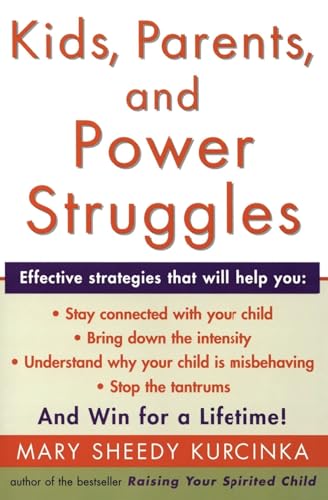
Kids, Parents, and Power Struggles: Raising Children to be More Caring and C – Transforming Discipline Through Connection - Softcover
Inhaltsangabe
From the author of Raising
Your Spirited Child, the award-winning bestseller that has helped millions,
a pioneering, research-based guide to help parents end power struggles and begin
connecting with their child.
Does bedtime mean struggle
time, with your child negotiating for "just another ten minutes"
every single night? Do most school mornings end with your child in tears? Does
your child ignore your repeated requests to get up and do their chores and
homework?
Every family experiences
power struggles, but these daily tugs of war are not inevitable. Beloved
parenting expert Mary Sheedy Kurcinka, Ed.D. addresses the everyday challenges
of disciplining children, while understanding the issues behind their behavior.
In Kids, Parents, and Power Struggles, Dr. Mary offers unique
approaches to solving the daily, and often draining, power struggles between
you and your children. She views these conflicts as rich opportunities to teach
your children essential life skills such as how
to calm themselves, to be assertive rather than aggressive, to solve problems,
and to work cooperatively with you and others.
In this book, you will find successful strategies for:
·
Understanding emotions
·
Managing intensity
·
Identifying triggers
With Dr. Mary’s effective guidance, you'll be able
to identify the trigger situations that set off the struggles and get to the
root of the emotions and needs of you and your child.
Die Inhaltsangabe kann sich auf eine andere Ausgabe dieses Titels beziehen.
Über die Autorin bzw. den Autor
Dr. Mary Sheedy Kurcinka, EdD, is a bestselling author and internationally recognized lecturer and parent educator. Her books Raising Your Spirited Child; Raising Your Spirited Baby; Raising Your Spirited Child Workbook; Kids, Parents and Power Struggles; and Sleepless in America have been translated into more than twenty languages. A former director of one of Minnesota’s largest Early Childhood Family Education programs, Mary is the founder of the Spirited Child and Kids, Parents, and Power Struggles workshops. She resides in Bozeman, Montana, with her husband.
Von der hinteren Coverseite
End Those Power Struggles and Begin Connecting with Your Child
Noted family educator Mary Sheedy Kurcinka struck a national chord with her bestselling Raising Your Spirited Child. Now she hits upon another crucial parenting topic: coping with the everyday challenges of disciplining your child, while understanding the issues behind his or her behavior. In Kids, Parents, and Power Struggles, she offers unique approaches to solving the daily, and often draining, power struggles between you and your child. Kurcinka views these conflicts as rich opportunities to teach your child essential life skills, like how to deal with strong emotions and problem solve. With her successful strategies, you'll be able to identify the trigger situations that set off these struggles and get to the root of the emotions and needs of you and your child.
Auszug. © Genehmigter Nachdruck. Alle Rechte vorbehalten.
Kids, Parents, and Power Struggles
Winning for a LifetimeBy Kurcinka, Mary SheedyQuill
Copyright © 2004 Mary Sheedy KurcinkaAll right reserved.
ISBN: 0060930438
Chapter One
A New Perspective on Power Struggles
Winning for a Lifetime
"Like a great mystery, power struggles are never solved until the real culprits have been identified." -- Diane, mother of two
On the surface power struggles look like a tug of war. Parents and kids pitted against one another. Opposing forces pulling in different directions. Two individuals at odds with each other, both determined to win!
The trouble is that if you win by simply outmuscling your child, you still feel lousy. There's little pleasure in victory when your child is left distressed and angry. If you lose, it's even worse. What kind of a parent can't even get a child to brush her teeth or finish her homework? Power struggles are frustrating. You don't have all day to negotiate. You just want to get out of the door! And power struggles make you angry. Aren't you supposed to be the parent in charge? Power struggles can leave you feeling scared and helpless. If it's like this now, how will you survive your child's adolescence? And power struggles can make you sad. Screaming at your kids wasn't part of your dream.
What I've learned after more than twenty years of working with families is that daily fights are not inevitable. You don't have to walk constantly on eggshells in order to avoid the blowups. You don't have to doubt yourself or feel exhausted from defending yourself. Like a diver discovering the beauty of a coral reef, going below the surface of a power struggle can take you to a new place, a place where parents and kids are working together and power struggles are few and far between. Below the surface, you'll discover that power struggles are about feelings and needs'yours and your child's.
Recognizing those emotions is the key to stopping power struggles before they ever start. Responding to those emotions builds the relationship that makes your child want to work with you.
Discipline isn't just about winning or losing. Every power struggle offers you the opportunity to connect with your child or to disconnect. The relationship you will have with your child when he's an adolescent lies in the words and actions you use today. Ultimately your real power is in that emotional bond.Why Emotions?
Over the years as I've worked with families, I have found that every family experiences power struggles. I've heard parents express frustrations over kids who've looked right at them, smiled, and then done what they've just been told not to do. Kids who've vehemently declared, "You're not my boss!" Capable kids who've suddenly refused to walk upstairs alone, finish their homework, or cried "Don't leave me!" when it was time to go to bed, even though they've been going to bed on their own for months or years.
The parents have told me they've tried time-outs, reward systems, insisting that their kids "toughen up" or stop being a "baby," and even spanking, but the struggles haven't stopped. I finally realized that the struggles continued because reward systems, time-outs, demands to "not feel that way," and spankings put a "lid" on the behaviors but failed to address the real fuel source behind them. As a result it was as though someone had put the lid back on a pot of boiling water but failed to turn down the heat. The water continued to boil and inevitably the lid popped off again.
Emotions are the real fuel source behind power struggles. When you identify those emotions you can select strategies that teach your kids what they are feeling and how to express those emotions more respectfully and suitably. The pot doesn't keep boiling over because ultimately the kids themselves learn to recognize the heat and turn it down! That was true of Kyla.
Whenever she was bored, ten-year-old Kyla would ask her mother Anne what she could do, but every suggestion made was rejected. No, she didn't want to call a friend. No, she didn't want to bake or read a book. And she was not the least bit interested in playing a game with her mother. Exasperated, her mother would ask, "Then what do you want to do?" But Kyla would only snap at her and complain about the "stupid" suggestions. Pushed to the boiling point, her mother would finally send Kyla to her room, which resulted in a screaming fit and nasty retorts like, "You're the meanest mother in the world!"
But all that changed when Anne learned that Kyla wasn't trying to frustrate her. There was a feeling and need that were fueling her behavior. It was a feeling that Kyla couldn't label and didn't know how to express respectfully; as a result she was irritable and disrespectful. But Anne could help Kyla to identify her emotions and choose more suitable ways to express them. Instead of offering suggestions, she chose to ask Kyla questions such as: Do you feel like doing something inside or outside? Do you want to be with people or alone? Do you want to do something active or quiet?
By asking questions instead of offering suggestions, Anne taught Kyla how to figure out what she was feeling. When she understood her feelings, she could choose an activity that truly met her needs. Instead of frustrating each other and disconnecting, Anne and Kyla learned to work together.
What I've discovered as I parent my own children and work with the families in my classes, workshops, and private consultations is that understanding and working with emotions can totally change relationships. You become aware of what you and your child need and what's important to you. Kids who are emotionally smart are self-motivated, willing to cooperate, and able to get along with others'even their siblings.
Continues...Excerpted from Kids, Parents, and Power Strugglesby Kurcinka, Mary Sheedy Copyright © 2004 by Mary Sheedy Kurcinka. Excerpted by permission.
All rights reserved. No part of this excerpt may be reproduced or reprinted without permission in writing from the publisher.
Excerpts are provided by Dial-A-Book Inc. solely for the personal use of visitors to this web site.
„Über diesen Titel“ kann sich auf eine andere Ausgabe dieses Titels beziehen.
Suchergebnisse für Kids, Parents, and Power Struggles: Raising Children...

Beispielbild für diese ISBN
Kids, Parents, and Power Struggles: Winning for a Lifetime
Verlag:
HarperCollins Publishers Inc, 2001
ISBN 10: 0060930438
ISBN 13: 9780060930431
Gebraucht
Paperback
Anbieter: World of Books (was SecondSale), Montgomery, IL, USA
Verkäuferbewertung 5 von 5 Sternen

Paperback. Zustand: Fair. From the author of Raising Your Spirited Child, the award-winning bestseller that has helped millions, a pioneering, research-based guide to help parents end power struggles and begin connecting with their child. Does bedtime mean struggle time, with your child negotiating for "just another ten minutes" every single night? Do most school mornings end with your child in tears? Does your child ignore your repeated requests to get up and do their chores and homework? Every family experiences power struggles, but these daily tugs of war are not inevitable. Beloved parenting expert Mary Sheedy Kurcinka, Ed.D. addresses the everyday challenges of disciplining children, while understanding the issues behind their behavior. In Kids, Parents, and Power Struggles, Dr. Mary offers unique approaches to solving the daily, and often draining, power struggles between you and your children. She views these conflicts as rich opportunities to teach your children essential life skills such as how to calm themselves, to be assertive rather than aggressive, to solve problems, and to work cooperatively with you and others. In this book, you will find successful strategies for: · Understanding emotions · Managing intensity · Identifying triggers With Dr. Mary's effective guidance, you'll be able to identify the trigger situations that set off the struggles and get to the root of the emotions and needs of you and your child. Artikel-Nr. 00068777822
Gebraucht kaufen
EUR 3,72
Versand gratis
Versand innerhalb von USA
Versand innerhalb von USA
Anzahl: 2 verfügbar
Beispielbild für diese ISBN
Kids, Parents, and Power Struggles: Winning for a Lifetime
Verlag:
HarperCollins Publishers Inc, 2001
ISBN 10: 0060930438
ISBN 13: 9780060930431
Gebraucht
Paperback
Anbieter: World of Books (was SecondSale), Montgomery, IL, USA
Verkäuferbewertung 5 von 5 Sternen
Paperback. Zustand: Good. From the author of Raising Your Spirited Child, the award-winning bestseller that has helped millions, a pioneering, research-based guide to help parents end power struggles and begin connecting with their child. Does bedtime mean struggle time, with your child negotiating for "just another ten minutes" every single night? Do most school mornings end with your child in tears? Does your child ignore your repeated requests to get up and do their chores and homework? Every family experiences power struggles, but these daily tugs of war are not inevitable. Beloved parenting expert Mary Sheedy Kurcinka, Ed.D. addresses the everyday challenges of disciplining children, while understanding the issues behind their behavior. In Kids, Parents, and Power Struggles, Dr. Mary offers unique approaches to solving the daily, and often draining, power struggles between you and your children. She views these conflicts as rich opportunities to teach your children essential life skills such as how to calm themselves, to be assertive rather than aggressive, to solve problems, and to work cooperatively with you and others. In this book, you will find successful strategies for: · Understanding emotions · Managing intensity · Identifying triggers With Dr. Mary's effective guidance, you'll be able to identify the trigger situations that set off the struggles and get to the root of the emotions and needs of you and your child. Artikel-Nr. 00056236054
Gebraucht kaufen
EUR 3,72
Versand gratis
Versand innerhalb von USA
Versand innerhalb von USA
Anzahl: Mehr als 20 verfügbar
Beispielbild für diese ISBN
Kids, Parents, and Power Struggles: Raising Children to be More Caring and C â" Transforming Discipline Through Connection
Verlag:
William Morrow Paperbacks (edition Quill ed.), 2001
ISBN 10: 0060930438
ISBN 13: 9780060930431
Gebraucht
Paperback
Anbieter: BooksRun, Philadelphia, PA, USA
Verkäuferbewertung 5 von 5 Sternen
Paperback. Zustand: Very Good. Quill ed. It's a well-cared-for item that has seen limited use. The item may show minor signs of wear. All the text is legible, with all pages included. It may have slight markings and/or highlighting. Artikel-Nr. 0060930438-11-1
Gebraucht kaufen
EUR 4,53
Versand gratis
Versand innerhalb von USA
Versand innerhalb von USA
Anzahl: 1 verfügbar
Beispielbild für diese ISBN
Kids, Parents, and Power Struggles: Winning for a Lifetime
Verlag:
William Morrow & Company, 2001
ISBN 10: 0060930438
ISBN 13: 9780060930431
Gebraucht
Paperback
Anbieter: ThriftBooks-Dallas, Dallas, TX, USA
Verkäuferbewertung 5 von 5 Sternen
Paperback. Zustand: Very Good. No Jacket. Former library book; May have limited writing in cover pages. Pages are unmarked. ~ ThriftBooks: Read More, Spend Less. Artikel-Nr. G0060930438I4N10
Gebraucht kaufen
EUR 5,97
Versand gratis
Versand innerhalb von USA
Versand innerhalb von USA
Anzahl: 1 verfügbar
Beispielbild für diese ISBN
Kids, Parents, and Power Struggles: Winning for a Lifetime
Verlag:
William Morrow & Company, 2001
ISBN 10: 0060930438
ISBN 13: 9780060930431
Gebraucht
Paperback
Anbieter: ThriftBooks-Phoenix, Phoenix, AZ, USA
Verkäuferbewertung 5 von 5 Sternen
Paperback. Zustand: Very Good. No Jacket. May have limited writing in cover pages. Pages are unmarked. ~ ThriftBooks: Read More, Spend Less. Artikel-Nr. G0060930438I4N00
Gebraucht kaufen
EUR 5,97
Versand gratis
Versand innerhalb von USA
Versand innerhalb von USA
Anzahl: 2 verfügbar
Beispielbild für diese ISBN
Kids, Parents, and Power Struggles: Winning for a Lifetime
Verlag:
William Morrow & Company, 2001
ISBN 10: 0060930438
ISBN 13: 9780060930431
Gebraucht
Paperback
Anbieter: ThriftBooks-Dallas, Dallas, TX, USA
Verkäuferbewertung 5 von 5 Sternen
Paperback. Zustand: Very Good. No Jacket. May have limited writing in cover pages. Pages are unmarked. ~ ThriftBooks: Read More, Spend Less. Artikel-Nr. G0060930438I4N00
Gebraucht kaufen
EUR 5,97
Versand gratis
Versand innerhalb von USA
Versand innerhalb von USA
Anzahl: 2 verfügbar
Beispielbild für diese ISBN
Kids, Parents, and Power Struggles: Winning for a Lifetime
Verlag:
William Morrow & Company, 2001
ISBN 10: 0060930438
ISBN 13: 9780060930431
Gebraucht
Paperback
Anbieter: ThriftBooks-Reno, Reno, NV, USA
Verkäuferbewertung 5 von 5 Sternen
Paperback. Zustand: Very Good. No Jacket. May have limited writing in cover pages. Pages are unmarked. ~ ThriftBooks: Read More, Spend Less. Artikel-Nr. G0060930438I4N00
Gebraucht kaufen
EUR 5,97
Versand gratis
Versand innerhalb von USA
Versand innerhalb von USA
Anzahl: 2 verfügbar
Beispielbild für diese ISBN
Kids, Parents, and Power Struggles: Winning for a Lifetime
Verlag:
William Morrow & Company, 2001
ISBN 10: 0060930438
ISBN 13: 9780060930431
Gebraucht
Paperback
Anbieter: ThriftBooks-Atlanta, AUSTELL, GA, USA
Verkäuferbewertung 5 von 5 Sternen
Paperback. Zustand: Very Good. No Jacket. Former library book; May have limited writing in cover pages. Pages are unmarked. ~ ThriftBooks: Read More, Spend Less. Artikel-Nr. G0060930438I4N10
Gebraucht kaufen
EUR 5,97
Versand gratis
Versand innerhalb von USA
Versand innerhalb von USA
Anzahl: 1 verfügbar
Beispielbild für diese ISBN
Kids, Parents, and Power Struggles: Winning for a Lifetime
Verlag:
William Morrow & Company, 2001
ISBN 10: 0060930438
ISBN 13: 9780060930431
Gebraucht
Paperback
Anbieter: ThriftBooks-Atlanta, AUSTELL, GA, USA
Verkäuferbewertung 5 von 5 Sternen
Paperback. Zustand: Very Good. No Jacket. May have limited writing in cover pages. Pages are unmarked. ~ ThriftBooks: Read More, Spend Less. Artikel-Nr. G0060930438I4N00
Gebraucht kaufen
EUR 5,97
Versand gratis
Versand innerhalb von USA
Versand innerhalb von USA
Anzahl: 2 verfügbar
Beispielbild für diese ISBN
Kids, Parents, and Power Struggles : Winning for a Lifetime
Verlag:
HarperCollins Publishers, 2001
ISBN 10: 0060930438
ISBN 13: 9780060930431
Gebraucht
Softcover
Anbieter: Better World Books: West, Reno, NV, USA
Verkäuferbewertung 5 von 5 Sternen
Zustand: Very Good. Pages intact with possible writing/highlighting. Binding strong with minor wear. Dust jackets/supplements may not be included. Stock photo provided. Product includes identifying sticker. Better World Books: Buy Books. Do Good. Artikel-Nr. 4824264-6
Gebraucht kaufen
EUR 6,19
Versand gratis
Versand innerhalb von USA
Versand innerhalb von USA
Anzahl: 1 verfügbar