
Inhaltsangabe
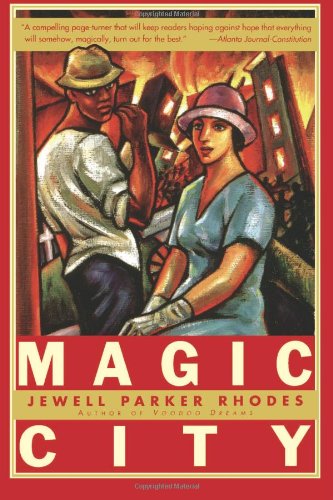
"A compelling page-turner that will keep readers hoping against hope that everything will somehow, magically, turn out for the best." — Atlanta Journal-Constitution
Jewell Parker Rhodes’ powerful and unforgettable novel of racism, vigilantism, and injustice, weaves history, mysticism, and murder into a harrowing tale of dreams and violence gone awry.
Tulsa, Oklahoma, 1921. A white woman and a black man are alone in an elevator. Suddenly, the woman screams, the man flees, and the chase to capture and lynch him begins.
When Joe Samuels, a young Black man with dreams of becoming the next Houdini, is accused of rape, he must perform his greatest escape by eluding a bloodthirsty mob.
Meanwhile, Mary Keane, the white, motherless daughter of a farmer who wants to marry her off to the farmhand who viciously raped her, must find the courage to help exonerate the man she accused with her panicked cry.
Magic City evokes one of the darkest chapters of twentieth century, Jim Crow America, painting an intimate portrait of the heroic but doomed stand that pitted the National Guard against a small band of black men determined to defend the prosperous town they had built.
Die Inhaltsangabe kann sich auf eine andere Ausgabe dieses Titels beziehen.
Über die Autorin bzw. den Autor
Jewell Parker Rhodes is the recipient of a Yaddo Creative Writing Fellowship and the National Endowment of the Arts Award in Fiction. She is professor of creative writing and American literature and Director of the M.F.A. program in creative writing at Arizona State University. She lives in Phoenix, AZ.
Von der hinteren Coverseite
Tulsa, Oklahoma, 1921. A white woman and a black man are alone in an elevator. Suddenly, the woman screams, the man runs out, and the chase to capture and lynch him begins.
When Joe, a young man trying to be the next Houdini, is accused of rape, he must perform his greatest escape by eluding a bloodthirsty lynch mob. And Mary, the motherless daughter of a farmer who tries to marry her off to the farmhand who viciously raped her, must find the courage to help exonerate the man she had accused with her panicked cry. Based on true events, Magic City is a portrait of an era, climaxing in the heroic but doomed stand that pitted the National Guard against a small band of black men determined to defend the town they had built into the "Negro Wall Street."
Named by the Chicago Tribune as a Favorite Book of 1997
Auszug. © Genehmigter Nachdruck. Alle Rechte vorbehalten.
Magic City
By Rhodes, Jewell ParkerPerennial
Copyright © 2004 Jewell Parker RhodesAll right reserved.
ISBN: 0060929073
Chapter One
Sunday, May 29, 1921
Joe Samuels had decided to quit dreaming. Decided to stop dreaming of leaving Tulsa, of discovering new horizons streaked with magic. Yet here he was lying by the tracks, his head to the ground, listening to the rumblings of the 9:45 preparing to leave, trailing Pullman cars and flat cars loaded with cotton and crude.
Weary, disoriented, Joe needed sleep. He wanted to ride the rails over the Rockies to the Pacific in a sleeper car, cozy, dreamless in an upper bunk. He didn't want to dream of dying. Three nights in a row, he'd had the same dream. A dream that he sensed was something more than a dream--a haunting, a premonition, an evil worked by the Devil.
The train whistle squealed: two short bursts, one long. The conductor called, "All aboard." Joe fought the urge to dash forward, jump aboard, and settle in the converted boxcar for Negroes. He'd be thrown off without a ticket. He could hide wedged between animals or crates. But without cash, he'd starve wherever he ended. He'd be forced to wire his father. Forced to admit he couldn't make it on his own.
Joe felt the ground vibrating beneath his fingertips. Steam hissed. The train lurched, picking up speed--its headlight glaring, glinting against the steel rails--moving, groaning, journeying on. Then gone. Leaving no trace, no murmur. Only stillness, quiet rails, and humid heat.
Despair washed over him. Joe did and didn't want to be in Tulsa.
He loved Deep Greenwood, the Negro section of Tulsa. Church women testified how Greenwood had risen miraculously out of the dust, how ex-slaves had built a town of telephone poles, electric lights, and a Booker T. Washington High School.
"In America, there's no better place than Greenwood to be a Negro," his father always said. "No better place to be a Samuels." Property and wealth. Joe, the youngest son. Born a bit too brown for his mother's taste; too lazy for his father's. But always, in Greenwood, he was the banker's son.
In Tulsa, he was just another nigger. A two-bit shoeshine.
Joe imagined himself riding the rails to the ocean. Then he'd leap, manacled, off the Golden Gate Bridge, just like Houdini had. He'd surface, hands freed, to champagne and cheering.
In a year of shining shoes, Joe had saved two hundred dollars. Another year, he'd have four hundred. Another year, his father might understand why he wanted to go. Might even wish him well. In another year, Joe might be able to say good-bye to his sister Hildy. To Lying Man. His brother's grave. He might understand why, in a place he loved so much, he felt like he was dying.
He was afraid of going home to bed, of being haunted by his nightmare. He'd give up all his imaginings, his longing to leave Tulsa, if only his nightmare would stop. He'd vow never to dream again. He'd be grateful for living in Tulsa.
Lifting his head, Joe thought he heard Lying Man's harmonica:
How long the train's been gone?
Baby, how long? How long?
Reluctant, Joe stood, humming the tune. Negro curfew was ten o'clock. He passed the ticket window. The clerk hollered, "Best hurry home, boy. Else you'll catch it."
"Yes, sir."
"Boy!" the ruddy man leaned out the window. Joe held his breath. The clerk's bald head caught the light. "Do that trick again."
"Yes, mister." Retracing his steps, Joe pulled a coin from his pocket. It flipped in and out between his knuckles, picking up speed, a thin ribbon of silver diving, weaving in and out across his dark fingers, until it disappeared.
"I'll be damned."
The station clock read 9:55.
Joe murmured, "Got to hurry, mister," and turned onto First Street. Glancing in the windows of the Pig's Ear Diner, he saw deputies still drinking coffee. He ought to make it.
A crowd was leaving the Opera House: women draped in silk and fox stoles; men, in top hats and tails. Joe avoided them, studying the pavement's cracks--he was still in Tulsa, not Greenwood.
Walking briskly, Joe turned into Courthouse Square. It was faster cutting across the park. Bluegrass cushioned his feet; oaks arched overhead. On the left was the Ambrose Building, where he worked, and the Henly Hotel. On the right was the Courthouse and the city's pride--a seven-story, steel and brick "inescapable" jail. Joe bet it couldn't hold Houdini. They could handcuff Houdini, lock and chain him in a darkened cell, and he'd still escape.
He headed northeast for another mile. Greenwood and Archer divided Tulsa like a cross. Bawdy houses, juke joints, and gambling dens flourished in back alleys.
Joe stepped onto the northeast curb; he was safe. Home. In Deep Greenwood. But he didn't feel any ease. He turned onto Elgin where, in daylight, children tossed balls, skinned their knees, and climbed trees. Atop the hill, in front of him, he could see Mt. Zion's steeple outlined against the sky. Street lamps cast gnarled shadows. Joe hesitated, feeling dread as he remembered his nightmare. His home, the entire street bursting into flames.
"Evening, Joe," voices called from the enclosed porches. Shrill and bass voices blended with evening sounds: trilling crickets, a hiccuping baby, frenzied moths batting at screens. Joe couldn't see faces. He didn't need to, for he knew everyone, who lived where.
"Fine evening."
"Yes, Mrs. Jackson."
"A bit late, aren't you, Joe?" asked Abe, a sweeper at McNulty's Baseball Park.
"Visiting a girl?" asked Miss Wright, his third-grade teacher, now blind as a newborn.
"No, Miss Wright."
Joe exhaled, feeling his spirits lift. Deep Greenwood. Tulsa's darker cousin. A black small town within the white city.
What was it that salesman had said? Joe had been buffing the final polish when the freckle-faced man, pleased with his day's sales of aluminum pots, dish rags, and lye, crowed to his companion, "I'd live in Greenwood myself, if there weren't so many niggers."
Joe slipped through the back door of his house, tiptoed through the parlor.
He wouldn't dream. "Everything is a matter of will," Houdini had said. He'd read it in a magazine. Staring at Houdini's eyes, brows arched, pinpricks of light trapped in his irises, Joe had felt magic stir inside him. He could be more than Tulsa's nigger, more than the banker's son.
A light was on in the kitchen. Hildy was probably reading her Bible and making biscuits. He climbed the stairs to his attic bedroom, stripped his clothes, and crawled into bed.
Handcuffs held him. Not regulation cuffs but metal of some private design with double bolts and a strange inflexible spring. Joe could feel fear tricking him, causing his heart to contract, telling him it couldn't be done--that he couldn't escape.
"Who do you think you are?"
Joe bit the thin skin inside his mouth, tasting blood, feeling pain rush behind his eyes. It was all a matter of will. Pain lessened fear. All he had to do was let himself relax, detach himself from the panic of feeling cold metal twisting his arms back in their sockets. The trick was to feel the steel's special grace. Not to be afraid of stillness, of wrists trapped in polished bands. He stretched his fingers, long and dark, arcing them as though he were about to sound a chord on ivory keys. Then, he sighed, clasping his palms (fingers alternating) in a gentle embrace.
"Who do you think you are?"
His street was deserted. Shutters closed; screen doors locked. No one could save him.
The sun scorched his neck as he tried to force back sweat running from beneath his arms, along his bare waist, and down to his penis, which hung...
„Über diesen Titel“ kann sich auf eine andere Ausgabe dieses Titels beziehen.
Weitere beliebte Ausgaben desselben Titels

Suchergebnisse für Magic City: A Novel

Beispielbild für diese ISBN
Magic City: A Novel
Anbieter: World of Books (was SecondSale), Montgomery, IL, USA
Verkäuferbewertung 5 von 5 Sternen

Zustand: Good. Item in good condition. Textbooks may not include supplemental items i.e. CDs, access codes etc. Artikel-Nr. 00056641993
Gebraucht kaufen
EUR 5,39
Versand gratis
Versand innerhalb von USA
Versand innerhalb von USA
Anzahl: 5 verfügbar
Beispielbild für diese ISBN
Magic City : A Novel
Verlag:
HarperCollins Publishers, 1998
ISBN 10: 0060929073
ISBN 13: 9780060929077
Gebraucht
Softcover
Anbieter: Better World Books, Mishawaka, IN, USA
Verkäuferbewertung 5 von 5 Sternen
Zustand: Very Good. Pages intact with possible writing/highlighting. Binding strong with minor wear. Dust jackets/supplements may not be included. Stock photo provided. Product includes identifying sticker. Better World Books: Buy Books. Do Good. Artikel-Nr. 13370028-75
Gebraucht kaufen
EUR 6,08
Versand gratis
Versand innerhalb von USA
Versand innerhalb von USA
Anzahl: 1 verfügbar
Beispielbild für diese ISBN
Magic City: A Novel
Anbieter: Wonder Book, Frederick, MD, USA
Verkäuferbewertung 5 von 5 Sternen
Zustand: Very Good. Very Good condition. A copy that may have a few cosmetic defects. May also contain light spine creasing or a few markings such as an owner's name, short gifter's inscription or light stamp. Artikel-Nr. J09N-00948
Gebraucht kaufen
EUR 6,71
Versand gratis
Versand innerhalb von USA
Versand innerhalb von USA
Anzahl: 1 verfügbar
Beispielbild für diese ISBN
Magic City
Anbieter: ThriftBooks-Dallas, Dallas, TX, USA
Verkäuferbewertung 5 von 5 Sternen
Paperback. Zustand: Very Good. No Jacket. May have limited writing in cover pages. Pages are unmarked. ~ ThriftBooks: Read More, Spend Less. Artikel-Nr. G0060929073I4N00
Gebraucht kaufen
EUR 7,49
Versand gratis
Versand innerhalb von USA
Versand innerhalb von USA
Anzahl: 1 verfügbar