
Verwandte Artikel zu DANCE DECEPTION: A Guide to Authenticity and Truth-Telling...
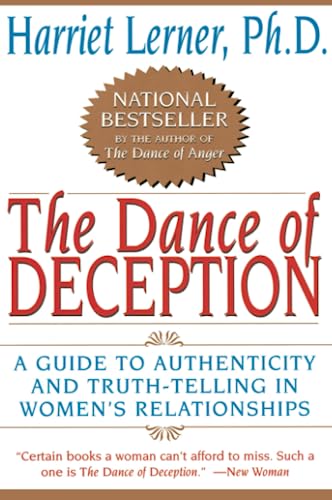
DANCE DECEPTION: A Guide to Authenticity and Truth-Telling in Women's Relationships – Navigating Lies, Affairs, and Silence for Real Intimacy - Softcover
Inhaltsangabe
When The Dance of Deceptionwas published, Lerner discovered that women were not eager to identify with the subject. "Well, I don't do deception" was a common resonse.
We all "do deception", often with the intention to protect ourselves and the relationships we depend on. The Dance of Deceptionunravels the ways (and whys) that women show the false and hide the real -- even to our own selves. We see how relationships are affected by lying and faking, by silence and pretending and by brave -- but misguided -- efforts to tell the truth.
Truth-telling is at the heart of what is most central in women's lives. It is at the foundation of authenticity and creativity, intimacy and joy. Yet in the name of "honesty", we can bludgeon each other. We can approach a difficult issue with such a poor sense of timing and tact that we can actually shut down the lines of communication rather than widening the path of truth-telling.
Sometimes Lerner's advice takes a surprising turn -- for example, when she asks us to engage in a bold act of pretending in order to discover something "more real"; or when she tells us not to parachute down on our family to bring up a "hot issue" without laying the necessary groundwork first.
Whether the subject is affairs, family secrets, sexual faking or the challenge of "being oneself", Lerner helps us to discover, speak and live our own truths.
Die Inhaltsangabe kann sich auf eine andere Ausgabe dieses Titels beziehen.
Über die Autorin bzw. den Autor
Harriet Lerner, Ph.D., is one of our nation’s most loved and respected relationship experts. Renowned for her work on the psychology of women and family relationships, she served as a staff psychologist at the Menninger Clinic for more than two decades. A distinguished lecturer, workshop leader, and psychotherapist, she is the author of The Dance of Anger and other bestselling books. She is also, with her sister, an award-winning children's book writer. She and her husband are therapists in Lawrence, Kansas, and have two sons.
Von der hinteren Coverseite
When The Dance of Deceptionwas published, Lerner discovered that women were not eager to identify with the subject. "Well, I don't do deception" was a common resonse.
We all "do deception", often with the intention to protect ourselves and the relationships we depend on. The Dance of Deceptionunravels the ways (and whys) that women show the false and hide the real -- even to our own selves. We see how relationships are affected by lying and faking, by silence and pretending and by brave -- but misguided -- efforts to tell the truth.
Truth-telling is at the heart of what is most central in women's lives. It is at the foundation of authenticity and creativity, intimacy and joy. Yet in the name of "honesty", we can bludgeon each other. We can approach a difficult issue with such a poor sense of timing and tact that we can actually shut down the lines of communication rather than widening the path of truth-telling.
Sometimes Lerner's advice takes a surprising turn -- for example, when she asks us to engage in a bold act of pretending in order to discover something "more real"; or when she tells us not to parachute down on our family to bring up a "hot issue" without laying the necessary groundwork first.
Whether the subject is affairs, family secrets, sexual faking or the challenge of "being oneself", Lerner helps us to discover, speak and live our own truths.
Auszug. © Genehmigter Nachdruck. Alle Rechte vorbehalten.
The Dance of Deception
A Guide to Authenticity and Truth-Telling in Women's RelationshipsBy Lerner, Harriet GoldhorQuill
Copyright ©2004 Harriet LernerAll right reserved.
ISBN: 0060924632
Chapter 1
Tony and the Martians
When I was twelve, I told a lie that grew to epic proportions. I told my friend Marla, who lived across the street from me in Brooklyn, that I had been contacted by a man named Tony who came from another planet. Since first grade, Marla and I had been on-again, off-again best friends.
I told Marla that Tony told me to find a date. Since no one had asked me out yet (and I believed that no one ever would), Marla had to fix me up with a blind date because Tony said that something bad might happen to me otherwise. Marla, who could accomplish almost anything she set her mind to, went about this project with her usual vigor and enthusiasm. The blind date came and went. Tony did not.
A few minor characters from the same planet were added to the drama, as the personality and presence of Tony grew and became part of my deepening friendship with Marla. Tony emerged as a good-hearted, playful fellow who told me funny things that I could tell only Marla--and that she could tell no one. At a time when my other girlfriends were dropping one best friend for another, my special status with Marla was secure. Tony stabilized our friendship and strengthened our sense of camaraderie and commitment. And I was in charge--an active director and orchestrator of the threesome: Tony and Marla and me.
I don't remember how often Tony visited or how long he stayed around, but I think it was at least a year before I let him drift out of our lives. Years later, when Marla and I were both graduate students in Berkeley, California, I tearfully told her I had made Tony up. Until then, we had both walled off the Tony business, not bothering to reflect on it or even to remember. Marla protected me and our friendship by choosing not to subject this interplanetary drama to close scrutiny. After all, anything is possible. When we finally talked about it, Marla was lighthearted and forgiving, as I hoped she would be with our long history of friendship binding us together.
In the early 1970s I entered psychoanalysis during my postdoctoral training program in clinical psychology and confessed my "Tony story." I half-jokingly voiced my concern that my analyst would downgrade my diagnosis to something either very bad or very sick. My uneasiness was hardly surprising. Although lying is commonplace in both personal and public--especially political--life, the label of "liar" is a profound condemnation in our culture, bringing to mind pathology and sin. I know parents who punish their children more severely for lying to them than for any other behavior. I have heard otherwise calm parents scream at their children, "Don't you ever lie to me again!" So heavy are the negative associations of intention and character that it is difficult to think lovingly, or even objectively, about the role that lying plays in the lives of children and adults.
My analyst (coincidentally also named Tony) was, as always, empathic and nonjudgmental. In psychoanalysis--as in the rest of life--insight and self-understanding do not flourish in an atmosphere of self-depreciation or blame. He and I explored Tony in the context of my distant relationship with my father and my related desperation about getting the "blind date" that I first used Tony for with Marla.
Many years later, after the birth of my second son in 1979, I faced a personal crisis, a health scare, that pushed me to learn more about my mother's diagnosis of advanced endometrial cancer when I was twelve. While talking to my parents at this time, I recognized that I had brought Tony into the picture when my mother, then forty-eight, had been given one year to live. Although I was unaware on a conscious level of her diagnosis and prognosis, I am certain that my unconscious knew everything.
As I reconstructed that year, multiple lies emerged, beginning with my mother's harrowing experience with a medical system that did not provide her with facts. After a long period of misdiagnosed vaginal bleeding, my mother hemorrhaged and was hospitalized for an emergency D&C. This procedure led to the unexpected diagnosis of a hitherto unknown invasive cancer. Her physician (who may himself have been reacting to the long period of misdiagnosis and neglect) told my father the facts--but swore him to secrecy. After the initial procedure, my mother was packing her bags to return home when she was told that an additional stay in the hospital was necessary for a second surgery to "stretch her uterus." With this improbable, mystifying explanation, her doctor performed a complete hysterectomy without her knowledge or permission. She awoke from the surgery, confused and disoriented, and suffering from inexplicable, intense pain.
My mother did not confront her doctor until immediately before her discharge from the hospital, when he referred her for radiation treatment. She demanded to know her diagnosis. He did not answer, but instead took her hand and told her to enjoy life and to try to have enjoyable sex in the year to come. He didn't mention cancer and she didn't push it. A part of her, too, must not have wanted to hear the word spoken out loud. With a referral for prolonged radiation treatment, however, my mother knew the name of her problem even though the medical establishment did not voice it.
In the year that followed, the word "cancer" was never spoken in my family. My mother's health was not even discussed. Inexplicably, she did not die, as predicted, and so we have had the opportunity to talk as adults about that traumatic year after her diagnosis. Our conversations have allowed me to appreciate more deeply how helplessly out of control I must have felt when I brought Tony down from another planet.
My mother, the emotional center of the family, seemed to be dying. Susan, my only sibling, had started college at Barnard and would soon be looking for an apartment in the city. She was getting launched, leaving me for her own grown-up life. My mother had quietly made plans for her brother and sister-in-law, then living in a different part of Brooklyn, to take me in after her death because she did not think that my father could care for me by himself. I was on the edge of losing everyone. Into this precarious world, threatening to pull apart at the seams, I brought Tony.
During the year after my mother's diagnosis, my most important relationships had a lie at their center. In my family, the lie was perpetuated through silence. There was a survival issue in my family that no one was talking about. Only once did I give voice to reality, to truth, in an incident that I myself do not remember. My mother tells me that some time after she had finished her radiation treatment and had recovered her energy and spirits, she came down with a bad cold and took to bed--a singularly rare occurrence for her. I stormed into the bedroom and screamed at her for lying down. "Get up!" I commanded with the full force of early adolescent rage. "You'd better not die--do you hear me?--or I'll never forgive you!" My mother recalls this outburst--over as suddenly as it began--as our family's only direct expression of feeling, our only articulation of danger.
Apart from this isolated outburst, I blanketed myself in denial, screening out my mother's illness and my questions about how I would be cared for if she died. Reading back through my diary--my one place to tell the truth--I do not find a word during that year...
„Über diesen Titel“ kann sich auf eine andere Ausgabe dieses Titels beziehen.
Suchergebnisse für DANCE DECEPTION: A Guide to Authenticity and Truth-Telling...

Beispielbild für diese ISBN
The Dance of Deception: A Guide to Authenticity and Truth-Telling in Women's Relationships - Navigating Lies, Affairs, and Silence for Real Intimacy
Anbieter: World of Books (was SecondSale), Montgomery, IL, USA
Verkäuferbewertung 5 von 5 Sternen

Zustand: Acceptable. Item in good condition. Textbooks may not include supplemental items i.e. CDs, access codes etc. Artikel-Nr. 00065858724
Gebraucht kaufen
EUR 3,58
Versand gratis
Versand innerhalb von USA
Versand innerhalb von USA
Anzahl: 4 verfügbar
Beispielbild für diese ISBN
The Dance of Deception: A Guide to Authenticity and Truth-Telling in Women's Relationships - Navigating Lies, Affairs, and Silence for Real Intimacy
Anbieter: World of Books (was SecondSale), Montgomery, IL, USA
Verkäuferbewertung 5 von 5 Sternen
Zustand: Very Good. Item in very good condition! Textbooks may not include supplemental items i.e. CDs, access codes etc. Artikel-Nr. 00104777530
Gebraucht kaufen
EUR 3,58
Versand gratis
Versand innerhalb von USA
Versand innerhalb von USA
Anzahl: 7 verfügbar
Beispielbild für diese ISBN
The Dance of Deception: A Guide to Authenticity and Truth-Telling in Women's Relationships - Navigating Lies, Affairs, and Silence for Real Intimacy
Anbieter: World of Books (was SecondSale), Montgomery, IL, USA
Verkäuferbewertung 5 von 5 Sternen
Zustand: Good. Item in good condition. Textbooks may not include supplemental items i.e. CDs, access codes etc. Artikel-Nr. 00093352151
Gebraucht kaufen
EUR 3,58
Versand gratis
Versand innerhalb von USA
Versand innerhalb von USA
Anzahl: Mehr als 20 verfügbar
Beispielbild für diese ISBN
The Dance of Deception: A Guide to Authenticity and Truth-Telling in Women's Relationships - Navigating Lies, Affairs, and Silence for Real Intimacy
Anbieter: World of Books (was SecondSale), Montgomery, IL, USA
Verkäuferbewertung 5 von 5 Sternen
Zustand: Acceptable. Item in acceptable condition! Textbooks may not include supplemental items i.e. CDs, access codes etc. Artikel-Nr. 00094117154
Gebraucht kaufen
EUR 3,58
Versand gratis
Versand innerhalb von USA
Versand innerhalb von USA
Anzahl: 11 verfügbar
Beispielbild für diese ISBN
DANCE DECEPTION
Verlag:
MorrowPb (edition Reprint), 1994
ISBN 10: 0060924632
ISBN 13: 9780060924638
Gebraucht
Paperback
Anbieter: BooksRun, Philadelphia, PA, USA
Verkäuferbewertung 5 von 5 Sternen
Paperback. Zustand: Fair. Reprint. The item might be beaten up but readable. May contain markings or highlighting, as well as stains, bent corners, or any other major defect, but the text is not obscured in any way. Artikel-Nr. 0060924632-7-1
Gebraucht kaufen
EUR 4,35
Versand gratis
Versand innerhalb von USA
Versand innerhalb von USA
Anzahl: 1 verfügbar
Beispielbild für diese ISBN
The Dance of Deception: A Guide to Authenticity and Truth-Telling in Women's Relationships
Verlag:
William Morrow & Company, 1994
ISBN 10: 0060924632
ISBN 13: 9780060924638
Gebraucht
Paperback
Anbieter: ThriftBooks-Phoenix, Phoenix, AZ, USA
Verkäuferbewertung 5 von 5 Sternen
Paperback. Zustand: Very Good. No Jacket. May have limited writing in cover pages. Pages are unmarked. ~ ThriftBooks: Read More, Spend Less. Artikel-Nr. G0060924632I4N00
Gebraucht kaufen
EUR 5,81
Versand gratis
Versand innerhalb von USA
Versand innerhalb von USA
Anzahl: 2 verfügbar
Beispielbild für diese ISBN
The Dance of Deception: A Guide to Authenticity and Truth-Telling in Women's Relationships
Verlag:
William Morrow & Company, 1994
ISBN 10: 0060924632
ISBN 13: 9780060924638
Gebraucht
Paperback
Anbieter: ThriftBooks-Reno, Reno, NV, USA
Verkäuferbewertung 5 von 5 Sternen
Paperback. Zustand: Very Good. No Jacket. May have limited writing in cover pages. Pages are unmarked. ~ ThriftBooks: Read More, Spend Less. Artikel-Nr. G0060924632I4N00
Gebraucht kaufen
EUR 5,81
Versand gratis
Versand innerhalb von USA
Versand innerhalb von USA
Anzahl: 2 verfügbar
Beispielbild für diese ISBN
The Dance of Deception: A Guide to Authenticity and Truth-Telling in Women's Relationships
Verlag:
William Morrow & Company, 1994
ISBN 10: 0060924632
ISBN 13: 9780060924638
Gebraucht
Paperback
Anbieter: ThriftBooks-Dallas, Dallas, TX, USA
Verkäuferbewertung 5 von 5 Sternen
Paperback. Zustand: Very Good. No Jacket. May have limited writing in cover pages. Pages are unmarked. ~ ThriftBooks: Read More, Spend Less. Artikel-Nr. G0060924632I4N00
Gebraucht kaufen
EUR 5,82
Versand gratis
Versand innerhalb von USA
Versand innerhalb von USA
Anzahl: 2 verfügbar
Beispielbild für diese ISBN
The Dance of Deception: A Guide to Authenticity and Truth-Telling in Women's Relationships
Verlag:
William Morrow & Company, 1994
ISBN 10: 0060924632
ISBN 13: 9780060924638
Gebraucht
Paperback
Anbieter: ThriftBooks-Atlanta, AUSTELL, GA, USA
Verkäuferbewertung 5 von 5 Sternen
Paperback. Zustand: Very Good. No Jacket. May have limited writing in cover pages. Pages are unmarked. ~ ThriftBooks: Read More, Spend Less. Artikel-Nr. G0060924632I4N00
Gebraucht kaufen
EUR 5,82
Versand gratis
Versand innerhalb von USA
Versand innerhalb von USA
Anzahl: 3 verfügbar
Beispielbild für diese ISBN
The Dance of Deception: A Guide to Authenticity and Truth-Telling in Women's Relationships
Verlag:
William Morrow & Company, 1994
ISBN 10: 0060924632
ISBN 13: 9780060924638
Gebraucht
Paperback
Anbieter: ThriftBooks-Atlanta, AUSTELL, GA, USA
Verkäuferbewertung 5 von 5 Sternen
Paperback. Zustand: Very Good. No Jacket. Former library book; May have limited writing in cover pages. Pages are unmarked. ~ ThriftBooks: Read More, Spend Less. Artikel-Nr. G0060924632I4N10
Gebraucht kaufen
EUR 5,82
Versand gratis
Versand innerhalb von USA
Versand innerhalb von USA
Anzahl: 1 verfügbar