
Verwandte Artikel zu They All Laughed...: From Light Bulbs to Lasers: The...
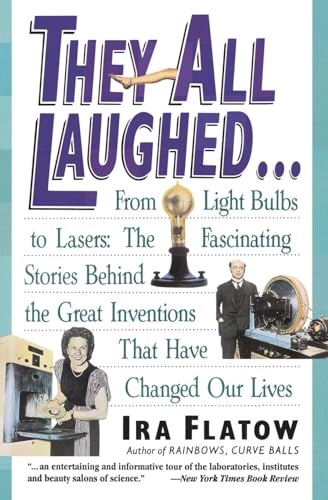
They All Laughed...: From Light Bulbs to Lasers: The Fascinating Stories Behind the Great Inventions – The Enlightening Account of How Wacky Accidents Shaped Important Discoveries - Softcover
Inhaltsangabe
An enlightening and fun look at scientific discoveries and the often wacky and accidental ways in which they have led to some of the most important inventions--by award-winning journalist Ira Flatow.
Die Inhaltsangabe kann sich auf eine andere Ausgabe dieses Titels beziehen.
Über die Autorin bzw. den Autor
Ira Flatow is the host and executive producer of Talk of the Nation: Science Friday®. He is the author of Rainbows, Curve Balls, and They All Laughed. He lives in Connecticut.
Von der hinteren Coverseite
An enlightening and fun look at scientific discoveries and the often wacky and accidental ways in which they have led to some of the most important inventions--by award-winning journalist Ira Flatow.
Auszug. © Genehmigter Nachdruck. Alle Rechte vorbehalten.
They All Laughed...
From Light Bulbs to Lasers: The Fascinating Stories Behind the Great InventionsBy Ira FlatowHarperCollins Publishers, Inc.
Copyright © 2008 Ira FlatowAll right reserved.
ISBN: 9780060924157
Chapter One
Franklin, the Modern Prometheus
The kite is to be raised when a thunder-gust appears to be coming on (which is very frequent in this country)
—Benjamin Franklin, describing how to fly a kite in a storm,October 1, 1752
One of the greatest myths of American history is the one told about Ben Franklin and his kite. We all grew up learning that good old Ben went out one stormy day and flew his kite in a thunderstorm, and when the kite was hit by lightning, Franklin discovered electricity.
Fortunately, Ben was a lot luckier than that. If lightning had actually struck his kite, Ben might not have been around to sign the Declaration of Independence and write Poor Richard's Almanac—and the rest of the world would have been much poorer for his stupidity.
Oddly enough, Ben wasn't the first person to carry out his lightning experiment. And while Franklin carefully described the steps to building and flying a kite in a storm in a letter dated October 1, 1752, no personal diary of Franklin describing his own kite-flying experience exists. He never wrote up the experiment as a good scientist—which he was—normally would. Rather, all we have to go on is his oral description written down by an acclaimed scientist of the day, Joseph Priestley, which for most reputable historians is good enough.
Perhaps for that reason the tale has grown into mythic proportions. If so, it goes along with the almost God-like reputation Franklin amassed during his tenure as America's first and premier electrical genius.
The sentry-box
A visit to Boston in 1746 brought Franklin to a demonstration of electricity by a Scottish lecturer, Dr. Adam Spencer. Franklin became so enamored with the sparks and cracks of the high-voltage world of static electricity that he immediately decided he had to own Spencer's equipment. Making him an offer he couldn't refuse, Franklin bought all of his paraphernalia. Peter Collinson, a friend in England, sent him some more, along with notes about the electrical experiments being conducted there.
The feisty colonist took issue with the thinking of Europe's leading scientists of the day (called natural philosophers) who claimed that electricity was really of two types. They claimed that static electricity produced by rubbing a glass rod would attract a pith ball. But electricity produced by rubbing a resinous rod would repel the ball because each kind of rod produced a different form of electricity.
Hogwash, thought Franklin. It's all the same stuff. One rod simply has more of it or less of it. Electricity flows, he said, from greater charge to lesser charge. You can pile it up here and let it snap back there when you draw the spark of an electric fire. The spark is the way electricity evens up all those charges that have been separated.
Franklin's experiments set Europe buzzing. Who was this young upstart who'd spent only five years of his life studying electricity? Nevertheless, this colonial printer did make sense, and his experiments couldn't be refuted. More importantly, they revolutionized the world of electricity and made Franklin's reputation as a world-class authority on the subject.
The idea behind the kite
Having already made a fortune in the printing business at the age of forty-two, Franklin turned his attention to experiments in electricity. He wanted to know if lightning and static electricity were made of the same stuff. Experiments were performed in Philadelphia in 1749 to test his idea that lightning was an electrical discharge from cloud to cloud and from cloud to earth. But he still wanted to find some way of capturing the electrical "fire" from storm clouds and bottling it up so it could be studied alongside common, earthly electrical charges. So he proposed an experiment for drawing electrical charges from clouds:
On the top of some high tower or steeple, place a kind of sentry-box big enough to contain a man and an electrical stand. From the middle of the stand let an iron rod rise and pass bending out of the door, and then upright 20 or 30 feet, pointed very sharp at the end. If the electrical stand be kept clean and dry, a man standing on it when such clouds are passing low, might be electrified and afford sparks, the rod drawing fire to him from a cloud.
Lest anyone be frightened off by the possibility of being fried by a lightning bolt, Franklin offered these consoling words:
If any danger to the man should be apprehended (though I think there would be none) let him stand on the floor of his box, and now and then bring near to the rod the loop of wire that has one end fastened to the leads, he holding it by a wax handle; so the sparks, if the rod is electrified, will strike from the rod to the wire and not affect him.'
Franklin described a good method of insulating, via wax, the subject from the wire. He also had the experimenter step down from the insulated box. So Franklin knew of the dangers of an errant lightning bolt and warned others to protect themselves.
The sentry-box experiment was published in London in 1751.
Continues...
Excerpted from They All Laughed...by Ira Flatow Copyright © 2008 by Ira Flatow. Excerpted by permission.
All rights reserved. No part of this excerpt may be reproduced or reprinted without permission in writing from the publisher.
Excerpts are provided by Dial-A-Book Inc. solely for the personal use of visitors to this web site.
„Über diesen Titel“ kann sich auf eine andere Ausgabe dieses Titels beziehen.
Suchergebnisse für They All Laughed...: From Light Bulbs to Lasers: The...

Beispielbild für diese ISBN
They All Laughed. From Light Bulbs to Lasers: The Fascinating Stories Behind the Great Inventions That Have Changed Our Lives
Anbieter: World of Books (was SecondSale), Montgomery, IL, USA
Verkäuferbewertung 5 von 5 Sternen

Zustand: Very Good. Item in very good condition! Textbooks may not include supplemental items i.e. CDs, access codes etc. Artikel-Nr. 00099703330
Gebraucht kaufen
EUR 3,63
Versand gratis
Versand innerhalb von USA
Versand innerhalb von USA
Anzahl: 4 verfügbar
Beispielbild für diese ISBN
They All Laughed. From Light Bulbs to Lasers: The Fascinating Stories Behind the Great Inventions That Have Changed Our Lives
Anbieter: World of Books (was SecondSale), Montgomery, IL, USA
Verkäuferbewertung 5 von 5 Sternen
Zustand: Acceptable. Item in acceptable condition! Textbooks may not include supplemental items i.e. CDs, access codes etc. Artikel-Nr. 00098103174
Gebraucht kaufen
EUR 3,63
Versand gratis
Versand innerhalb von USA
Versand innerhalb von USA
Anzahl: 2 verfügbar
Beispielbild für diese ISBN
They All Laughed. From Light Bulbs to Lasers: The Fascinating Stories Behind the Great Inventions That Have Changed Our Lives
Anbieter: World of Books (was SecondSale), Montgomery, IL, USA
Verkäuferbewertung 5 von 5 Sternen
Zustand: Good. Item in good condition. Textbooks may not include supplemental items i.e. CDs, access codes etc. Artikel-Nr. 00046687374
Gebraucht kaufen
EUR 3,63
Versand gratis
Versand innerhalb von USA
Versand innerhalb von USA
Anzahl: 7 verfügbar
Beispielbild für diese ISBN
They All Laughed. From Light Bulbs to Lasers: The Fascinating Stories Behind the Great Inventions That Have Changed Our Lives
Verlag:
Harper Perennial (edition Reprint), 1993
ISBN 10: 0060924152
ISBN 13: 9780060924157
Gebraucht
Paperback
Anbieter: BooksRun, Philadelphia, PA, USA
Verkäuferbewertung 5 von 5 Sternen
Paperback. Zustand: Very Good. Reprint. It's a well-cared-for item that has seen limited use. The item may show minor signs of wear. All the text is legible, with all pages included. It may have slight markings and/or highlighting. Artikel-Nr. 0060924152-11-1
Gebraucht kaufen
EUR 4,75
Versand gratis
Versand innerhalb von USA
Versand innerhalb von USA
Anzahl: 1 verfügbar
Beispielbild für diese ISBN
They All Laughed. From Light Bulbs to Lasers: The Fascinating Stories Behind the Great Inventions That Have Changed Our Lives
Anbieter: Wonder Book, Frederick, MD, USA
Verkäuferbewertung 5 von 5 Sternen
Zustand: Good. Good condition. A copy that has been read but remains intact. May contain markings such as bookplates, stamps, limited notes and highlighting, or a few light stains. Artikel-Nr. D09M-01102
Gebraucht kaufen
EUR 6,28
Versand gratis
Versand innerhalb von USA
Versand innerhalb von USA
Anzahl: 5 verfügbar
Beispielbild für diese ISBN
They All Laughed. : From Light Bulbs to Lasers: the Fascinating Stories Behind the Great Inventions
Verlag:
HarperCollins Publishers, 1993
ISBN 10: 0060924152
ISBN 13: 9780060924157
Gebraucht
Softcover
Anbieter: Better World Books, Mishawaka, IN, USA
Verkäuferbewertung 5 von 5 Sternen
Zustand: Good. Reprint. Pages intact with minimal writing/highlighting. The binding may be loose and creased. Dust jackets/supplements are not included. Stock photo provided. Product includes identifying sticker. Better World Books: Buy Books. Do Good. Artikel-Nr. GRP97599659
Gebraucht kaufen
EUR 6,42
Versand gratis
Versand innerhalb von USA
Versand innerhalb von USA
Anzahl: 5 verfügbar
Beispielbild für diese ISBN
They All Laughed. : From Light Bulbs to Lasers: the Fascinating Stories Behind the Great Inventions
Verlag:
HarperCollins Publishers, 1993
ISBN 10: 0060924152
ISBN 13: 9780060924157
Gebraucht
Softcover
Anbieter: Better World Books, Mishawaka, IN, USA
Verkäuferbewertung 5 von 5 Sternen
Zustand: Good. Reprint. Former library copy. Pages intact with minimal writing/highlighting. The binding may be loose and creased. Dust jackets/supplements are not included. Includes library markings. Stock photo provided. Product includes identifying sticker. Better World Books: Buy Books. Do Good. Artikel-Nr. GRP90039189
Gebraucht kaufen
EUR 6,42
Versand gratis
Versand innerhalb von USA
Versand innerhalb von USA
Anzahl: 1 verfügbar
Beispielbild für diese ISBN
They All Laughed.: From Light Bulbs to Lasers: The Fascinating Stories Behind the Great Inventions
Anbieter: ThriftBooks-Reno, Reno, NV, USA
Verkäuferbewertung 5 von 5 Sternen
Paperback. Zustand: As New. No Jacket. Pages are clean and are not marred by notes or folds of any kind. ~ ThriftBooks: Read More, Spend Less. Artikel-Nr. G0060924152I2N00
Gebraucht kaufen
EUR 6,64
Versand gratis
Versand innerhalb von USA
Versand innerhalb von USA
Anzahl: 1 verfügbar
Beispielbild für diese ISBN
They All Laughed.: From Light Bulbs to Lasers: The Fascinating Stories Behind the Great Inventions
Anbieter: ThriftBooks-Dallas, Dallas, TX, USA
Verkäuferbewertung 5 von 5 Sternen
Paperback. Zustand: As New. No Jacket. Pages are clean and are not marred by notes or folds of any kind. ~ ThriftBooks: Read More, Spend Less. Artikel-Nr. G0060924152I2N00
Gebraucht kaufen
EUR 6,64
Versand gratis
Versand innerhalb von USA
Versand innerhalb von USA
Anzahl: 1 verfügbar
Beispielbild für diese ISBN
They All Laughed.: From Light Bulbs to Lasers: The Fascinating Stories Behind the Great Inventions
Anbieter: ThriftBooks-Atlanta, AUSTELL, GA, USA
Verkäuferbewertung 5 von 5 Sternen
Paperback. Zustand: As New. No Jacket. Pages are clean and are not marred by notes or folds of any kind. ~ ThriftBooks: Read More, Spend Less. Artikel-Nr. G0060924152I2N00
Gebraucht kaufen
EUR 6,64
Versand gratis
Versand innerhalb von USA
Versand innerhalb von USA
Anzahl: 1 verfügbar