
Verwandte Artikel zu The Mighty and the Almighty: Reflections on America,...
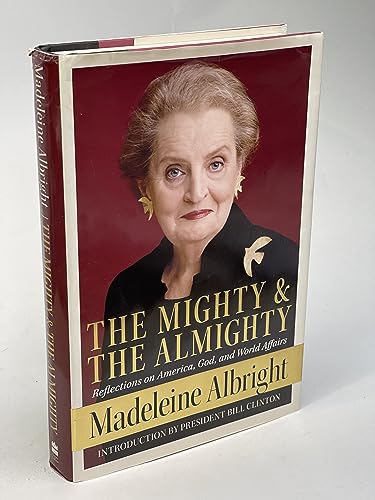
The Mighty and the Almighty: Reflections on America, God, and World Affairs – A Bold Critique and Call for Moral Consensus in an Era of Religious Terrorism - Hardcover
Inhaltsangabe
“In this fascinating book, Madeleine Albright weaves together history, personal experiences, and brilliant analysis in exploring how religion can be a force for liberty and tolerance rather than oppression and terror.” -- Walter Isaacson, author of The Code Breaker
The New York Times bestselling author and former secretary of state Madeleine Albright offers a provocative and very personal look at the role of religion in America’s foreign policy
Traditionally, America’s foreign policy professionals have sought to downplay the impact of religious beliefs in international affairs. Reinforced by the constitutional separation between church and state, policymakers have shied away from this potentially volatile and divisive issue. In this timely precient book, one of the most renowned figures in American politic argues that in today’s climate, a secular approach is no longer sufficient. The 21st century seems to be devolving into a period of religious war, and in an era of confrontation between international terrorism and the West, our political leaders can no longer avoid dealing directly and explicitly with religious issues.
In The Mighty and the Almighty, Madeleine Albright examines religion and foreign affairs through the lens of U.S. history as well as her own experience in public office. She offers a sharp critique of U.S. policy, condemnation for those who exploit religious fervor for violent ends, and praise for political, cultural, and spiritual leaders who seek to harness the values of faith to unite us in these confusing and dangerous times.
Illuminating and engrossing, this is a provocative work calling for leadership that is bold enough to rein in divisive religious rivalries and lay the groundwork for a new moral consensus.
How does a nation founded on the separation of church and state confront a world where God and world affairs are increasingly intertwined?
- U.S. Policy in the Middle East: A candid critique of America’s approach to the Arab-Israeli conflict, the Iraq War, and relationships with key nations like Saudi Arabia and Iran.
- The Clash of Civilizations: An insider’s analysis of the growing divide between the West and the Islamic world, arguing that a purely secular approach is no longer enough to bridge the gap.
- The Rise of Political Islam: From the Iranian Revolution to the challenge of Al Qaeda, Albright examines the forces behind religious fervor and condemns those who exploit it for violent ends.
- Human Rights and Foreign Policy: Drawing on her own experiences in public office, Albright makes the case for a new moral consensus grounded in faith, tolerance, and liberty.
Die Inhaltsangabe kann sich auf eine andere Ausgabe dieses Titels beziehen.
Über die Autorin bzw. den Autor
Madeleine Albright served as America’s sixty-fourth secretary of state from 1997 to 2001. Her distinguished career also included positions at the White House, on Capitol Hill, and as U.S. ambassador to the United Nations. She was a resident of Washington D.C., and Virginia.
Von der hinteren Coverseite
Does America, as George W. Bush has proclaimed, have a special mission, derived from God, to bring liberty and democracy to the world? How much influence does the Christian right have over U.S. foreign policy? And how should America deal with violent Islamist extremists?
Madeleine Albright, the former secretary of state and bestselling author of Madam Secretary, offers a thoughtful and often surprising look at the role of religion in shaping America’s approach to the world. Drawing upon her experiences while in office and her own deepest beliefs about morality, the United States, and the present state of world affairs, a woman noted for plain speaking offers her thoughts about the most controversial topics of our time.
In The Mighty and the Almighty, Madeleine Albright examines the profound impact of religion on America’s view of itself, the effect on U.S. policy of the rise of the Christian right, the Bush administration’s successes and failures in responding to 9/11, the challenges posed by the war in Iraq, and the importance of understanding Islam. She offers a balanced but, when necessary, devastating analysis of U.S. strategy and condemns those of all faiths who exploit religious fervor to create divisions or enhance their own power.
In this illuminating account, Albright argues that, to be effective, U.S. policy-makers must understand the power and place of religion in motivating others and in coloring how American actions are perceived. Defying the conventional wisdom, she suggests not only that religion and politics are inseparable, but that their partnership, when properly harnessed, can be a force for justice and peace.
Auszug. © Genehmigter Nachdruck. Alle Rechte vorbehalten.
The Mighty and the Almighty
Reflections on America, God, and World AffairsBy Madeleine AlbrightHarperCollins Publishers, Inc.
Copyright © 2006 Madeleine AlbrightAll right reserved.
ISBN: 0060892579
Chapter One
The Mighty and the Almighty
I had watched previous inaugural addresses, but the first one I truly took in was John Kennedy's in 1961. My brother John, who was in junior high school, played the trumpet in the Denver police band and had been invited to Washington to march in the inaugural parade. It seems that everyone remembers the snow on the ground and how the glare of sunshine made it impossible for Robert Frost to read the poem he had composed for the occasion. The new president, hatless in the crystal-cold air, his breath visible, asked us to "ask not." It was the speech about "passing the torch" to another generation. I saw it on television -- that is how I experienced all the inaugural addresses until 1993. Then, and again four years later, I watched President Clinton deliver his speeches from the balcony of the U.S. Capitol. The words combined with the crowds and the view of the Washington Monument brought out the sense of history and pride in the United States that has done so much to shape my view of the world.
The inaugural address provides an American president with a matchless opportunity to speak directly to 6 billion fellow human beings, including some 300 million fellow citizens. By defining his country's purpose, a commander in chief can make history and carve out a special place for himself (or perhaps, one day, herself) within it. On January 20, 2005, facing an audience assembled in the shadow of the Capitol, President George W. Bush addressed America and the world. From the first words, it was evident that both he and his speechwriters had aimed high. "It is the policy of the United States," he declared, "to seek and support the growth of democratic movements and institutions in every nation and culture, with the ultimate goal of ending tyranny in our world." He continued, "History has an ebb and flow of justice, but history also has a visible direction, set by liberty and the Author of Liberty." The president concluded that "America, in this young century, proclaims liberty throughout the world and to all the inhabitants thereof." He might have added that, in the Bible, God had assigned that same job, in the same words, to Moses.
The speech was vintage George W. Bush, one that his admirers would hail as inspirational and his detractors would dismiss as self-exalting. It was of a piece with the president's first term, during which he had responded to history's deadliest strike on U.S. soil, led America into two wars, roused passions among both liberals and conservatives, set America apart from longtime allies, aggravated relations with Arab and Muslim societies, and conveyed a sense of U.S. intentions that millions found exhilarating, many others ill-advised.
Within the United States, there are those who see the president as a radical presiding over a foreign policy that is, in the words of one commentator, "more than preemptive, it is theologically presumptuous; not only unilateral, but dangerously messianic; not just arrogant, but rather bordering on the idolatrous and blasphemous." The president's supporters suggest the contrary, that his leadership is ideally, even heroically, suited to the perils of this era and in keeping with the best traditions of America.
My own initial instinct, particularly when the president is trumpeting the merits of freedom, is to applaud. I firmly believe that democracy is one of humankind's best inventions: a form of government superior to any other and a powerful source of hope. I believe just as firmly in the necessity of American leadership. Why wouldn't I? When I was a little girl, U.S. soldiers crossed the ocean to help save Europe from the menace of Adolf Hitler. When I was barely in my teens, the American people welcomed my family after the communists had seized power in my native Czechoslovakia. Unlike most in my generation who were born in Central Europe, I had the chance to grow up in a democracy, a privilege for which I will forever be grateful. I take seriously the welcoming words at the base of the Statue of Liberty; and I love to think of America as an inspiration to people everywhere -- especially to those who have been denied freedom in their own lands.
As appealing as President Bush's rhetoric may sometimes be, however, I also know that proclaiming liberty is far simpler than building genuine democracy. Political liberty is not a magic pill people can swallow at night and awaken with all problems solved, nor can it be imposed from the outside. According to the president, "Freedom is God's gift to everybody in the world." He told Bob Woodward, "As a matter of fact, I was the person who wrote the line, or said it. I didn't write it, I just said it in a speech. And it became part of the jargon. And I believe that. And I believe we have a duty to free people. I would hope we wouldn't have to do it militarily, but we have a duty."
These are uplifting sentiments, undoubtedly, but what exactly do they mean? The president says that liberty is a gift to everybody, but is he also implying that God appointed America to deliver that gift? Even to raise that question is to invite others. Does the United States believe it has a special relationship with God? Does it have a divinely inspired mission to promote liberty? What role, if any, should religious convictions play in the decisions of those responsible for U.S. foreign policy? But perhaps we should begin by asking why we are even thinking about these questions, given America's constitutional separation between church and state. And haven't we long since concluded that it is a mistake, in any case, to mix religion and foreign policy? I had certainly thought so.
Continues...
Excerpted from The Mighty and the Almightyby Madeleine Albright Copyright © 2006 by Madeleine Albright. Excerpted by permission.
All rights reserved. No part of this excerpt may be reproduced or reprinted without permission in writing from the publisher.
Excerpts are provided by Dial-A-Book Inc. solely for the personal use of visitors to this web site.
„Über diesen Titel“ kann sich auf eine andere Ausgabe dieses Titels beziehen.
Suchergebnisse für The Mighty and the Almighty: Reflections on America,...

Beispielbild für diese ISBN
The Mighty and the Almighty: Reflections on America, God, and World Affairs - A Bold Critique and Call for Moral Consensus in an Era of Religious Terrorism
Anbieter: World of Books (was SecondSale), Montgomery, IL, USA
Verkäuferbewertung 5 von 5 Sternen

Zustand: Acceptable. Item in acceptable condition! Textbooks may not include supplemental items i.e. CDs, access codes etc. Artikel-Nr. 00082397734
Gebraucht kaufen
EUR 3,78
Versand gratis
Versand innerhalb von USA
Versand innerhalb von USA
Anzahl: 1 verfügbar
Beispielbild für diese ISBN
The Mighty and the Almighty: Reflections on America, God, and World Affairs - A Bold Critique and Call for Moral Consensus in an Era of Religious Terrorism
Anbieter: World of Books (was SecondSale), Montgomery, IL, USA
Verkäuferbewertung 5 von 5 Sternen
Zustand: Good. Item in good condition. Textbooks may not include supplemental items i.e. CDs, access codes etc. Artikel-Nr. 00036116429
Gebraucht kaufen
EUR 3,78
Versand gratis
Versand innerhalb von USA
Versand innerhalb von USA
Anzahl: 18 verfügbar
Beispielbild für diese ISBN
The Mighty and the Almighty: Reflections on America, God, and World Affairs - A Bold Critique and Call for Moral Consensus in an Era of Religious Terrorism
Anbieter: World of Books (was SecondSale), Montgomery, IL, USA
Verkäuferbewertung 5 von 5 Sternen
Zustand: Very Good. Item in very good condition! Textbooks may not include supplemental items i.e. CDs, access codes etc. Artikel-Nr. 00108728436
Gebraucht kaufen
EUR 3,78
Versand gratis
Versand innerhalb von USA
Versand innerhalb von USA
Anzahl: 1 verfügbar
Beispielbild für diese ISBN
The Mighty and the Almighty: Reflections on America, God, and World Affairs â" A Bold Critique and Call for Moral Consensus in an Era of Religious Terrorism
Verlag:
HarperCollins (edition ), 2006
ISBN 10: 0060892579
ISBN 13: 9780060892579
Gebraucht
Hardcover
Anbieter: BooksRun, Philadelphia, PA, USA
Verkäuferbewertung 5 von 5 Sternen
Hardcover. Zustand: Fair. With dust jacket. The item might be beaten up but readable. May contain markings or highlighting, as well as stains, bent corners, or any other major defect, but the text is not obscured in any way. Artikel-Nr. 0060892579-7-1-29
Gebraucht kaufen
EUR 5,07
Versand gratis
Versand innerhalb von USA
Versand innerhalb von USA
Anzahl: 1 verfügbar
Beispielbild für diese ISBN
The Mighty and the Almighty: Reflections on America, God, and World Affairs
Anbieter: Wonder Book, Frederick, MD, USA
Verkäuferbewertung 5 von 5 Sternen
Zustand: Very Good. Very Good condition. Very Good dust jacket. With remainder mark. A copy that may have a few cosmetic defects. May also contain a few markings such as an owner's name, short gifter's inscription or light stamp. Artikel-Nr. L05N-00544
Gebraucht kaufen
EUR 5,67
Versand gratis
Versand innerhalb von USA
Versand innerhalb von USA
Anzahl: 1 verfügbar
Beispielbild für diese ISBN
The Mighty and the Almighty : Reflections on America, God, and World Affairs
Verlag:
HarperCollins Publishers, 2006
ISBN 10: 0060892579
ISBN 13: 9780060892579
Gebraucht
Hardcover
Anbieter: Better World Books: West, Reno, NV, USA
Verkäuferbewertung 5 von 5 Sternen
Zustand: Good. Pages intact with minimal writing/highlighting. The binding may be loose and creased. Dust jackets/supplements are not included. Stock photo provided. Product includes identifying sticker. Better World Books: Buy Books. Do Good. Artikel-Nr. 2190758-75
Gebraucht kaufen
EUR 6,26
Versand gratis
Versand innerhalb von USA
Versand innerhalb von USA
Anzahl: 1 verfügbar
Beispielbild für diese ISBN
The Mighty and the Almighty : Reflections on America, God, and World Affairs
Verlag:
HarperCollins Publishers, 2006
ISBN 10: 0060892579
ISBN 13: 9780060892579
Gebraucht
Hardcover
Anbieter: Better World Books, Mishawaka, IN, USA
Verkäuferbewertung 5 von 5 Sternen
Zustand: Very Good. Former library copy. Pages intact with possible writing/highlighting. Binding strong with minor wear. Dust jackets/supplements may not be included. Includes library markings. Stock photo provided. Product includes identifying sticker. Better World Books: Buy Books. Do Good. Artikel-Nr. GRP58723275
Gebraucht kaufen
EUR 6,26
Versand gratis
Versand innerhalb von USA
Versand innerhalb von USA
Anzahl: 1 verfügbar
Beispielbild für diese ISBN
The Mighty and the Almighty : Reflections on America, God, and World Affairs
Verlag:
HarperCollins Publishers, 2006
ISBN 10: 0060892579
ISBN 13: 9780060892579
Gebraucht
Hardcover
Anbieter: Better World Books, Mishawaka, IN, USA
Verkäuferbewertung 5 von 5 Sternen
Zustand: Good. Pages intact with minimal writing/highlighting. The binding may be loose and creased. Dust jackets/supplements are not included. Stock photo provided. Product includes identifying sticker. Better World Books: Buy Books. Do Good. Artikel-Nr. 2190758-75
Gebraucht kaufen
EUR 6,26
Versand gratis
Versand innerhalb von USA
Versand innerhalb von USA
Anzahl: 1 verfügbar
Beispielbild für diese ISBN
The Mighty and the Almighty: Reflections on America, God, and World Affairs
Anbieter: Wonder Book, Frederick, MD, USA
Verkäuferbewertung 5 von 5 Sternen
Zustand: As New. Like New condition. Like New dust jacket. A near perfect copy that may have very minor cosmetic defects. Artikel-Nr. S24D-21460
Gebraucht kaufen
EUR 6,33
Versand gratis
Versand innerhalb von USA
Versand innerhalb von USA
Anzahl: 2 verfügbar
Beispielbild für diese ISBN
The Mighty and the Almighty: Reflections on America, God, and World Affairs
Anbieter: Wonder Book, Frederick, MD, USA
Verkäuferbewertung 5 von 5 Sternen
Zustand: Very Good. Very Good condition. Very Good dust jacket. A copy that may have a few cosmetic defects. May also contain light spine creasing or a few markings such as an owner's name, short gifter's inscription or light stamp. Bundled media such as CDs, DVDs, floppy disks or access codes may not be included. Artikel-Nr. E18I-00004
Gebraucht kaufen
EUR 6,33
Versand gratis
Versand innerhalb von USA
Versand innerhalb von USA
Anzahl: 2 verfügbar