
Verwandte Artikel zu The Professor and the Madman: A Tale of Murder, Insanity,...
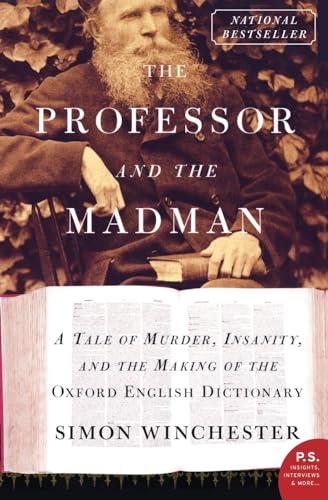
The Professor and the Madman: A Tale of Murder, Insanity, and the Making of the Oxford English Dictionary - Softcover
Inhaltsangabe
A New York Times Notable Book
The Professor and the Madman is an extraordinary tale of madness, genius, and the incredible obsessions of two remarkable men that led to the making of the Oxford English Dictionary—and literary history.
The making of the OED was one of the most ambitious projects ever undertaken. As definitions were collected, the overseeing committee, led by Professor James Murray, was stunned to discover that one man, Dr. W. C. Minor, had submitted more than ten thousand. But their surprise would pale in comparison to what they were about to discover when the committee insisted on honoring him. For Dr. Minor, an American Civil War veteran, was also an inmate at an asylum for the criminally insane.
Masterfully researched and eloquently written, The Professor and the Madman “is the linguistic detective story of the decade.” (William Safire, New York Times Magazine)
This P.S. edition features an extra 16 pages of insights into the book, including author interviews, recommended reading, and more.
Die Inhaltsangabe kann sich auf eine andere Ausgabe dieses Titels beziehen.
Über die Autorin bzw. den Autor
Simon Winchester is the acclaimed author of many books, including The Professor and the Madman, The Men Who United the States, The Map That Changed the World, The Man Who Loved China, A Crack in the Edge of the World, and Krakatoa, all of which were New York Times bestsellers and appeared on numerous best and notable lists. In 2006, Winchester was made an officer of the Order of the British Empire (OBE) by Her Majesty the Queen. He resides in western Massachusetts.
Von der hinteren Coverseite
The Professor and the Madman, masterfully researched and eloquently written, is an extraordinary tale of madness, genius, and the incredible obsessions of two remarkable men that led to the making of the Oxford English Dictionary -- and literary history. The compilation of the OED began in 1857, it was one of the most ambitious projects ever undertaken. As definitions were collected, the overseeing committee, led by Professor James Murray, discovered that one man, Dr. W. C. Minor, had submitted more than ten thousand. When the committee insisted on honoring him, a shocking truth came to light: Dr. Minor, an American Civil War veteran, was also an inmate at an asylum for the criminally insane.
This P.S. edition features an extra 16 pages of insights into the book, including author interviews, recommended reading, and more.
Auszug. © Genehmigter Nachdruck. Alle Rechte vorbehalten.
The Professor and the Madman
A Tale of Murder, Insanity, and the Making of the Oxford English DictionaryBy Winchester, SimonPerennial
ISBN: 0060839783Chapter One
In Victorian London, even in a place as louche and notoriously crime-ridden as Lambeth Marsh, the sound of gunshots was a rare event indeed. The marsh was a sinister place, a jumble of slums and sin that crouched, dark and ogrelike, on the bank of the Thames just across from Westminster; few respectable Londoners would ever admit to venturing there. It was a robustly violent part of town as well -- the footpad lurked in Lambeth, there had once been an outbreak of garroting, and in every crowded alley were the roughest kinds of pickpocket. Fagin, Bill Sikes, and Oliver Twist would have all seemed quite at home in Victorian Lambeth: This was Dickensian London writ large.
But it was not a place for men with guns. The armed criminal was a phenomenon little known in the Lambeth of Prime Minister Gladstone's day, and even less known in the entire metropolitan vastness of London. Guns were costly, cumbersome, difficult to use, hard to conceal. Then, as still today, the use of a firearm in the commission of a crime was thought of as somehow a very un-British act -- and as something to be written about and recorded as a rarity. "Happily," proclaimed a smug editorial in Lambeth's weekly newspaper, "we in this country have no experience of the crime of 'shooting down,' so common in the United States."
So when a brief fusillade of three revolver shots rang out shortly after two o'clock on the moonlit Saturday morning of February 17, 1872, the sound was unimagined, unprecedented, and shocking. The three cracks -- perhaps there were four -- were loud, very loud, and they echoed through the cold and smokily damp night air. They were heard -- and, considering their rarity, just by chance instantly recognized -- by a keen young police constable named Henry Tarrant, then attached to the Southwark Constabulary's L Division.
The clocks had only recently struck two, his notes said later; he was performing with routine languor the duties of the graveyard shift, walking slowly beneath the viaduct arches beside Waterloo Railway Station, rattling the locks of the shops and cursing the bone-numbing chill.
When he heard the shots, Tarrant blew his whistle to alert any colleagues who (he hoped) might be on patrol nearby, and he began to run. Within seconds he had raced through the warren of mean and slippery lanes that made up what in those days was still called a village, and had emerged into the wide riverside swath of Belvedere Road, from whence he was certain the sounds had come.
Another policeman, Henry Burton, who had heard the piercing whistle, as had a third, William Ward, rushed to the scene. According to Burton's notes, he dashed toward the echoing sound and came across his colleague Tarrant, who was by then holding a man, as if arresting him. "Quick!" cried Tarrant. "Go to the road -- a man has been shot!" Burton and Ward raced toward Belvedere Road and within seconds found the unmoving body of a dying man. They fell to their knees, and onlookers noted they had cast off their helmets and gloves and were hunched over the victim.
There was blood gushing onto the pavement -- blood staining a spot that would for many months afterward be described in London's more dramatically minded papers as the location of A HEINOUS CRIME, A TERRIBLE EVENT, AN ATROCIOUS OCCURRENCE, A VILE MURDER.
The Lambeth Tragedy, the papers eventually settled upon calling it -- as if the simple existence of Lambeth itself were not something of a tragedy. Yet this was a most unusual event, even by the diminished standards of the marsh dwellers. For though the place where the killing occurred had over the years been witness to many strange events, the kind eagerly chronicled in the penny dreadfuls, this particular drama was to trigger a chain of consequences that was quite without precedent. And while some aspects of this crime and its aftermath would turn out to be sad and barely believable, not all of them, as this account will show, were to be wholly tragic. Far from it, indeed.
Even today Lambeth is a singularly unlovely part of the British capital, jammed anonymously between the great fan of roads and railway lines that take commuters in and out of the city center from the southern counties. These days the Royal Festival Hall and the South Bank Centre stand there, built on the site of the 1951 fairgrounds where an entertainment was staged to help cheer up the rationed and threadbare Londoners. Otherwise it is an unlovely, characterless sort of place -- rows of prisonlike buildings that house lesser government ministries, the headquarters of an oil company around which winter winds whip bitterly, a few unmemorable pubs and newspaper shops, and the lowering presence of Waterloo Station -- lately expanded with the terminal for the Channel Tunnel express trains -- which exerts its dull magnetic pull over the neighborhood.
The railway chiefs of old never bothered to build a grand station hotel at Waterloo -- though they did build monster structures of great luxury at the other London stations, like Victoria and Paddington, and even St. Pancras and King's Cross. Lambeth has long been one of the nastier parts of London; until very recently, with the further development of the Festival Hall site, no one of any style and consequence has ever wanted to linger there, neither a passenger back in the days of the Victorian boat trains, nor anyone for any reason at all today. It is slowly improving; but its reputation dogs it.
A hundred years ago it was positively vile. It was still then low, marshy, and undrained, a swampy gyre of pathways where a sad little stream called the Neckinger seeped into the Thames. The land was jointly owned by the archbishop of Canterbury and the duke of Cornwall, landlords who, rich enough in their own right, never bothered to develop it in the manner of the great...
Continues...Excerpted from The Professor and the Madmanby Winchester, Simon Excerpted by permission.
All rights reserved. No part of this excerpt may be reproduced or reprinted without permission in writing from the publisher.
Excerpts are provided by Dial-A-Book Inc. solely for the personal use of visitors to this web site.
„Über diesen Titel“ kann sich auf eine andere Ausgabe dieses Titels beziehen.
Suchergebnisse für The Professor and the Madman: A Tale of Murder, Insanity,...

Beispielbild für diese ISBN
The Professor and the Madman: A Tale of Murder, Insanity, and the Making of the Oxford English Dictionary
Verlag:
HarperCollins Publishers Inc, 2005
ISBN 10: 0060839783
ISBN 13: 9780060839789
Gebraucht
Paperback
Anbieter: World of Books (was SecondSale), Montgomery, IL, USA
Verkäuferbewertung 5 von 5 Sternen

Paperback. Zustand: Good. A New York Times Notable Book The Professor and the Madman is an extraordinary tale of madness, genius, and the incredible obsessions of two remarkable men that led to the making of the Oxford English Dictionary--and literary history. The making of the OED was one of the most ambitious projects ever undertaken. As definitions were collected, the overseeing committee, led by Professor James Murray, was stunned to discover that one man, Dr. W. C. Minor, had submitted more than ten thousand. But their surprise would pale in comparison to what they were about to discover when the committee insisted on honoring him. For Dr. Minor, an American Civil War veteran, was also an inmate at an asylum for the criminally insane. Masterfully researched and eloquently written, The Professor and the Madman "is the linguistic detective story of the decade." (William Safire, New York Times Magazine) This P.S. edition features an extra 16 pages of insights into the book, including author interviews, recommended reading, and more. Artikel-Nr. 00103272908
Gebraucht kaufen
EUR 3,71
Versand gratis
Versand innerhalb von USA
Versand innerhalb von USA
Anzahl: Mehr als 20 verfügbar
Beispielbild für diese ISBN
The Professor and the Madman:
Anbieter: World of Books (was SecondSale), Montgomery, IL, USA
Verkäuferbewertung 5 von 5 Sternen
Zustand: Acceptable. Item in acceptable condition! Textbooks may not include supplemental items i.e. CDs, access codes etc. Artikel-Nr. 00082749817
Gebraucht kaufen
EUR 3,71
Versand gratis
Versand innerhalb von USA
Versand innerhalb von USA
Anzahl: Mehr als 20 verfügbar
Beispielbild für diese ISBN
The Professor and the Madman: A Tale of Murder, Insanity, and the Making of the Oxford English Dictionary
Anbieter: ThriftBooks-Phoenix, Phoenix, AZ, USA
Verkäuferbewertung 5 von 5 Sternen
Paperback. Zustand: Very Good. No Jacket. May have limited writing in cover pages. Pages are unmarked. ~ ThriftBooks: Read More, Spend Less. Artikel-Nr. G0060839783I4N00
Gebraucht kaufen
EUR 5,96
Versand gratis
Versand innerhalb von USA
Versand innerhalb von USA
Anzahl: 1 verfügbar
Beispielbild für diese ISBN
The Professor and the Madman: A Tale of Murder, Insanity, and the Making of the Oxford English Dictionary
Anbieter: ThriftBooks-Phoenix, Phoenix, AZ, USA
Verkäuferbewertung 5 von 5 Sternen
Paperback. Zustand: Good. No Jacket. Pages can have notes/highlighting. Spine may show signs of wear. ~ ThriftBooks: Read More, Spend Less. Artikel-Nr. G0060839783I3N00
Gebraucht kaufen
EUR 5,96
Versand gratis
Versand innerhalb von USA
Versand innerhalb von USA
Anzahl: 4 verfügbar
Beispielbild für diese ISBN
The Professor and the Madman: A Tale of Murder, Insanity, and the Making of the Oxford English Dictionary
Anbieter: ThriftBooks-Atlanta, AUSTELL, GA, USA
Verkäuferbewertung 5 von 5 Sternen
Paperback. Zustand: Good. No Jacket. Former library book; Pages can have notes/highlighting. Spine may show signs of wear. ~ ThriftBooks: Read More, Spend Less. Artikel-Nr. G0060839783I3N10
Gebraucht kaufen
EUR 5,96
Versand gratis
Versand innerhalb von USA
Versand innerhalb von USA
Anzahl: 1 verfügbar
Beispielbild für diese ISBN
The Professor and the Madman: A Tale of Murder, Insanity, and the Making of the Oxford English Dictionary
Anbieter: ThriftBooks-Dallas, Dallas, TX, USA
Verkäuferbewertung 5 von 5 Sternen
Paperback. Zustand: Good. No Jacket. Pages can have notes/highlighting. Spine may show signs of wear. ~ ThriftBooks: Read More, Spend Less. Artikel-Nr. G0060839783I3N00
Gebraucht kaufen
EUR 5,96
Versand gratis
Versand innerhalb von USA
Versand innerhalb von USA
Anzahl: 5 verfügbar
Beispielbild für diese ISBN
The Professor and the Madman: A Tale of Murder, Insanity, and the Making of the Oxford English Dictionary
Anbieter: ThriftBooks-Atlanta, AUSTELL, GA, USA
Verkäuferbewertung 5 von 5 Sternen
Paperback. Zustand: Good. No Jacket. Pages can have notes/highlighting. Spine may show signs of wear. ~ ThriftBooks: Read More, Spend Less. Artikel-Nr. G0060839783I3N00
Gebraucht kaufen
EUR 5,96
Versand gratis
Versand innerhalb von USA
Versand innerhalb von USA
Anzahl: 5 verfügbar
Beispielbild für diese ISBN
The Professor and the Madman: A Tale of Murder, Insanity, and the Making of the Oxford English Dictionary
Anbieter: ThriftBooks-Reno, Reno, NV, USA
Verkäuferbewertung 5 von 5 Sternen
Paperback. Zustand: Very Good. No Jacket. May have limited writing in cover pages. Pages are unmarked. ~ ThriftBooks: Read More, Spend Less. Artikel-Nr. G0060839783I4N00
Gebraucht kaufen
EUR 5,96
Versand gratis
Versand innerhalb von USA
Versand innerhalb von USA
Anzahl: 1 verfügbar
Beispielbild für diese ISBN
The Professor and the Madman: A Tale of Murder, Insanity, and the Making of the Oxford English Dictionary
Anbieter: ThriftBooks-Dallas, Dallas, TX, USA
Verkäuferbewertung 5 von 5 Sternen
Paperback. Zustand: Fair. No Jacket. Readable copy. Pages may have considerable notes/highlighting. ~ ThriftBooks: Read More, Spend Less. Artikel-Nr. G0060839783I5N00
Gebraucht kaufen
EUR 5,96
Versand gratis
Versand innerhalb von USA
Versand innerhalb von USA
Anzahl: 1 verfügbar
Beispielbild für diese ISBN
The Professor and the Madman: A Tale of Murder, Insanity, and the Making of the Oxford English Dictionary
Anbieter: ThriftBooks-Atlanta, AUSTELL, GA, USA
Verkäuferbewertung 5 von 5 Sternen
Paperback. Zustand: Very Good. No Jacket. May have limited writing in cover pages. Pages are unmarked. ~ ThriftBooks: Read More, Spend Less. Artikel-Nr. G0060839783I4N00
Gebraucht kaufen
EUR 5,96
Versand gratis
Versand innerhalb von USA
Versand innerhalb von USA
Anzahl: 2 verfügbar