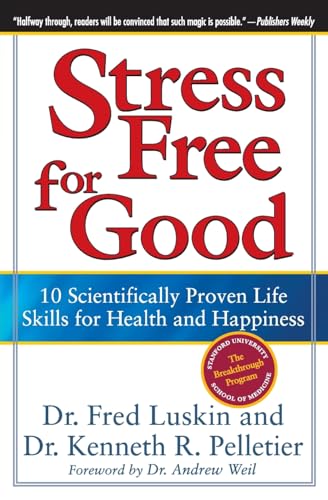
Stress Free for Good: 10 Scientifically Proven Life Skills for Health and Happiness – The Stanford Program for Immediate and Lasting Relief - Softcover
Inhaltsangabe
Ten Minutes to Learn One Minute to Practice Ten Seconds to Work
Imagine if you could . . .
- Radically reduce stress
- Increase your physical vitality
- Improve your quality of life
Now you can. We live in an age of stress. Each day at work and at home as we struggle to take care of the basics, constant stress significantly affects our ability to lead healthy and happy lives. We struggle with stomach pain, headaches, mood swings, fatigue, depression, high blood pressure, and even heart failure. Not only does stress damage our physical and emotional well-being, but our relationships and productivity suffer as well. What, if anything, can we do to stop this cycle?
There is a multitude of books, magazine features, TV programs, videotapes, meditation classes, and seminars, all aimed at stopping stress. But until now there has never been a scientifically based program that not only starts working within seconds but also creates a foundation to help remove stress and the symptoms associated with it from your life for good.
Dr. Fred Luskin and Dr. Kenneth R. Pelletier spent years at the Stanford University School of Medicine developing ten proven skills for eliminating the stress, anxiety, and pain that occur in daily life. Delivering skills that have been honed and tested among a diverse group of Americans, Stress Free for Good is easy to use and starts working immediately. Offering more than just the promise of breaking even and eliminating daily stress, these ten skills provide a foundation for living a healthier and happier life. This is not only a practical and accessible guide to conquering the stress in our lives once and for all, it is also the last stress aid you will ever need.
Die Inhaltsangabe kann sich auf eine andere Ausgabe dieses Titels beziehen.
Über die Autorinnen und Autoren
Fred Luskin, Ph.D. is the author of Forgive for Good and one of the world's leading researchers and teachers on the subject of forgiveness. He is the director of the Stanford Forgiveness Project, a series of research projects that investigate forgiveness methods. He holds an appointment at the Stanford Center on Conflict and Negotiation as a senior fellow and is an associate professor at the Institute of Transpersonal Psychology. He lives in Palo Alto, California.
Dr. Kenneth R. Pelletier is a clinical professor of medicine at the University of Arizona School of Medicine and at the University of Maryland School of Medicine, and a lecturer in family and community medicine at the University of California School of Medicine in San Francisco. Pelletier is the author of several books, including the international bestseller Mind as Healer, Mind as Slayer; Sound Mind, Sound Body; and The Best Alternative Medicine. He is chairman of the American Health Association and is a vice president of Healthtrac.
Von der hinteren Coverseite
Ten Minutes to Learn One Minute to Practice Ten Seconds to Work
Imagine if you could . . .
- Radically reduce stress
- Increase your physical vitality
- Improve your quality of life
Now you can. We live in an age of stress. Each day at work and at home as we struggle to take care of the basics, constant stress significantly affects our ability to lead healthy and happy lives. We struggle with stomach pain, headaches, mood swings, fatigue, depression, high blood pressure, and even heart failure. Not only does stress damage our physical and emotional well-being, but our relationships and productivity suffer as well. What, if anything, can we do to stop this cycle?
There is a multitude of books, magazine features, TV programs, videotapes, meditation classes, and seminars, all aimed at stopping stress. But until now there has never been a scientifically based program that not only starts working within seconds but also creates a foundation to help remove stress and the symptoms associated with it from your life for good.
Dr. Fred Luskin and Dr. Kenneth R. Pelletier spent years at the Stanford University School of Medicine developing ten proven skills for eliminating the stress, anxiety, and pain that occur in daily life. Delivering skills that have been honed and tested among a diverse group of Americans, Stress Free for Good is easy to use and starts working immediately. Offering more than just the promise of breaking even and eliminating daily stress, these ten skills provide a foundation for living a healthier and happier life. This is not only a practical and accessible guide to conquering the stress in our lives once and for all, it is also the last stress aid you will ever need.
Auszug. © Genehmigter Nachdruck. Alle Rechte vorbehalten.
Stress Free for Good
10 Scientifically Proven Life Skills for Health and HappinessBy Frederic LuskinHarperCollins Publishers, Inc.
Copyright ©2006 Frederic LuskinAll right reserved.
ISBN: 0060832991
Chapter One
The Birth of LifeSkills
The Stress Free program consists of a set of ten LifeSkills. These skills include exercises (such as deep breathing, muscle relaxation, and focused attention) that will help you create a state of physical relaxation while remaining mentally alert, exercises that will help you remain emotionally stable while under stress, exercises that will help you experience greater peace in your life, and exercises that will show you how to recognize and appreciate the many positives and blessings that surround you. With the help of these ten LifeSkills, you will have the capability to respond appropriately and with intelligence to any situation that arises in your day-to-day life -- and you will be happier besides.
We assert that these simple LifeSkills are for everyone. We're not suggesting that everyone is miserable or stressed out. Nor are we suggesting that every person reading this book is a failure at managing their lives. What we are saying is that life presents each of us with challenges almost every day and at every stage. Some of us are parenting small children, experiencing the difficulties of getting up on demand in the middle of the night and spending less time with a spouse. Others of us are working long hours to pay off a large mortgage or to put a child through college. Still others are mourning as their children leave home or their parents become old or disabled. In each situation, normal life is hard and we require tools to remain emotionally afloat and physically intact.
We coined the term LifeSkills to reflect the tools needed in order to manage the stress inherent in change, illness, loss, overwork, divorce, long commutes, and other normal life experiences. LifeSkills are practical, quick, and effective strategies that you can use anytime to optimize your performance and enjoyment of both work and play. You can learn these skills with regular practice in a relatively short time, and this book will take you step by step through that learning process. With practice, you can learn to enter a state of peaceful awareness in less than ten seconds. Each LifeSkill uses a phrase, found in the titles of Chapters 3 through 12, that helps you to quickly and easily remember your positive goal. This is our summary phrase for the Stress Free program: ten minutes to learn, one minute to practice, and ten seconds to work.
Our research and clinical practice confirm the effectiveness of this program in helping to reduce stress and its associated symptoms. Now it can help you feel energetic, be more productive at work, and reduce the wear and tear on your body. It can help prevent and reduce the risks associated with heart disease as well as manage the emotional and physical pain that accompany other diseases such as diabetes, high blood pressure, angina, chronic pain, anxiety, depression, menopausal discomforts, headaches, and stomach and/or intestinal troubles. It is important to remember, however, that while this book is helpful in reducing the disabling effects of illness (and maybe even preventing some illness), it is intended as a supplement to, not a replacement for, your regular medical and psychological care.
Every story has a beginning. In 1996, I (Fred Luskin) was a brand new intern at the Stanford Center for Research in Disease Prevention (SCRDP) of the Department of Medicine at the Stanford University School of Medicine. I was in the middle of my third year as a doctoral student in psychology and had spent a nervous few months hunting around for a campus job that would cover my $25,000 yearly tuition. It was difficult, and getting a graduate degree at Stanford, at midlife, was no cheap undertaking. At that time, Ken Pelletier had just hired me to lead the Mind/Body team of the new National Institutes of Health–funded Complementary and Alternative Medicine Program at Stanford (CAMPS) and I was awaiting my first assignment. Ken was the director of CAMPS and a clinical professor of medicine at the Stanford University School of Medicine.
At SCRDP I was trying to make myself useful when I wandered into the office of the coordinator of the HEARRT program (an acronym for Heart Education and Risk Reduction Training). This now sophisticated program of stress management skills, social support, and self-care instruction was designed to lead people to lifestyle changes that would reduce their risk of heart disease. It was provided to patients by skilled nurses who taught people how to lower their blood pressure and cholesterol, eat better, and get more exercise. Back then the program was just considering adding a stress management component. To begin this process, the HEARRT coordinator and I looked at a series of modules that Ken had developed for one of his worksite stress management research projects.
Over the next few weeks we edited these modules and met occasionally to plan our next step. Editing wasn't easy because the modules were designed for a different audience, one with a higher level of education than the group we were working with had. In addition, these modules required a significant time commitment from participants. Finally, the modules were lengthy and cumbersome.
Ken soon discovered that I had been editing his stress modules for the HEARRT program and was curious about how the work was going. One day after our weekly CAMPS meeting Ken walked up to me and asked, "What do you think of those stress management modules?"
When your boss asks you how you like something he developed and you've been working with him for only a few weeks and need the job for at least the next year and a half, your mind doesn't always run first to the truth. My temptation was to say that the modules were the greatest thing since sliced bread. Well, the first thing out of my mouth was, "The modules are too complicated and way too long." Knowing that I was perhaps being too honest for my own good, I added, "They require people to make a time commitment they may not be willing to make, and the bottom line is we need stress management tools that people can quickly and easily understand. Besides that, they're terrific."
Continues...
Excerpted from Stress Free for Goodby Frederic Luskin Copyright ©2006 by Frederic Luskin. Excerpted by permission.
All rights reserved. No part of this excerpt may be reproduced or reprinted without permission in writing from the publisher.
Excerpts are provided by Dial-A-Book Inc. solely for the personal use of visitors to this web site.
„Über diesen Titel“ kann sich auf eine andere Ausgabe dieses Titels beziehen.
Weitere beliebte Ausgaben desselben Titels

Suchergebnisse für Stress Free for Good: 10 Scientifically Proven Life...

Beispielbild für diese ISBN
Stress Free for Good: 10 Scientifically Proven Life Skills for Health and Happiness
Anbieter: Wonder Book, Frederick, MD, USA
Verkäuferbewertung 5 von 5 Sternen

Zustand: Very Good. Very Good condition. A copy that may have a few cosmetic defects. May also contain light spine creasing or a few markings such as an owner's name, short gifter's inscription or light stamp. Artikel-Nr. R14Q-00689
Gebraucht kaufen
EUR 5,35
Versand gratis
Versand innerhalb von USA
Versand innerhalb von USA
Anzahl: 1 verfügbar
Beispielbild für diese ISBN
Stress Free for Good: 10 Scientifically Proven Life Skills for Health and Happiness
Anbieter: Wonder Book, Frederick, MD, USA
Verkäuferbewertung 5 von 5 Sternen
Zustand: Very Good. Very Good condition. A copy that may have a few cosmetic defects. May also contain light spine creasing or a few markings such as an owner's name, short gifter's inscription or light stamp. Bundled media such as CDs, DVDs, floppy disks or access codes may not be included. Artikel-Nr. Y01A-01417
Gebraucht kaufen
EUR 5,35
Versand gratis
Versand innerhalb von USA
Versand innerhalb von USA
Anzahl: 1 verfügbar
Beispielbild für diese ISBN
Stress Free for Good: 10 Scientifically Proven Life Skills for Health and Happiness
Anbieter: ThriftBooks-Dallas, Dallas, TX, USA
Verkäuferbewertung 5 von 5 Sternen
Paperback. Zustand: Very Good. No Jacket. May have limited writing in cover pages. Pages are unmarked. ~ ThriftBooks: Read More, Spend Less. Artikel-Nr. G0060832991I4N00
Gebraucht kaufen
EUR 5,96
Versand gratis
Versand innerhalb von USA
Versand innerhalb von USA
Anzahl: 1 verfügbar
Beispielbild für diese ISBN
Stress Free for Good: 10 Scientifically Proven Life Skills for Health and Happiness
Anbieter: ThriftBooks-Reno, Reno, NV, USA
Verkäuferbewertung 5 von 5 Sternen
Paperback. Zustand: Very Good. No Jacket. May have limited writing in cover pages. Pages are unmarked. ~ ThriftBooks: Read More, Spend Less. Artikel-Nr. G0060832991I4N00
Gebraucht kaufen
EUR 5,96
Versand gratis
Versand innerhalb von USA
Versand innerhalb von USA
Anzahl: 1 verfügbar
Beispielbild für diese ISBN
Stress Free for Good: 10 Scientifically Proven Life Skills for Health and Happiness
Anbieter: ThriftBooks-Atlanta, AUSTELL, GA, USA
Verkäuferbewertung 5 von 5 Sternen
Paperback. Zustand: Very Good. No Jacket. May have limited writing in cover pages. Pages are unmarked. ~ ThriftBooks: Read More, Spend Less. Artikel-Nr. G0060832991I4N00
Gebraucht kaufen
EUR 5,96
Versand gratis
Versand innerhalb von USA
Versand innerhalb von USA
Anzahl: 1 verfügbar
Beispielbild für diese ISBN
Stress Free for Good : 10 Scientifically Proven Life Skills for Health and Happiness
Verlag:
HarperCollins Publishers, 2005
ISBN 10: 0060832991
ISBN 13: 9780060832995
Gebraucht
Softcover
Anbieter: Better World Books: West, Reno, NV, USA
Verkäuferbewertung 5 von 5 Sternen
Zustand: Very Good. Reprint. Used book that is in excellent condition. May show signs of wear or have minor defects. Artikel-Nr. 5188140-6
Gebraucht kaufen
EUR 6,05
Versand gratis
Versand innerhalb von USA
Versand innerhalb von USA
Anzahl: 1 verfügbar
Beispielbild für diese ISBN
Stress Free for Good : 10 Scientifically Proven Life Skills for Health and Happiness
Verlag:
HarperCollins Publishers, 2005
ISBN 10: 0060832991
ISBN 13: 9780060832995
Gebraucht
Softcover
Anbieter: Better World Books, Mishawaka, IN, USA
Verkäuferbewertung 5 von 5 Sternen
Zustand: Very Good. Reprint. Used book that is in excellent condition. May show signs of wear or have minor defects. Artikel-Nr. 5188140-6
Gebraucht kaufen
EUR 6,05
Versand gratis
Versand innerhalb von USA
Versand innerhalb von USA
Anzahl: 1 verfügbar
Beispielbild für diese ISBN
Stress Free for Good: 10 Scientifically Proven Life Skills for Health and Happiness
Verlag:
HarperOne December 2005, 2005
ISBN 10: 0060832991
ISBN 13: 9780060832995
Gebraucht
Trade Paperback
Anbieter: Books End Bookshop, Syracuse, NY, USA
Verkäuferbewertung 4 von 5 Sternen

Trade Paperback. Zustand: Very Good. Zustand des Schutzumschlags: None. Shelfwear/edgewear on covers and spine; pages age-toned. ; 223 pages. Artikel-Nr. 445386
Gebraucht kaufen
EUR 3,96
EUR 5,12 shipping
Versand innerhalb von USA
Versand innerhalb von USA
Anzahl: 1 verfügbar
Beispielbild für diese ISBN
Stress Free For Good: 10 Scientifically Proven Life Skills For Health An d Happiness
ISBN 10: 0060832991
ISBN 13: 9780060832995
Gebraucht
Paperback
Anbieter: WorldofBooks, Goring-By-Sea, WS, Vereinigtes Königreich
Verkäuferbewertung 5 von 5 Sternen
Paperback. Zustand: Very Good. The book has been read, but is in excellent condition. Pages are intact and not marred by notes or highlighting. The spine remains undamaged. Artikel-Nr. GOR004994149
Gebraucht kaufen
EUR 19,64
EUR 6,47 shipping
Versand von Vereinigtes Königreich nach USA
Versand von Vereinigtes Königreich nach USA
Anzahl: 2 verfügbar
Beispielbild für diese ISBN
Stress Free for Good: 10 Scientifically Proven Life Skills for Health And Happiness
Anbieter: Revaluation Books, Exeter, Vereinigtes Königreich
Verkäuferbewertung 5 von 5 Sternen
Paperback. Zustand: Brand New. reprint edition. 223 pages. 7.75x5.00x0.50 inches. In Stock. Artikel-Nr. x-0060832991
Neu kaufen
EUR 20,08
EUR 11,55 shipping
Versand von Vereinigtes Königreich nach USA
Versand von Vereinigtes Königreich nach USA
Anzahl: 2 verfügbar