
Verwandte Artikel zu Focus: The Future of Your Company Depends on It –...
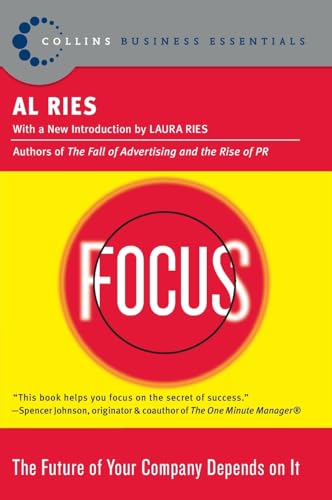
Focus: The Future of Your Company Depends on It – Resist Diversification and Achieve Market Dominance Through Category Ownership (Collins Business Essentials) - Softcover
Inhaltsangabe
What's the secret to a company's continued growth and prosperity? Internationally known marketing expert Al Ries has the answer: focus. His commonsense approach to business management is founded on the premise that long-lasting success depends on focusing on core products and eschewing the temptation to diversify into unrelated enterprises.
Using real-world examples, Ries shows that in industry after industry, it is the companies that resist diversification, and focus instead on owning a category in consumers' minds, that dominate their markets. He offers solid guidance on how to get focused and how to stay focused, laying out a workable blueprint for any company's evolution that will increase market share and shareholder value while ensuring future success.
Die Inhaltsangabe kann sich auf eine andere Ausgabe dieses Titels beziehen.
Über die Autorin bzw. den Autor
Al Ries and his daughter and business partner Laura Ries are two of the world's best-known marketing consultants, and their firm, Ries & Ries, works with many Fortune 500 companies. They are the authors of The 22 Immutable Laws of Branding and The Fall of Advertising and the Rise of PR, which was a Wall Street Journal and a BusinessWeek bestseller, and, most recently, The Origin of Brands. Al was recently named one of the Top 10 Business Gurus by the Marketing Executives Networking Group. Laura is a frequent television commentator and has appeared on the Fox News and Fox Business Channels, CNN, CNBC, PBS, ABC, CBS, and others. Their Web site (Ries.com) has some simple tests that will help you determine whether you are a left brainer or a right brainer.
Von der hinteren Coverseite
What's the secret to a company's continued growth and prosperity? Internationally known marketing expert Al Ries has the answer: focus. His commonsense approach to business management is founded on the premise that long-lasting success depends on focusing on core products and eschewing the temptation to diversify into unrelated enterprises.
Using real-world examples, Ries shows that in industry after industry, it is the companies that resist diversification, and focus instead on owning a category in consumers' minds, that dominate their markets. He offers solid guidance on how to get focused and how to stay focused, laying out a workable blueprint for any company's evolution that will increase market share and shareholder value while ensuring future success.
Auszug. © Genehmigter Nachdruck. Alle Rechte vorbehalten.
Focus
The Future of Your Company Depends on ItBy Al RiesHarperCollins Publishers, Inc.
Copyright © 2005 Al RiesAll right reserved.
ISBN: 0060799900
Chapter One
The Unfocusing of Corporate America
What's the driving force in Corporate America? In a word, growth.
Management demands substantial increases in annual sales and profits, even when companies are in markets that show no overall growth.
Predictably, in order to meet these targets, companies offer more varieties and flavors. Or they branch out into other markets. Or they acquire other firms or products. Or they set up joint ventures.
Whether you call this expansion process "line extension" or "diversification" or "synergy," it's the process itself, the urge to grow, that causes companies to become unfocused.
That's why a company like IBM can have $63 billion in revenues and still lose $8 billion. And General Motors can have $133 billion in revenues and still lose $23 billion.
While growth might be an admirable result of other initiatives, the pursuit of growth for its own sake is a serious strategic error. It's the major reason why so many American corporations have become unfocused.
Chief executive officers have been paying the price for their strategic mistakes. There's no question that many CEOs have made strategic errors that have unfocused their companies. Never in history have so many chief executives been handed their hat and told to go home by their own boards of directors.
To name a few: James Robinson at American Express, John Sculley at Apple, Anthony D'Amato and Ervin Shames at Borden, Barry Gibbons at Burger King, Rod Canion at Compaq, Ken Olsen at Digital Equipment, Kay Whitmore at Eastman Kodak, Robert Stempel at General Motors, Tom Barrett at Goodyear, John Akers at IBM, Joseph Antonini at Kmart, William Agee at Morrison Knudsen, and Paul Lego at Westinghouse.
It's not just the pursuit of growth that causes unfocusing problems. Unfocusing itself seems to be a natural phenomenon that occurs without any conscious effort on a company's part.
A successful company usually starts out highly focused on an individual product, service, or market. Over time, the company becomes unfocused. It offers too many products and services for too many markets at too many different price levels. It loses its sense of direction. It doesn't know where it's going or why. Its mission statement loses its meaning.
You've probably worked for a company like that. Most people have. At first, everything seems to be going well. The initial product or service turns out to be a big winner. The company has momentum and great expectations. The stock is taking off like a rocket.
But success creates something else: the opportunity to branch out in many different directions. The halls are filled with anticipation and excitement. Most often heard comment in the corridors: "We're going to rule the world."
Such a scenario could describe General Motors in the sixties. Sears in the seventies. IBM in the eighties. And Microsoft in the nineties.
It never happens. After a while things start to go wrong. What seemed like a world of opportunity turns into a world of problems. Objectives unmet. Sales flattening. Profits declining. The press unflattering.
"I sometimes wonder if the people at the top of most big U.S. corporations are afflicted with attention deficit disorder," says consultant Barry Spiker. "They don't stay focused." This is what happened at General Motors, Sears, and IBM. But the jury is still out on Microsoft. If history repeats itself, as it generally does, Microsoft is the next IBM, the next company to become unfocused.
In the physical world, unfocusing is called entropy, or disorder. And Rudolf Clausius's law of entropy states that over time, the entropy of any closed system increases. Let's say you straighten out your clothes closet. A month later, the closet is a mess. You have witnessed the effects of entropy, one of the fundamental laws of nature.
Corporations are no different from clothes closets. Over time, every company tends to become unfocused.
Also garages. Let's say you take a Saturday afternoon in April to straighten out your garage. It's hard work, but at the end of the day you're pleased with yourself because everything looks great. You have a place for everything and everything's in its place. You make yourself a promise: From now on you're going to put everything back where it belongs and keep the garage exactly as it is this particular Saturday in April.
A year later, you're back to square one. Everything is a mess again. Corporations are no different from garages.
Or glove compartments. Empty the glove compartment of your car and see what you find. Probably a lot of things you never knew were there. Maps, pens, sunglasses, gas receipts, portable telephone, chewing gum, change, Kleenex, vehicle registration certificate, insurance cards for the last three years, owner's manual. Everything except a pair of gloves. Corporations are no different from glove compartments.
Open the top drawer of your desk. Is it focused or unfocused? Enough said.
Like human nature itself, the destiny of corporations is to become unfocused. Peter Drucker paints a bleak picture of the typical corporation: "Analysis of the entire business and its basic economics always shows it to be in worse disrepair than anyone expected. The products everyone boasts of turn out to be yesterday's breadwinners or investments in managerial ego. Activities to which no one paid much attention turn out to be major costs centers and so expensiveas to endanger the competitive position of the company. What everyone in the business believes to be quality turns out to have little meaning to the customer."
Does that sound like the company you are working for? Peter Drucker recommends focusing "scarce resources on the greatest opportunities." Or you might consider a strong dose of Ritalin for top management.
There are two reasons for this unfocusing. One has been widely discredited; the other is still alive, but showing signs of wear and tear.
The discredited reason is "diversification." Remember how wildly popular the management strategy of diversification once was? Literally every major corporation in America went out of its way to proclaim its belief in the philosophy of not putting all your eggs in one basket.
Continues...
Excerpted from Focusby Al Ries Copyright © 2005 by Al Ries. Excerpted by permission.
All rights reserved. No part of this excerpt may be reproduced or reprinted without permission in writing from the publisher.
Excerpts are provided by Dial-A-Book Inc. solely for the personal use of visitors to this web site.
„Über diesen Titel“ kann sich auf eine andere Ausgabe dieses Titels beziehen.
Suchergebnisse für Focus: The Future of Your Company Depends on It –...

Beispielbild für diese ISBN
Focus
Verlag:
HarperCollins Publishers Inc, 2005
ISBN 10: 0060799900
ISBN 13: 9780060799908
Gebraucht
Paperback
Anbieter: World of Books (was SecondSale), Montgomery, IL, USA
Verkäuferbewertung 5 von 5 Sternen

Paperback. Zustand: Good. What's the secret to a company's continued growth and prosperity? Internationally known marketing expert Al Ries has the answer: focus. His commonsense approach to business management is founded on the premise that long-lasting success depends on focusing on core products and eschewing the temptation to diversify into unrelated enterprises. Using real-world examples, Ries shows that in industry after industry, it is the companies that resist diversification, and focus instead on owning a category in consumers' minds, that dominate their markets. He offers solid guidance on how to get focused and how to stay focused, laying out a workable blueprint for any company's evolution that will increase market share and shareholder value while ensuring future success. Artikel-Nr. 00091891685
Gebraucht kaufen
EUR 4,29
Versand gratis
Versand innerhalb von USA
Versand innerhalb von USA
Anzahl: 6 verfügbar
Beispielbild für diese ISBN
Focus
Verlag:
HarperCollins Publishers Inc, 2005
ISBN 10: 0060799900
ISBN 13: 9780060799908
Gebraucht
Paperback
Anbieter: World of Books (was SecondSale), Montgomery, IL, USA
Verkäuferbewertung 5 von 5 Sternen
Paperback. Zustand: Fair. What's the secret to a company's continued growth and prosperity? Internationally known marketing expert Al Ries has the answer: focus. His commonsense approach to business management is founded on the premise that long-lasting success depends on focusing on core products and eschewing the temptation to diversify into unrelated enterprises. Using real-world examples, Ries shows that in industry after industry, it is the companies that resist diversification, and focus instead on owning a category in consumers' minds, that dominate their markets. He offers solid guidance on how to get focused and how to stay focused, laying out a workable blueprint for any company's evolution that will increase market share and shareholder value while ensuring future success. Artikel-Nr. 00105794134
Gebraucht kaufen
EUR 4,29
Versand gratis
Versand innerhalb von USA
Versand innerhalb von USA
Anzahl: 1 verfügbar
Beispielbild für diese ISBN
Focus
Verlag:
HarperCollins Publishers Inc, 2005
ISBN 10: 0060799900
ISBN 13: 9780060799908
Gebraucht
Paperback
Anbieter: World of Books (was SecondSale), Montgomery, IL, USA
Verkäuferbewertung 5 von 5 Sternen
Paperback. Zustand: Very Good. What's the secret to a company's continued growth and prosperity? Internationally known marketing expert Al Ries has the answer: focus. His commonsense approach to business management is founded on the premise that long-lasting success depends on focusing on core products and eschewing the temptation to diversify into unrelated enterprises. Using real-world examples, Ries shows that in industry after industry, it is the companies that resist diversification, and focus instead on owning a category in consumers' minds, that dominate their markets. He offers solid guidance on how to get focused and how to stay focused, laying out a workable blueprint for any company's evolution that will increase market share and shareholder value while ensuring future success. Artikel-Nr. 00106041831
Gebraucht kaufen
EUR 4,29
Versand gratis
Versand innerhalb von USA
Versand innerhalb von USA
Anzahl: 3 verfügbar
Foto des Verkäufers
Focus: The Future of Your Company Depends on It
Anbieter: Dream Books Co., Denver, CO, USA
Verkäuferbewertung 5 von 5 Sternen
Zustand: acceptable. This copy has clearly been enjoyedâ"expect noticeable shelf wear and some minor creases to the cover. Binding is strong, and all pages are legible. May contain previous library markings or stamps. Artikel-Nr. 4EKTGN003JXL_ns
Gebraucht kaufen
EUR 5,05
Versand gratis
Versand innerhalb von USA
Versand innerhalb von USA
Anzahl: 2 verfügbar
Beispielbild für diese ISBN
Focus : The Future of Your Company Depends on It
Verlag:
HarperCollins Publishers, 2005
ISBN 10: 0060799900
ISBN 13: 9780060799908
Gebraucht
Softcover
Anbieter: Better World Books, Mishawaka, IN, USA
Verkäuferbewertung 5 von 5 Sternen
Zustand: Fine. Used book that is in almost brand-new condition. May contain a remainder mark. Better World Books: Buy Books. Do Good. Artikel-Nr. 67518538-6
Gebraucht kaufen
EUR 6,16
Versand gratis
Versand innerhalb von USA
Versand innerhalb von USA
Anzahl: 1 verfügbar
Beispielbild für diese ISBN
Focus : The Future of Your Company Depends on It
Verlag:
HarperCollins Publishers, 2005
ISBN 10: 0060799900
ISBN 13: 9780060799908
Gebraucht
Softcover
Anbieter: Better World Books, Mishawaka, IN, USA
Verkäuferbewertung 5 von 5 Sternen
Zustand: Good. Pages intact with minimal writing/highlighting. The binding may be loose and creased. Dust jackets/supplements are not included. Stock photo provided. Product includes identifying sticker. Better World Books: Buy Books. Do Good. Artikel-Nr. 7643578-6
Gebraucht kaufen
EUR 6,16
Versand gratis
Versand innerhalb von USA
Versand innerhalb von USA
Anzahl: 1 verfügbar
Beispielbild für diese ISBN
Focus
Verlag:
Harperbusiness Essentials, 2005
ISBN 10: 0060799900
ISBN 13: 9780060799908
Gebraucht
Paperback
Anbieter: ThriftBooks-Atlanta, AUSTELL, GA, USA
Verkäuferbewertung 5 von 5 Sternen
Paperback. Zustand: Good. No Jacket. Pages can have notes/highlighting. Spine may show signs of wear. ~ ThriftBooks: Read More, Spend Less. Artikel-Nr. G0060799900I3N00
Gebraucht kaufen
EUR 6,22
Versand gratis
Versand innerhalb von USA
Versand innerhalb von USA
Anzahl: 1 verfügbar
Beispielbild für diese ISBN
Focus: The Future of Your Company Depends on It
Anbieter: Wonder Book, Frederick, MD, USA
Verkäuferbewertung 5 von 5 Sternen
Zustand: Good. Good condition. A copy that has been read but remains intact. May contain markings such as bookplates, stamps, limited notes and highlighting, or a few light stains. Artikel-Nr. E07B-04409
Gebraucht kaufen
EUR 6,40
Versand gratis
Versand innerhalb von USA
Versand innerhalb von USA
Anzahl: 2 verfügbar
Foto des Verkäufers
Focus: The Future of Your Company Depends on It (Collins Business Essentials)
Anbieter: WeBuyBooks, Rossendale, LANCS, Vereinigtes Königreich
Verkäuferbewertung 5 von 5 Sternen
paperback. Zustand: Good. Most items will be dispatched the same or the next working day. A copy that has been read but remains in clean condition. All of the pages are intact and the cover is intact and the spine may show signs of wear. The book may have minor markings which are not specifically mentioned. Artikel-Nr. rev9508266666
Gebraucht kaufen
EUR 5,21
EUR 5,54 Versand
Versand von Vereinigtes Königreich nach USA
Versand von Vereinigtes Königreich nach USA
Anzahl: 2 verfügbar
Beispielbild für diese ISBN
Focus: The Future of Your Company Depends on It (Collins Business Essentials)
Anbieter: WorldofBooks, Goring-By-Sea, WS, Vereinigtes Königreich
Verkäuferbewertung 5 von 5 Sternen
Paperback. Zustand: Very Good. The book has been read, but is in excellent condition. Pages are intact and not marred by notes or highlighting. The spine remains undamaged. Artikel-Nr. GOR001961006
Gebraucht kaufen
EUR 6,38
EUR 6,59 Versand
Versand von Vereinigtes Königreich nach USA
Versand von Vereinigtes Königreich nach USA
Anzahl: 1 verfügbar