
Verwandte Artikel zu U2 by U2: Bono, the Edge, Adam Clayton, Larry Mullen...
Inhaltsangabe
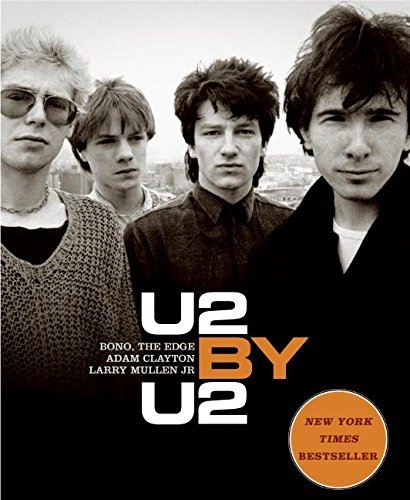
In 1975, four teenagers from Mount Temple School in Dublin gathered in a crowded kitchen to discuss forming a band. More than thirty years later, Bono, The Edge, Adam Clayton, and Larry Mullen Jr. are still together, bound by intense loyalty, passionate idealism, and a relentless belief in the power of rock and roll to change the world. In an epic journey that has taken the band from the clubs of Dublin to the stadiums of the world, U2 has sold more than 130 million albums, revolutionized live performance, spearheaded political campaigns, and made music that defines the age in which we live.
Told with wit, insight, and astonishing candor by the band members themselves and manager Paul McGuinness—with pictures from their own archives—U2 by U2 allows unprecedented access into the inner life of the greatest rock band of our times.
Die Inhaltsangabe kann sich auf eine andere Ausgabe dieses Titels beziehen.
Über die Autorinnen und Autoren
U2 is one of the most successful and innovative groups of the last two decades. The members are Bono, The Edge, Adam Clayton and Larry Mullen Jr. Together, they have sold more than 100 million records around the globe and are consistently featured in the best albums of all time. They are also involved in many charities including Amnesty International, Greenpeace, Drop the Debt, and the Chernobyl Children's Project.
Neil McCormick has been a close personal friend of U2 for many years (he grew up with the band). A staff music writer for The Daily Telegraph, his latest novel was called Killing Bono. He lives in London, England.
Von der hinteren Coverseite
In 1975, four teenagers from Mount Temple School in Dublin gathered in a crowded kitchen to discuss forming a band. More than thirty years later, Bono, The Edge, Adam Clayton, and Larry Mullen Jr. are still together, bound by intense loyalty, passionate idealism, and a relentless belief in the power of rock and roll to change the world. In an epic journey that has taken the band from the clubs of Dublin to the stadiums of the world, U2 has sold more than 130 million albums, revolutionized live performance, spearheaded political campaigns, and made music that defines the age in which we live.
Told with wit, insight, and astonishing candor by the band members themselves and manager Paul McGuinness—with pictures from their own archives—U2 by U2 allows unprecedented access into the inner life of the greatest rock band of our times.
Auszug. © Genehmigter Nachdruck. Alle Rechte vorbehalten.
U2 by U2
By Elizabeth U2HarperCollins Publishers, Inc.
Copyright © 2007 Elizabeth U2All right reserved.
ISBN: 9780060776749
Chapter One
1960-1975
Stories for Boys
Adam Clayton
I was born into a house full of women and full of music: two forces which have pretty much dictated the shape of my subsequent life. It was in my grandparents' house in an Oxfordshire village called Chinnor on 13th March 1960.
My father had a career in aviation and it always seemed he wasn't there very much. Even now that he has retired, he spends a lot of his time fishing, which is a very solitary activity, away from the family.
My grandfather was a PE instructor in the RAE, so he wasn't often around. But my grandmother, her mother, my mother and her two sisters all lived in this house. I was the first child, a boy, fussed over by this group of women.
My grandmother was a piano-player in a dance hand. She was always off gigging at weekends and I was left with my mum and the two sisters. I remember listening to Forces radio and also being aware that my aunts had music they'd play on reel-to-reel tapes. Later there was a record-player and a lot of singles.
My youngest aunt was into Elvis and then The Beatles, when all that kicked off. I remember being aware of black and white Top of the Pops and really being intrigued by the outfits and instruments. I think even then I kind of knew the shape and shine of electric guitars, although strangely enough Ringo was my favourite Beatle.
My dad was an RAE pilot and when he was demobbed he started picking up work as a flying instructor at Biggin Hill, and then gradually he moved into civil aviation. My mum did a little hit of moonlighting as a stewardess and dad was the pilot on the small planes that eventually became BA (British Airways).
When I was four years old, dad found work in Kenya flying for East African Airways. We were based in Nairobi: this was definitely the happiest period I can remember from my early life; the heat and the freedom. My parents would have been living relatively comfortably compared to before, with regular work, a decent-sized house, someone to clean and help, that sort of stuff. Mostly I remember the sunshine and the smells. I have kept a lot of things African with me over the years, and whenever I've been back there it has always seemed very familiar.
Kenya had become an independent country as recently as 1963, throwing off British rule, and the situation there was still volatile. By 1965, it was getting quite dangerous to be a white person there. My dad had job offers in Ireland and Hong Kong but Ireland seemed closer to the family, so we came here, settling in Malahide, a suburban coastal town about eight miles from Dublin. I went to the local National school and that was pretty much where it stopped making sense for me. I arrived into an Ireland that was subtly repressive. The sky was grey and grim and at school there was a lot of instruction in Irish, a language I didn't understand. I found it difficult to fit into that system.
It was there that I met David Evans, The Edge, for the first time, although I have no real memory of it. His parents were part of that same community, which, unusually for Ireland, had a lot of Protestants and British ex-pats. The Evanses were amongst a group of parents who would occasionally call by the house, or we might visit their house and I'd meet Dave and his brother and sister. We didn't really bond until we came to know each other again in the hand.
I have a sister, Sindy, who is four years younger than me, and a brother Sebastian, who is ten years younger. But it is hard for me to remember us as a family much of the time. Dad always seemed to be away working. Because he was doing a lot of the Atlantic runs for Aer Lingus when I was growing up, invariably he would be away three or four days at a time. Then, at the age of eight, I was sent to boarding school, which just disrupted things even more. Sindy was four when I went away and so I would see her only at weekends and holidays and we never developed an intense relationship until we were much older, we were simply not close enough in age to share common experiences. It's funny, but even though there is a bigger gap with my brother, for some reason we clicked, perhaps because by the time I'd finished school he was six or seven so I had the chance to get to know him better.
The boarding school was called Castle Park, in Dalkey, way over on the other side of Dublin Bay. In retrospect, I can understand that my parents were in a foreign country (as they would have seen it and they didn't really know what would be an appropriate way to educate a child. Castle Park was a prep school along the lines of the English system and some of their friends had kids there, and they would have probably seen it leading on to a good English public school, like Eton or Harrow, and then a degree from Oxford or Cambridge. That was the plan, anyway. It didn't quite work out.
I didn't respond to boarding school particularly well. I wasn't sports orientated, I wasn't a hugely social character. I just kept my head down. Even then, I was keen on music, but we weren't allowed to listen to pop or watch television. Sport was the thing! But there was a boy who played classical guitar and he was allowed to have a guitar up in the dorms. Whenever he played I always had an emotional connection. In some way it spirited me away from the confines of school. I consequently joined the Gramophone Society . . .
Continues...
Excerpted from U2 by U2by Elizabeth U2 Copyright © 2007 by Elizabeth U2. Excerpted by permission.
All rights reserved. No part of this excerpt may be reproduced or reprinted without permission in writing from the publisher.
Excerpts are provided by Dial-A-Book Inc. solely for the personal use of visitors to this web site.
„Über diesen Titel“ kann sich auf eine andere Ausgabe dieses Titels beziehen.
Suchergebnisse für U2 by U2: Bono, the Edge, Adam Clayton, Larry Mullen...

Beispielbild für diese ISBN
U2 by U2
Anbieter: World of Books (was SecondSale), Montgomery, IL, USA
Verkäuferbewertung 5 von 5 Sternen

Zustand: Good. Item in good condition. Textbooks may not include supplemental items i.e. CDs, access codes etc. Artikel-Nr. 00070526146
Gebraucht kaufen
EUR 6,48
Versand gratis
Versand innerhalb von USA
Versand innerhalb von USA
Anzahl: 2 verfügbar
Beispielbild für diese ISBN
U2 by U2
Anbieter: ThriftBooks-Dallas, Dallas, TX, USA
Verkäuferbewertung 5 von 5 Sternen
Paperback. Zustand: As New. No Jacket. Pages are clean and are not marred by notes or folds of any kind. ~ ThriftBooks: Read More, Spend Less. Artikel-Nr. G0060776749I2N00
Gebraucht kaufen
EUR 6,73
Versand gratis
Versand innerhalb von USA
Versand innerhalb von USA
Anzahl: 1 verfügbar
Beispielbild für diese ISBN
U2 by U2
Verlag:
Harper Paperbacks (edition Reprint), 2007
ISBN 10: 0060776749
ISBN 13: 9780060776749
Gebraucht
Paperback
Anbieter: BooksRun, Philadelphia, PA, USA
Verkäuferbewertung 5 von 5 Sternen
Paperback. Zustand: Very Good. Reprint. It's a well-cared-for item that has seen limited use. The item may show minor signs of wear. All the text is legible, with all pages included. It may have slight markings and/or highlighting. Artikel-Nr. 0060776749-11-1
Gebraucht kaufen
EUR 7,18
Versand gratis
Versand innerhalb von USA
Versand innerhalb von USA
Anzahl: 1 verfügbar
Beispielbild für diese ISBN
U2 by U2
Verlag:
HarperCollins Publishers, 2007
ISBN 10: 0060776749
ISBN 13: 9780060776749
Gebraucht
Softcover
Anbieter: Better World Books, Mishawaka, IN, USA
Verkäuferbewertung 5 von 5 Sternen
Zustand: Very Good. Reprint. Pages intact with possible writing/highlighting. Binding strong with minor wear. Dust jackets/supplements may not be included. Stock photo provided. Product includes identifying sticker. Better World Books: Buy Books. Do Good. Artikel-Nr. 8229651-20
Gebraucht kaufen
EUR 7,76
Versand gratis
Versand innerhalb von USA
Versand innerhalb von USA
Anzahl: 1 verfügbar
Beispielbild für diese ISBN
U2 by U2
Verlag:
HarperCollins Publishers, 2007
ISBN 10: 0060776749
ISBN 13: 9780060776749
Gebraucht
Softcover
Anbieter: Better World Books, Mishawaka, IN, USA
Verkäuferbewertung 5 von 5 Sternen
Zustand: Good. Reprint. Pages intact with minimal writing/highlighting. The binding may be loose and creased. Dust jackets/supplements are not included. Stock photo provided. Product includes identifying sticker. Better World Books: Buy Books. Do Good. Artikel-Nr. 4655596-6
Gebraucht kaufen
EUR 7,76
Versand gratis
Versand innerhalb von USA
Versand innerhalb von USA
Anzahl: 2 verfügbar
Beispielbild für diese ISBN
U2 by U2: Bono, the Edge, Adam Clayton, Larry Mullen Jr.
Anbieter: WorldofBooks, Goring-By-Sea, WS, Vereinigtes Königreich
Verkäuferbewertung 5 von 5 Sternen
Paperback. Zustand: Very Good. The book has been read, but is in excellent condition. Pages are intact and not marred by notes or highlighting. The spine remains undamaged. Artikel-Nr. GOR004177128
Gebraucht kaufen
EUR 8,42
EUR 6,67 Versand
Versand von Vereinigtes Königreich nach USA
Versand von Vereinigtes Königreich nach USA
Anzahl: 1 verfügbar