Inhaltsangabe
The sixth book in David Feldman’s bestselling Imponderables® series, packed with even more answers to perplexing questions and solutions to everyday mysteries
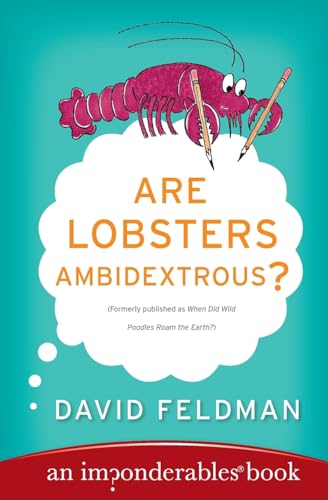
Culled from the thousands of letters submitted by desperate fans, the questions in Are Lobsters Ambidextrous? would have overwhelmed a lesser authority than David Feldman.
- Has anyone ever seen a live Cornish game hen?
- When a body is laid out in a funeral home, why is the head always on the left side from the viewer’s vantage point?
- Why is there no Betty Rubble in Flintstones vitamins?
- What are the little numbers on the bottom right of cancelled checks?
- Why do quarterbacks always say “Hut”?
- Why do dogs eat standing up while cats often eat sitting down?
- What does the “Q” in “Q-tips” stand for?
- What do they do with the caffeine left over from making decaffeinated coffee?
- And more!
With 141 irresistible entries, charming illustrations by longtime Imponderables® collaborator Kassie Schwan, and almost 100,000 copies sold in combined editions, Are Lobsters Ambidextrous? is an Imponderables® classic.
Die Inhaltsangabe kann sich auf eine andere Ausgabe dieses Titels beziehen.
Über die Autorin bzw. den Autor
David Feldman is the author of ten previous volumes of Imponderables(R). He has a master's degree in popular culture from Bowling Green State University in Ohio and consults and lectures on the media. He lives in New York City.
Von der hinteren Coverseite
Ponder, if you will ...
Has anyone ever seen a live Cornish game hen?
Why do quarterbacks say "Hut"?
Why do "sea" gulls congregate in parking
lots of shopping centers?
What does the "Q" in Q-Tips stand for?
Pop culture guru David Feldman demystifies these questions and much more in Are Lobsters Ambidextrous? Part of the Imponderables® series—the unchallenged source of answers to civilization's everyday mysteries—and charmingly illustrated by Kassie Schwan, this book provides you with information that encyclopedias, dictionaries, and almanacs just don't have. And think about it, where else are you going to find out what happens to the caffeine left over from making decaffeinated coffee?
Auszug. © Genehmigter Nachdruck. Alle Rechte vorbehalten.
Are Lobsters Ambidextrous?
An Imponderables BookBy David FeldmanHarperCollins Publishers, Inc.
Copyright © 2005 David FeldmanAll right reserved.
ISBN: 0060762950
Chapter One
Are lobsters ambidextrous?
Have you ever noticed, while digging into a lobster, that one claw is significantly larger than the other, as if one claw was pumping iron and taking steroids, while the other claw was used only for riffling the pages of library books? The large claw is called the "crusher" and the smaller one the "cutter" (terms that sound like the members of a new tag team in the World Wrestling Federation). The crusher has broader and bigger teeth but moves relatively slowly. The cutter has tiny, serrated teeth and moves swiftly.
The two claws do not start out distinctly different. Lobsters shed their shells more often than Cher has plastic surgery -- they undergo three molts in the larval stage alone. When lobsters are first hatched, the two claws look identical, but with each successive stage in their development, the differences become more pronounced. It isn't until their fifth molt, and second postlarval molt, that the two claws are truly differentiated.
As you may have guessed, the crusher claw is important for the defense of lobsters against predators, and the cutter particularly useful in eating. Claws of lobsters are often torn off in accidents and in fights. Although there are some differences among species of lobsters, most lobsters will regenerate severed claws.
Most bizarre of all, if the remaining claw of an injured lobster is a cutter, many species with "plastic dimorphism" will change the function of that claw from cutter to crusher, presumably because the crusher is more essential for survival. The next regenerated claw of that lobster is capable itself of shifting to the cutter function, so that the positions of the two claws are reversed.
According to Darryl Felder, chairman of the University of Louisiana, Lafayette, biology department, lobsters are not always right- or left-"handed." The crusher may be on the right or left side of a lobster.
The ultimate answer to this Imponderable depends upon how you define ambidextrous. Certainly, lobsters can use either cheliped (the scientific name for claw) with equal ease. Although their regenerative powers give lobsters a certain flexibility, the versatility of each claw is not as great as that of a switch hitter in baseball, who can swing the bat equally well from both sides, or the pickpocket who can pilfer skillfully with either hand.
Submitted by Danny Kotok of New York, New York.
Why is there no Betty Rubble character in Flmtstones Multivitamins?
For reasons too unfathomable for even us to delve into, we are thrown this question periodically on radio phone-in shows but have never received it in a letter. Perhaps no one wants to take credit for asking this Imponderable. One radio host said that he had investigated the matter, and found that for technical reasons, it was difficult to manufacture a realistic Betty facsimile.
Ah, we wish that were true, but the real story is far sadder, far darker. We heard from William D. Turpin, director of consumer relations for Multivitamins' manufacturer, Miles, Inc.:
The current group of Flintstones characters was selected based upon research of the popularity of each character with children. As a result of this research, it was determined that Betty Rubble is not as popular with the majority of the children as the other characters.
Thus, if you investigate the contents of a Flintstones Multivitamins jar carefully, you'll find seven different "characters." As expected, Wilma, Fred, and a lonely Barney are included. Bamm-Bamm, Pebbles, and Dino are there, too, to help round out the nuclear family. But the Flintmobile? Is a car really more popular with children than a fine specimen of womanhood? You'd better believe it.
Truth be told, Betty was never our favorite character either. In fact, we don't think she deserved a great catch like Barney. Nevertheless, her lack of charisma is hardly reason enough to break up the family units that helped make the Flintstones a television and multivitamin supplement institution.
What in the heck is a tumbleweed? Why does it tumble? And how can it reproduce if it doesn't stay in one place?
Three Imponderables for the price of one. The first part is easy. The most common form of tumbleweed, the one you see wreaking havoc in movie westerns, is the Russian thistle. But actually the term is applied to any plant that rolls with the wind, drops its seed as it tumbles, and possesses panicles (branched flower clusters) that break off.
Usually, the stems of tumbleweed dry up and snap away from their roots in late fall, when the seeds are ripe and the leaves dying. Although tumbleweeds cannot walk or fly on their own, they are configured to move with the wind. The aboveground portion of the thistle is shaped like a flattened globe, so it can roll more easily than other plants.
In his March 1991 Scientific American article "Tumbleweed," James Young points out how tumbleweed has adapted to the arid conditions of the Great Plains. One Russian thistle plant can contain a quarter of a million seeds. Even these impressive amounts of seeds will not reproduce efficiently if dumped all at once. But the flowers, which bloom in the summer, are wedged in the axil between the leaves and the stem, so that their seeds don't fall out as soon as they are subjected to their first tumbles. In effect, the seeds are dispersed sparingly by the natural equivalent of time-release capsules, assuring wide dissemination.
Young points out that tumbleweed actually thrives on solitude. If tumbleweed bumps into another plant, or thick, tall grass, it becomes lodged there, and birds and small animals find and eat the seeds:
Hence, successful germination, establishment of seedlings, and flowering depend on dispersal to sites where competition is minimal: Russian thistle would rather tumble than fight.
Although songs have romanticized the tumbleweed, do not forget that the last word in "tumbleweed" is "weed." In fact, if the Russian thistle had been discovered in our . . .
Submitted by Plácido García of Albuquerque, New Mexico.
Continues...
Excerpted from Are Lobsters Ambidextrous?by David Feldman Copyright © 2005 by David Feldman. Excerpted by permission.
All rights reserved. No part of this excerpt may be reproduced or reprinted without permission in writing from the publisher.
Excerpts are provided by Dial-A-Book Inc. solely for the personal use of visitors to this web site.
„Über diesen Titel“ kann sich auf eine andere Ausgabe dieses Titels beziehen.
Suchergebnisse für Are Lobsters Ambidextrous?: An Imponderables Book:...

Beispielbild für diese ISBN
Are Lobsters Ambidextrous?: An Imponderables Book (Imponderables Series, 6)
Anbieter: Wonder Book, Frederick, MD, USA
Verkäuferbewertung 5 von 5 Sternen

Zustand: Very Good. Very Good condition. With remainder mark. A copy that may have a few cosmetic defects. May also contain light spine creasing or a few markings such as an owner's name, short gifter's inscription or light stamp. Bundled media such as CDs, DVDs, floppy disks or access codes may not be included. Artikel-Nr. P03C-01448
Gebraucht kaufen
EUR 5,27
Versand gratis
Versand innerhalb von USA
Versand innerhalb von USA
Anzahl: 1 verfügbar
Beispielbild für diese ISBN
Are Lobsters Ambidextrous?: An Imponderables Book (Imponderables Series, 6)
Anbieter: Wonder Book, Frederick, MD, USA
Verkäuferbewertung 5 von 5 Sternen
Zustand: Very Good. Very Good condition. A copy that may have a few cosmetic defects. May also contain light spine creasing or a few markings such as an owner's name, short gifter's inscription or light stamp. Artikel-Nr. B18A-03356
Gebraucht kaufen
EUR 5,27
Versand gratis
Versand innerhalb von USA
Versand innerhalb von USA
Anzahl: 1 verfügbar
Beispielbild für diese ISBN
Are Lobsters Ambidextrous? : An Imponderables Book
Verlag:
HarperCollins Publishers, 2005
ISBN 10: 0060762950
ISBN 13: 9780060762957
Gebraucht
Softcover
Anbieter: Better World Books: West, Reno, NV, USA
Verkäuferbewertung 5 von 5 Sternen
Zustand: Very Good. Reissue. Used book that is in excellent condition. May show signs of wear or have minor defects. Artikel-Nr. GRP73130939
Gebraucht kaufen
EUR 6,06
Versand gratis
Versand innerhalb von USA
Versand innerhalb von USA
Anzahl: 1 verfügbar
Beispielbild für diese ISBN
Are Lobsters Ambidextrous? : An Imponderables Book
Verlag:
HarperCollins Publishers, 2005
ISBN 10: 0060762950
ISBN 13: 9780060762957
Gebraucht
Softcover
Anbieter: Better World Books, Mishawaka, IN, USA
Verkäuferbewertung 5 von 5 Sternen
Zustand: Good. Reissue. Used book that is in clean, average condition without any missing pages. Artikel-Nr. 225098-6
Gebraucht kaufen
EUR 6,06
Versand gratis
Versand innerhalb von USA
Versand innerhalb von USA
Anzahl: 1 verfügbar
Beispielbild für diese ISBN
Are Lobsters Ambidextrous?: An Imponderables Book
Anbieter: ThriftBooks-Atlanta, AUSTELL, GA, USA
Verkäuferbewertung 5 von 5 Sternen
Paperback. Zustand: Very Good. No Jacket. May have limited writing in cover pages. Pages are unmarked. ~ ThriftBooks: Read More, Spend Less. Artikel-Nr. G0060762950I4N00
Gebraucht kaufen
EUR 6,76
Versand gratis
Versand innerhalb von USA
Versand innerhalb von USA
Anzahl: 1 verfügbar
Beispielbild für diese ISBN
Are Lobsters Ambidextrous?: An Imponderables Book
Anbieter: ThriftBooks-Atlanta, AUSTELL, GA, USA
Verkäuferbewertung 5 von 5 Sternen
Paperback. Zustand: Very Good. No Jacket. Former library book; May have limited writing in cover pages. Pages are unmarked. ~ ThriftBooks: Read More, Spend Less. Artikel-Nr. G0060762950I4N10
Gebraucht kaufen
EUR 6,76
Versand gratis
Versand innerhalb von USA
Versand innerhalb von USA
Anzahl: 1 verfügbar
Beispielbild für diese ISBN
Are Lobsters Ambidextrous?: An Imponderables Book (Imponderables Books (Paperback))
Verlag:
William Morrow & Company, 2005
ISBN 10: 0060762950
ISBN 13: 9780060762957
Gebraucht
Paperback
Anbieter: AwesomeBooks, Wallingford, Vereinigtes Königreich
Verkäuferbewertung 5 von 5 Sternen
Paperback. Zustand: Very Good. Are Lobsters Ambidextrous?: An Imponderables Book (Imponderables Books (Paperback)) This book is in very good condition and will be shipped within 24 hours of ordering. The cover may have some limited signs of wear but the pages are clean, intact and the spine remains undamaged. This book has clearly been well maintained and looked after thus far. Money back guarantee if you are not satisfied. See all our books here, order more than 1 book and get discounted shipping. . Artikel-Nr. 7719-9780060762957
Gebraucht kaufen
EUR 14,98
EUR 5,71 shipping
Versand von Vereinigtes Königreich nach USA
Versand von Vereinigtes Königreich nach USA
Anzahl: 1 verfügbar
Beispielbild für diese ISBN
Are Lobsters Ambidextrous?: An Imponderables Book (Imponderables Books (Paperback))
Verlag:
William Morrow & Company 01/08/2005, 2005
ISBN 10: 0060762950
ISBN 13: 9780060762957
Gebraucht
Paperback
Anbieter: Bahamut Media, Reading, Vereinigtes Königreich
Verkäuferbewertung 5 von 5 Sternen
Paperback. Zustand: Very Good. Shipped within 24 hours from our UK warehouse. Clean, undamaged book with no damage to pages and minimal wear to the cover. Spine still tight, in very good condition. Remember if you are not happy, you are covered by our 100% money back guarantee. Artikel-Nr. 6545-9780060762957
Gebraucht kaufen
EUR 14,98
EUR 7,99 shipping
Versand von Vereinigtes Königreich nach USA
Versand von Vereinigtes Königreich nach USA
Anzahl: 1 verfügbar
Beispielbild für diese ISBN
Are Lobsters Ambidextrous?: An Imponderables Book
Anbieter: Revaluation Books, Exeter, Vereinigtes Königreich
Verkäuferbewertung 5 von 5 Sternen
Paperback. Zustand: Brand New. reissue edition. 295 pages. 7.75x5.25x1.00 inches. In Stock. Artikel-Nr. x-0060762950
Neu kaufen
EUR 18,83
EUR 11,44 shipping
Versand von Vereinigtes Königreich nach USA
Versand von Vereinigtes Königreich nach USA
Anzahl: 2 verfügbar
Beispielbild für diese ISBN
Are Lobsters Ambidextrous?: An Imponderables Book: 6
Anbieter: HR1 Books, Hereford, Vereinigtes Königreich
Verkäuferbewertung 5 von 5 Sternen
paperback. Zustand: Very Good. Same / next day dispatch (Monday - Friday), Artikel-Nr. mon0000132092
Gebraucht kaufen
EUR 13,27
EUR 17,73 shipping
Versand von Vereinigtes Königreich nach USA
Versand von Vereinigtes Königreich nach USA
Anzahl: 1 verfügbar