
Verwandte Artikel zu Setting the Table: The Transforming Power of Hospitality...
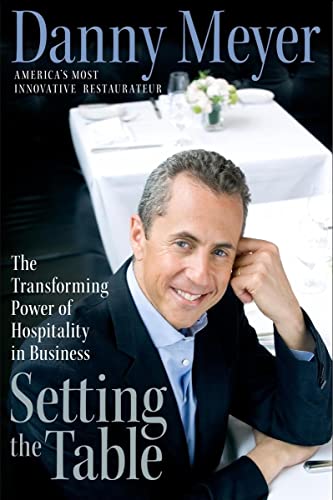
Inhaltsangabe
The bestselling business book from award-winning restauranteur Danny Meyer, of Union Square Cafe, Gramercy Tavern, and Shake Shack
Seventy-five percent of all new restaurant ventures fail, and of those that do stick around, only a few become icons. Danny Meyer started Union Square Cafe when he was 27, with a good idea and hopeful investors. He is now the co-owner of a restaurant empire. How did he do it? How did he beat the odds in one of the toughest trades around? In this landmark book, Danny shares the lessons he learned developing the dynamic philosophy he calls Enlightened Hospitality. The tenets of that philosophy, which emphasize strong in-house relationships as well as customer satisfaction, are applicable to anyone who works in any business. Whether you are a manager, an executive, or a waiter, Danny’s story and philosophy will help you become more effective and productive, while deepening your understanding and appreciation of a job well done.
Setting the Table is landmark a motivational work from one of our era’s most gifted and insightful business leaders.
Die Inhaltsangabe kann sich auf eine andere Ausgabe dieses Titels beziehen.
Über die Autorin bzw. den Autor
Danny Meyer is the founder of Union Square Hospitality Group, which has created some of New York’s most beloved restaurants, including Union Square Cafe, Gramercy Tavern, Eleven Madison Park, Tabla, The Modern, Blue Smoke, Maialino, Ci Siamo, Daily Provisions and more. He is also the founder of Shake Shack, co-founder of Enlightened Hospitality Investments, and is a sought-after speaker and educator, setting industry standards for innovative hiring practices, building culture, corporate responsibility, and leading change.
Von der hinteren Coverseite
In October 1985, at age twenty-seven, Danny Meyer, with a good idea and scant experience, opened what would become one of New York City's most revered restaurants—Union Square Cafe. Little more than twenty years later, Danny is the CEO of one of the world's most dynamic restaurant organizations, which includes eleven unique dining establishments, each at the top of its game. How has he done it? How has he consistently beaten the odds and set the competitive bar in one of the toughest trades around?
In this landmark book, Danny shares the lessons he's learned while developing the winning recipe for doing the business he calls "enlightened hospitality." This innovative philosophy emphasizes putting the power of hospitality to work in a new and counterintuitive way: The first and most important application of hospitality is to the people who work for you, and then, in descending order of priority, to the guests, the community, the suppliers, and the investors. This way of prioritizing stands the more traditional business models on their heads, but Danny considers it the foundation of every success that he and his restaurants have achieved.
Some of Danny's other insights:
Hospitality is present when something happens for you. It is absent when something happens to you. These two simple concepts—for and to—express it all.
Context, context, context, trumps the outdated location, location, location.
Shared ownership develops when guests talk about a restaurant as if it's theirs. That sense of affiliation builds trust and invariably leads to repeat business.
Err on the side of generosity: You get more by first giving more.
Wherever your center lies, know it, name it, believe in it. When you cede your core values to someone else, it's time to quit.
Full of behind-the-scenes history on the creation of Danny's most famous restaurants and the anecdotes, advice, and lessons he has accumulated on his long and ecstatic journey to the top of the American restaurant scene, Setting the Table is a treasure trove of innovative insights that are applicable to any business or organization.
Auszug. © Genehmigter Nachdruck. Alle Rechte vorbehalten.
Setting the Table
The Transforming Power of Hospitality in BusinessBy Danny MeyerHarperCollins Publishers, Inc.
Copyright © 2006 Danny MeyerAll right reserved.
ISBN: 0060742755
Chapter One
The First Course
I've learned more of what I know about life from people than from books, and I've learned much of what I know about people from the food they eat. I'm on the road a number of days each year, solo, or with my family, buddies, or colleagues—and when I travel, the first thing I do in my first free moments in a town is visit its food markets, pastry shops, butchers, and grocery stores. I read menus posted outside restaurants. I watch the residents argue back and forth with the merchants over the virtues of their wares. When I meet people who look like locals, I ask them where they'd eat if they had only one or two days in town, as I do. Cultures that care deeply about food often care about life, history, and tradition. I'm constantly on the lookout for local idiosyncrasies, ways of eating that exist nowhere else. And I'm always energized by a hunt for the best version of any local specialty.
In towns throughout Italy's Piedmont I've tasted a meringue-hazelnut cookie called brutti ma buoni ("ugly but good"). In Siena I've searched for the supreme panforte, a sweet cake. In New York's Chinatown I walk into butcher shops—not necessarily to buy, but to observe how people select their cuts of meat and and sausage. In Maine, of course, I cherish tiny wild blueberries. In northern Wisconsin I'm unable to resist perch, bass, pike, and Native American fry bread. In Miami, I look for Cuban counter restaurants. In Texas, there isn't time enough to visit all the Mexican taquerias for breakfast. And the barbecue—within a thirty-five-mile radius of Austin in the Texas Hill Country lie five towns I revere, each with a distinctly different style of barbecue. The elements of barbecue are limited—ribs, brisket, pulled pork, chopped pork, minced pork, sausage, chicken, cole slaw, beans, and a handful of side dishes—but it has become an American culinary language with thousands of dialects and accents. I try to understand each variation. During one thirty-six-hour road trip through North Carolina, I tasted fourteen variations on chopped pork, each defined by subtle and dramatic differences in texture, the degree and type of smoke used, the amount of tomato or vinegar in the sauce, how much heat was applied to the meat, as well as how much or how little crackling got chopped up and tossed in. And that's in addition to checking out the many styles of fried chicken, Brunswick stew, and hush puppies on offer.
From as far back as I can remember, I've been eating with my eyes, nose, and mouth. When I was four I fell in love with stone crab at the Lagoon restaurant in Miami Beach. I couldn't stop eating it (and apparently I couldn't stop talking to anyone who would listen about the "cwacked cwab"). Over the next years I remember savoring variations of key lime pie in Key West; eating my first roadside cheeseburger somewhere in the hills outside Santa Barbara; trying Dungeness crab and saline abalone at San Francisco's Fisherman's Wharf; and having a lobster roll in Ogunquit, Maine. I devoured my first custardy quiche lorraine as a seven-year-old when my parents took us to the city of Nancy in France. I tasted bottled water (Evian and Vittel) for the first time in the town of Talloires, and I can also remember exactly how the water of Lake Annecy tasted as I swam in it. I discovered fraises des bois (wild strawberries) and crème fraîche at La Colombe d'Or in Saint-Paul de Vence; I tasted a baguette with saucisson and pungent moutarde in Paris's Jardin des Tuilieries. My writing improved because my mother insisted that I keep a diary of our trip. At the time, I hated doing this. But the diary turned out to be one of the greatest gifts she ever gave me. I wasn't writing about the museums and churches we'd seen. Instead I chose to write about food.
Back in my hometown, St. Louis, I was no less curious about what people ate. When I brought my lunch from home to elementary school, I swapped and shared sandwiches, not because the other kids' lunches were better, but because this was the best way I knew of to learn about another family. I had never heard of Miracle Whip until I traded my braunschweiger on rye with another kid for his baloney sandwich (one slice of Oscar Mayer and Miracle Whip on Tastee white bread). It tasted nothing like the Hellmann's mayonnaise we used at home, and I began to understand something about families, solely on the basis of their preference for Hellmann's or Miracle Whip. I was fascinated to discover that the household across the street used Maull's, the thin, tangy classic St. Louis barbecue sauce, whereas my family was in the more mainstream Open Pit camp, using it as a base to be doctored with other ingredients. I learned that various brands of peanut butter tasted better with certain brands of jelly. I observed that some families chose Heinz ketchup, while others used Hunt's or Brooks. I got to know and cared about the differences in the flavors of these ketchups.
These explorations of food not only taught me about myself and others but were central factors in how and why I chose to go into the restaurant business, and perhaps even in why the restaurants have fared so well. My discoveries have also convinced me that there's always someone out there who has figured out how to make something taste just a little bit better. And I am inspired by both the search and the discovery. The restaurants and other businesses I have opened in New York City—Union Square Cafe, Gramercy Tavern, Eleven Madison Park, Tabla, Blue Smoke, Jazz Standard, Shake Shack, The Modern, Cafe 2, and Terrace 5 (our cafés for visitors within the Museum of Modern Art), plus Hudson Yards Catering—were all conceived and are all driven by a passion to add something new and compelling to what I call a dialogue between what already exists and what could be. When I decided to create Tabla, our Indian-inspired restaurant, I wrote a list of ten things that one could ordinarily expect of an Indian restaurant in New York—they included a predictable menu; ornate décor with background sitar music; and austere service and hospitality. Then I asked myself what Tabla might add to these expectations—what it could perhaps add to the dialogue New Yorkers already had with Indian restaurants. Although its earliest years were rather rocky—perhaps because we were trying to learn and educate at the same time—Tabla has more than exceeded my goals for it, pioneering "new Indian" cooking in America and building a solid foundation of loyal customers. Perhaps the surest sign of its success is that it has inspired derivative restaurants in New York and beyond.
Whether the subject is Indian spices, new American cuisine, the neighborhood bistro, barbecue, luxe dining, a big-league jazz club, the traditional museum cafeteria, or hamburgers and milk shakes, my passion is always to explore the object of my interest in depth, and then to combine the best of what I've found with something unexpected to create a fresh context. I then look at the result and ask myself and my colleagues what it would take to do this even better. Creating restaurants or even recipes is like composing music: there are only so many notes in the scale from which all melodies and harmonies are created. The trick is to put those notes together in a way not heard before. For us, the ongoing challenge...
„Über diesen Titel“ kann sich auf eine andere Ausgabe dieses Titels beziehen.
Suchergebnisse für Setting the Table: The Transforming Power of Hospitality...

Beispielbild für diese ISBN
Setting the Table The Transfor
Anbieter: World of Books (was SecondSale), Montgomery, IL, USA
Verkäuferbewertung 5 von 5 Sternen

Zustand: Good. Item in good condition. Textbooks may not include supplemental items i.e. CDs, access codes etc. Artikel-Nr. 00107333523
Gebraucht kaufen
EUR 5,29
Versand gratis
Versand innerhalb von USA
Versand innerhalb von USA
Anzahl: 11 verfügbar
Beispielbild für diese ISBN
Setting the Table The Transfor
Anbieter: World of Books (was SecondSale), Montgomery, IL, USA
Verkäuferbewertung 5 von 5 Sternen
Zustand: Acceptable. Item in acceptable condition! Textbooks may not include supplemental items i.e. CDs, access codes etc. Artikel-Nr. 00109386671
Gebraucht kaufen
EUR 5,29
Versand gratis
Versand innerhalb von USA
Versand innerhalb von USA
Anzahl: 4 verfügbar
Beispielbild für diese ISBN
Setting the Table The Transfor
Anbieter: World of Books (was SecondSale), Montgomery, IL, USA
Verkäuferbewertung 5 von 5 Sternen
Zustand: Very Good. Item in very good condition! Textbooks may not include supplemental items i.e. CDs, access codes etc. Artikel-Nr. 00110304609
Gebraucht kaufen
EUR 5,29
Versand gratis
Versand innerhalb von USA
Versand innerhalb von USA
Anzahl: 1 verfügbar
Foto des Verkäufers
Setting the Table: The Transforming Power of Hospitality in Business
Anbieter: Dream Books Co., Denver, CO, USA
Verkäuferbewertung 5 von 5 Sternen
Zustand: acceptable. This copy has clearly been enjoyedâ"expect noticeable shelf wear and some minor creases to the cover. Binding is strong, and all pages are legible. May contain previous library markings or stamps. Artikel-Nr. DBV.0060742755.A
Gebraucht kaufen
EUR 6,13
Versand gratis
Versand innerhalb von USA
Versand innerhalb von USA
Anzahl: 1 verfügbar
Beispielbild für diese ISBN
Setting the Table: The Transforming Power of Hospitality in Business
Anbieter: ThriftBooks-Reno, Reno, NV, USA
Verkäuferbewertung 5 von 5 Sternen
Hardcover. Zustand: Good. No Jacket. Missing dust jacket; Pages can have notes/highlighting. Spine may show signs of wear. ~ ThriftBooks: Read More, Spend Less. Artikel-Nr. G0060742755I3N01
Gebraucht kaufen
EUR 6,15
Versand gratis
Versand innerhalb von USA
Versand innerhalb von USA
Anzahl: 2 verfügbar
Beispielbild für diese ISBN
Setting the Table: The Transforming Power of Hospitality in Business
Anbieter: ThriftBooks-Dallas, Dallas, TX, USA
Verkäuferbewertung 5 von 5 Sternen
Hardcover. Zustand: Good. No Jacket. Missing dust jacket; Pages can have notes/highlighting. Spine may show signs of wear. ~ ThriftBooks: Read More, Spend Less. Artikel-Nr. G0060742755I3N01
Gebraucht kaufen
EUR 6,15
Versand gratis
Versand innerhalb von USA
Versand innerhalb von USA
Anzahl: 3 verfügbar
Beispielbild für diese ISBN
Setting the Table: The Transforming Power of Hospitality in Business
Anbieter: ThriftBooks-Atlanta, AUSTELL, GA, USA
Verkäuferbewertung 5 von 5 Sternen
Hardcover. Zustand: Very Good. No Jacket. Missing dust jacket; May have limited writing in cover pages. Pages are unmarked. ~ ThriftBooks: Read More, Spend Less. Artikel-Nr. G0060742755I4N01
Gebraucht kaufen
EUR 6,15
Versand gratis
Versand innerhalb von USA
Versand innerhalb von USA
Anzahl: 2 verfügbar
Beispielbild für diese ISBN
Setting the Table: The Transforming Power of Hospitality in Business
Anbieter: ThriftBooks-Phoenix, Phoenix, AZ, USA
Verkäuferbewertung 5 von 5 Sternen
Hardcover. Zustand: Good. No Jacket. Pages can have notes/highlighting. Spine may show signs of wear. ~ ThriftBooks: Read More, Spend Less. Artikel-Nr. G0060742755I3N00
Gebraucht kaufen
EUR 6,15
Versand gratis
Versand innerhalb von USA
Versand innerhalb von USA
Anzahl: 6 verfügbar
Beispielbild für diese ISBN
Setting the Table: The Transforming Power of Hospitality in Business
Anbieter: ThriftBooks-Atlanta, AUSTELL, GA, USA
Verkäuferbewertung 5 von 5 Sternen
Hardcover. Zustand: Good. No Jacket. Pages can have notes/highlighting. Spine may show signs of wear. ~ ThriftBooks: Read More, Spend Less. Artikel-Nr. G0060742755I3N00
Gebraucht kaufen
EUR 6,15
Versand gratis
Versand innerhalb von USA
Versand innerhalb von USA
Anzahl: 7 verfügbar
Beispielbild für diese ISBN
Setting the Table: The Transforming Power of Hospitality in Business
Anbieter: ThriftBooks-Reno, Reno, NV, USA
Verkäuferbewertung 5 von 5 Sternen
Hardcover. Zustand: Good. No Jacket. Former library book; Pages can have notes/highlighting. Spine may show signs of wear. ~ ThriftBooks: Read More, Spend Less. Artikel-Nr. G0060742755I3N10
Gebraucht kaufen
EUR 6,15
Versand gratis
Versand innerhalb von USA
Versand innerhalb von USA
Anzahl: 1 verfügbar