Inhaltsangabe
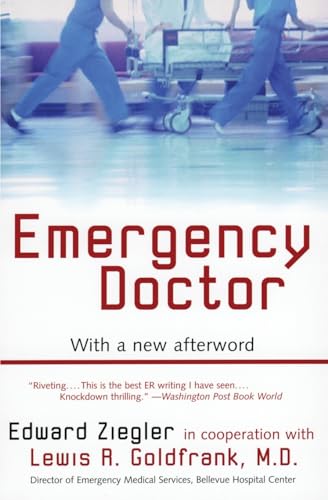
Hundreds of people slam through its doors every day: gun-shot cops, battered kids, drug addicts, and suicides, destitute drunks, homeless people, AIDS sufferers, and accident victims. It’s a bizarre parade of humanity looking for help -- in the one place they know they can find it.
Welcome to the frontline trenches of medicine: the emergency room of the legendary Bellevue Hospital. Here, an army of doctors and nurses faces the onslaught of young and old, rich and ragged, sick and dying. All day, all night. All year.This is their story -- an around-the-clock drama of the unexpected: a crane falling on a hapless pedestrian; a crazed executive wearing two-thirds of a three-piece suit; a pretty paralegal aide struggling with an on-the-job cocaine overdose; a trauma victim of an East River helicopter crash clinging to life. It’s terrifying, tragic, triumphant ... and true.
Die Inhaltsangabe kann sich auf eine andere Ausgabe dieses Titels beziehen.
Über die Autorin bzw. den Autor
Edward Ziegler is a former editor at Reader's Digest.
Auszug. © Genehmigter Nachdruck. Alle Rechte vorbehalten.
Emergency Doctor
By Ziegler, EdwardPerennial
ISBN: 0060595027Chapter One
An Overturned Crane
It was almost noon on a bright spring day when the thirty-five-ton crane began to unload steel rods from a flat-bed truck idling at curb side. The site was that of a projected forty-two-story luxury condominium on Third Avenue between Sixty-third and Sixty-fourth streets in Manhattan.
As the extended arm of the machine began to lift a load of rods and swing them over toward the construction excavation, lunchtime pedestrians scurried uncomfortably along a sidewalk bordered by plywood barrier, behind which was the pit from which the building would rise. Two women brushed past a third. This third woman was virtually in the shadow of the machine as its loaded arm began to counterbalance the base of the crane, causing it to tip up on two of its giant wheels.
For an instant, the machine wavered, angled oddly toward the excavation. The first two women sensed something amiss and rushed to get away. The third, Brigitte Gerney, was not so fortunate. She tried to retrace her steps toward Sixty-fourth Street.
"Get out of the way! We're going over!" a voice close to her shouted. It was the twenty-nine-year-old construction worker who was at the controls of the heavy machine. Below him, the sidewalk which had been undermined by the excavation of the past few days began to cave in. Then, amid the splintering of wood and the screech of bending metal, the crane turned over, trapping Mrs. Gerney suddenly underneath and coming to rest upside down at the edge of the abyss. Only a thin course of lightly framed plywood resting atop an I-beam seemed to be keeping the crane from plunging with its victim some thirty feet into the construction pit below.
"It was like an earthquake," Mrs. Gerney later recalled. "I remember my bag flying out of my hands. I heard the noise of all the bones cracking in my legs."
For the forty-nine-year-old Manhattan mother of two, it was the beginning of a seemingly endless ordeal. Both of her legs were pinned at a point ten inches above the knees between an edge of the giant machine and the crumbled sidewalk. As the crane came to rest, her right leg seemed to be almost severed, her left severely crushed. "I felt the warm blood going out and I had the impression that my legs wer completely cut off," she would remember months later. After a moment of shocked disbelief, she cried out: "Get this off me!" Her cries set in motion one of the most intensely observed rescue attempts New York had experienced in years.
* * *
The fate of Mrs. Gerney would depend in some significant degree on a doctor who as yet had no awareness of her predicament. Some forty blocks downtown, at Bellevue Hospital, on First Avenue and Twenty-sixth Street, a phone rang in the crowded doctors' station just behind the triage* desk, at the principal entry into the Emergency Department. It is here that emergency medical specialists make their initial judgments, separating all cases into one of three categories: "emergent" (gunshot wounds, heart attacks), "urgent" (broken bone, minor cuts) and "non-urgent" (sore throats, rashes).
The attending physician on duty immediately acknowledged the message and made his triage decision, "emergent," and set in motioin the machinery to dispatch a physician in the mobile emergency rescue van (MERVan) to the scene. Whenever the Bellevue MERVan, rolls, the first person to be apprised is Dr. Lewis Goldfrank, Director of the Emergency Department (ED) at Bellevue.
Goldfrank is a tall and vigorous man in his mid-forties who had been striding swiftly toward one of the trauma slots to look in on a seven-year-old girl who had been hit by a taxi and had just been brought in. As her stretcher was wheeled by, he could tell at a glance that the girl's color was good but her breathing was labored -- sounding like the muted squealing associated with airway compromise. He swiftly assigned a team of physicians and nurses to the little girl's care, then paused momentarily to hear the specifics about the crane.
At least one person was trapped. Two others had just been freed with superficial injuries. One of the city's Emergency Medical Services ambulances was on its way to the scene and police paramedics were even then burrowing their way toward Mrs. Gerney.
Goldfrank sought out the senior attending physician on duty. That was Kathleen Delaney, a Los Angeles native who, after progressing toward a Ph.D. in biochemistry at UCLA, had applied instead to medical school, and enrolled at Columbia University's College of Physicians and Surgeons. Now, nine years later, she was board certified in internal medicine and was just completing her second year of full-time service at Bellevue's Emergency Department.
"Kathy? Can you go with the MERVan to that crane accident?
"Sure. Where?"
The attending physician at the doctors' station gave the particulars and sent word to the parking area, tucked into a courtyard behind a neighboring building, where the MERVan was parked, ready to go at a moment's notice. This kind of van, a small replica of an emergency room, extends the walls of Bellevue Hospital's Emergency Department into the streets. Two or three times a week, the MERVan is called on to augment the service that Emergency Medical Service (EMS) ambulances normally provide.
So successful has been the experience with such emergency medical services that the familiar term "DOA" -- dead on arrival -- has be come something of a rarity on the Bellevue Emergency Department charts. Dr. Delaney ran out the sliding doors of the ambulance entrance and stepped into the MERVan, which then made a wide swing around the hospital drive and went howling off up First Avenue.
Goldfrank continued with his tasks -- overseeing the work of the trauma team and pediatric staff working on the little girl ...
Continues...Excerpted from Emergency Doctorby Ziegler, Edward Excerpted by permission.
All rights reserved. No part of this excerpt may be reproduced or reprinted without permission in writing from the publisher.
Excerpts are provided by Dial-A-Book Inc. solely for the personal use of visitors to this web site.
„Über diesen Titel“ kann sich auf eine andere Ausgabe dieses Titels beziehen.
Weitere beliebte Ausgaben desselben Titels

Suchergebnisse für Emergency Doctor

Beispielbild für diese ISBN
Emergency Doctor
Anbieter: Wonder Book, Frederick, MD, USA
Verkäuferbewertung 5 von 5 Sternen

Zustand: Good. Good condition. A copy that has been read but remains intact. May contain markings such as bookplates, stamps, limited notes and highlighting, or a few light stains. Bundled media such as CDs, DVDs, floppy disks or access codes may not be included. Artikel-Nr. S00B-03058
Beispielbild für diese ISBN
Emergency Doctor
Verlag:
Harper Perennial (edition Reprint), 2004
ISBN 10: 0060595027
ISBN 13: 9780060595029
Gebraucht
Paperback
Anbieter: BooksRun, Philadelphia, PA, USA
Verkäuferbewertung 5 von 5 Sternen
Paperback. Zustand: Good. Reprint. It's a preowned item in good condition and includes all the pages. It may have some general signs of wear and tear, such as markings, highlighting, slight damage to the cover, minimal wear to the binding, etc., but they will not affect the overall reading experience. Artikel-Nr. 0060595027-11-1
Beispielbild für diese ISBN
Emergency Doctor
Verlag:
HarperCollins Publishers, 2004
ISBN 10: 0060595027
ISBN 13: 9780060595029
Gebraucht
Softcover
Anbieter: Better World Books: West, Reno, NV, USA
Verkäuferbewertung 5 von 5 Sternen
Zustand: Good. Used book that is in clean, average condition without any missing pages. Artikel-Nr. 4862628-6
Beispielbild für diese ISBN
Emergency Doctor
Verlag:
HarperCollins Publishers, 2004
ISBN 10: 0060595027
ISBN 13: 9780060595029
Gebraucht
Softcover
Anbieter: Better World Books, Mishawaka, IN, USA
Verkäuferbewertung 5 von 5 Sternen
Zustand: Good. Used book that is in clean, average condition without any missing pages. Artikel-Nr. 4862628-6
Beispielbild für diese ISBN
Emergency Doctor
Anbieter: ThriftBooks-Atlanta, AUSTELL, GA, USA
Verkäuferbewertung 5 von 5 Sternen
Paperback. Zustand: Very Good. No Jacket. May have limited writing in cover pages. Pages are unmarked. ~ ThriftBooks: Read More, Spend Less. Artikel-Nr. G0060595027I4N00
Beispielbild für diese ISBN
Emergency Doctor
Anbieter: ThriftBooks-Dallas, Dallas, TX, USA
Verkäuferbewertung 5 von 5 Sternen
Paperback. Zustand: Very Good. No Jacket. Former library book; May have limited writing in cover pages. Pages are unmarked. ~ ThriftBooks: Read More, Spend Less. Artikel-Nr. G0060595027I4N10
Foto des Verkäufers
Emergency Doctor
Anbieter: WeBuyBooks, Rossendale, LANCS, Vereinigtes Königreich
Verkäuferbewertung 5 von 5 Sternen
Zustand: Very Good. Most items will be dispatched the same or the next working day. A copy that has been read, but is in excellent condition. Pages are intact and not marred by notes or highlighting. The spine remains undamaged. Artikel-Nr. rev6710247543
Gebraucht kaufen
EUR 1,60
Versand:
EUR 7,44
Von Vereinigtes Königreich nach USA
Anzahl: 1 verfügbar
Beispielbild für diese ISBN
Emergency Doctor
Anbieter: AwesomeBooks, Wallingford, Vereinigtes Königreich
Verkäuferbewertung 5 von 5 Sternen
Paperback. Zustand: Very Good. Emergency Doctor This book is in very good condition and will be shipped within 24 hours of ordering. The cover may have some limited signs of wear but the pages are clean, intact and the spine remains undamaged. This book has clearly been well maintained and looked after thus far. Money back guarantee if you are not satisfied. See all our books here, order more than 1 book and get discounted shipping. Artikel-Nr. 7719-9780060595029
Gebraucht kaufen
EUR 3,98
Versand:
EUR 5,69
Von Vereinigtes Königreich nach USA
Anzahl: 2 verfügbar
Beispielbild für diese ISBN
Emergency Doctor
Anbieter: Bahamut Media, Reading, Vereinigtes Königreich
Verkäuferbewertung 5 von 5 Sternen
Paperback. Zustand: Very Good. This book is in very good condition and will be shipped within 24 hours of ordering. The cover may have some limited signs of wear but the pages are clean, intact and the spine remains undamaged. This book has clearly been well maintained and looked after thus far. Money back guarantee if you are not satisfied. See all our books here, order more than 1 book and get discounted shipping. Artikel-Nr. 6545-9780060595029
Gebraucht kaufen
EUR 3,98
Versand:
EUR 7,97
Von Vereinigtes Königreich nach USA
Anzahl: 2 verfügbar
Beispielbild für diese ISBN
Emergency Doctor
Verlag:
HarperCollins Publishers, 2004
ISBN 10: 0060595027
ISBN 13: 9780060595029
Gebraucht
Softcover
Anbieter: Better World Books Ltd, Dunfermline, Vereinigtes Königreich
Verkäuferbewertung 5 von 5 Sternen
Zustand: Good. Ships from the UK. Used book that is in clean, average condition without any missing pages. Artikel-Nr. 4862628-6
Gebraucht kaufen
EUR 5,37
Versand:
EUR 9,13
Von Vereinigtes Königreich nach USA
Anzahl: 1 verfügbar