
Verwandte Artikel zu Better Off: Flipping the Switch on Technology –...
Better Off: Flipping the Switch on Technology – A Smart, Riveting Experiment in Simple Living That Reveals the Surprising Science of Happiness (P.S.) - Softcover
Inhaltsangabe
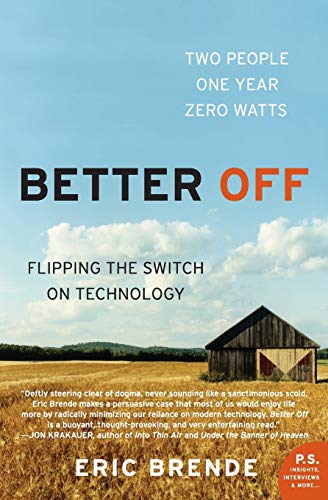
What is the least we need to achieve the most? With this question in mind, MIT graduate Eric Brende flipped the switch on technology. He and his wife, Mary, ditched their car, electric stove, refrigerator, running water, and everything else motorized or "hooked to the grid," and spent eighteen months living in a remote community so primitive in its technology that even the Amish consider it antiquated.
Better Off is the story of their real-life experiment to see whether our cell phones, wide-screen TVs, and SUVs have made life easier -- or whether life would be preferable without them. This smart, funny, and enlightening book mingles scientific analysis with the human story to demonstrate how a world free of technological excess can shrink stress -- and waistlines -- and expand happiness, health, and leisure.
This P.S. edition features an extra 16 pages of insights into the book, including author interviews, recommended reading, and more.Die Inhaltsangabe kann sich auf eine andere Ausgabe dieses Titels beziehen.
Über die Autorin bzw. den Autor
Eric Brende has degrees from Yale, Washburn University, and MIT, and has received a Citation of Excellence from the National Science Foundation and a graduate fellowship from the Mellon Foundation in the Humanities. At the insistence of his editor, he now has an e-mail account at the local library but continues to minimize modern technology for himself and his family. Eric and Mary Brende have recently relocated to an old-town section in St. Louis, where Eric makes his living as a rickshaw driver and a soap maker.
Von der hinteren Coverseite
What is the least we need to achieve the most? With this question in mind, MIT graduate Eric Brende flipped the switch on technology. He and his wife, Mary, ditched their car, electric stove, refrigerator, running water, and everything else motorized or "hooked to the grid," and spent eighteen months living in a remote community so primitive in its technology that even the Amish consider it antiquated.
Better Off is the story of their real-life experiment to see whether our cell phones, wide-screen TVs, and SUVs have made life easier -- or whether life would be preferable without them. This smart, funny, and enlightening book mingles scientific analysis with the human story to demonstrate how a world free of technological excess can shrink stress -- and waistlines -- and expand happiness, health, and leisure.
This P.S. edition features an extra 16 pages of insights into the book, including author interviews, recommended reading, and more.Auszug. © Genehmigter Nachdruck. Alle Rechte vorbehalten.
Better Off
Flipping the Switch on TechnologyBy Eric BrendePerennial
Copyright © 2005 Eric BrendeAll right reserved.
ISBN: 0060570059
Chapter One
Seeds of Discontent
I used to be as optimistic as anyone about technology. Once asked ingrade school to draw a picture of what my home would look likewhen I grew up, I sketched, in crayon, a transparent hemisphere restingon a single pole and a little flying saucer containing me, my wife,and our many kids about to dock at it. There were exactly eight littleheads (besides mine and my wife's) peeking over the rim of the craft,all identical and propagated with the help of a fertility drug.
When I reached my early teens, I never failed to watch an episodeof Star Trek, and I read almost every piece of science fiction IsaacAsimov wrote. On our family's first cross-country trip, I became ecstaticwhen we got caught in a traffic jam on the Oakland Bay Bridge. Toa midwestern boy, traffic jams were exotic events in which only specialpeople living in modernistic cities took part.
There was always an undertow to my technological infatuation,however, which at first I was loath to acknowledge. On that trip outwest, I spent most of the time carsick. A few years later, after returningto the lazy metropolis of Topeka, Kansas, I began to notice anomaliesin the mechanical utopia of our modernized household. After wegot an automatic dishwasher, the size of the pile of dirty plates on thecountertop didn't decrease at all. If anything, it increased. My dadbought one of the first word processors ever made in the hopes of easingthe time and effort of writing. He spent so much time with thatmachine, I almost never saw him again.
In my grade-school years, the neighborhood seemed alive withchildren out in the street playing stickball and hide-and-seek. But theolder I grew, the more deserted the street became -- except for the cars,of course, which had multiplied over time and made playing out-of-doorsmore perilous. After supper even the cars went into hibernation;the only signs of life were the faint glows cast by cathode ray tubes onliving-room blinds.
I had always been on the bashful side, so I went more or less theway of the trend, retreating as determinedly as everyone else to thealtar of TV. But lest I surrender utterly to The Void, I applied myselfdiligently at the piano, practicing several hours a day. To survivesocially in a place dominated by the automobile, of course, you had todrive; so I also made an attempt to earn money to buy a car by workingat McDonald's. But soon I saw the futility and the irony: in a townwhose borders motor vehicles had pushed to the horizons (with a populationof 120,000, Topeka covered 50 square miles), the only sensibleway to get to my job was by automobile. Until I could afford one,I had to bike the six-mile round trip on busy roads with no shouldersor sidewalks, and I arrived dripping wet. Had I stayed on, I calculatedthat, like the other workers, I would be working mostly in order topay for my transportation to work.
What had begun as car sickness in boyhood had developed, byadolescence, into a deeper case of cultural indigestion. It was onlywhen I got to college that I began the attempt to put a name to this,but already the symptoms of the malady -- burdensome materialinconvenience and social isolation -- had become too acute to ignore.
Luckily, my musical diligence paid off, and I got into a good university.There it was exciting to meet other people of similar interestswho lived within walking distance. I threw out the sheet music andthrew myself into the life of the campus. I joined debating groups. Itook up rowing. I made new friends. I dabbled in religion. And in myacademic pursuits, I tried to gain some understanding of what wasgoing wrong in Oz.
On a hunch, I signed up for a course in the history of technology.It was an eye-opener. The young professor, Eda Kranakis, capably surveyedthe development of wind- and water mills, steam engines, and railroads, and tossed in a graphic description of the inhuman workingconditions in nineteenth century factories. She related the tragic taleof the British land enclosure movement, inspired by "scientific farming,"which uprooted countless laborers from their hereditary commonsin the country and flung them into the cities, where they formedan easily exploited labor pool.
As illuminating as the class was, though, it raised more questionsthan it answered. Hadn't American society moved beyond the barbaritiesof Dickensian England (or at least hadn't it subcontracted thedirty work to countries like Mexico)? What was technology's role inthe present age? Problems hadn't disappeared; they were just different.But the exponents of public policy remained about as starry-eyedas I had been in grade school. Even the leaders of my elite universityaccorded every latest gizmo a virtual hero's welcome. Appalled by thismindlessness, I engaged in many heated discussions with classmates.And I wrote an extended research paper for Kranakis, describing theunhealthy side effects associated with sedentary stress and the use ofordinary automated devices. Kranakis liked the paper and encouragedme to develop my ideas.
The conviction was growing in me that the besetting problem wasour culture's blindness to the distinction between the tool and theautomatic machine. Everyone tended to treat them alike, as neutralagents of human intention. But machines clearly were not neutral orinert objects. They were complex fuel-consuming entities with certaindefinite proclivities and needs. Besides often depriving their users ofskills and physical exercise, they created new and artificial demands -- for fuel, space, money, and time. These in turn crowded out otherimportant human pursuits, like involvement in family and community,or even the process of thinking itself. The very act of accepting themachine was becoming automatic ...
Continues...Continues...
Excerpted from Better Offby Eric Brende Copyright © 2005 by Eric Brende. Excerpted by permission.
All rights reserved. No part of this excerpt may be reproduced or reprinted without permission in writing from the publisher.
Excerpts are provided by Dial-A-Book Inc. solely for the personal use of visitors to this web site.
„Über diesen Titel“ kann sich auf eine andere Ausgabe dieses Titels beziehen.
Suchergebnisse für Better Off: Flipping the Switch on Technology –...

Beispielbild für diese ISBN
Better Off: Flipping The Switch On Technology
Verlag:
HarperCollins Publishers Inc, 2005
ISBN 10: 0060570059
ISBN 13: 9780060570057
Gebraucht
Paperback
Anbieter: World of Books (was SecondSale), Montgomery, IL, USA
Verkäuferbewertung 5 von 5 Sternen

Paperback. Zustand: Good. What is the least we need to achieve the most? With this question in mind, MIT graduate Eric Brende flipped the switch on technology. He and his wife, Mary, ditched their car, electric stove, refrigerator, running water, and everything else motorized or "hooked to the grid," and spent eighteen months living in a remote community so primitive in its technology that even the Amish consider it antiquated. Better Off is the story of their real-life experiment to see whether our cell phones, wide-screen TVs, and SUVs have made life easier -- or whether life would be preferable without them. This smart, funny, and enlightening book mingles scientific analysis with the human story to demonstrate how a world free of technological excess can shrink stress -- and waistlines -- and expand happiness, health, and leisure. This P.S. edition features an extra 16 pages of insights into the book, including author interviews, recommended reading, and more. Artikel-Nr. 00094834651
Gebraucht kaufen
EUR 3,99
Versand gratis
Versand innerhalb von USA
Versand innerhalb von USA
Anzahl: 18 verfügbar
Beispielbild für diese ISBN
Better Off: Flipping the Switc
Anbieter: World of Books (was SecondSale), Montgomery, IL, USA
Verkäuferbewertung 5 von 5 Sternen
Zustand: Acceptable. Item in acceptable condition! Textbooks may not include supplemental items i.e. CDs, access codes etc. Artikel-Nr. 00108196382
Gebraucht kaufen
EUR 3,99
Versand gratis
Versand innerhalb von USA
Versand innerhalb von USA
Anzahl: 2 verfügbar
Beispielbild für diese ISBN
Better Off: Flipping the Switc
Anbieter: World of Books (was SecondSale), Montgomery, IL, USA
Verkäuferbewertung 5 von 5 Sternen
Zustand: Very Good. Item in very good condition! Textbooks may not include supplemental items i.e. CDs, access codes etc. Artikel-Nr. 00104660816
Gebraucht kaufen
EUR 3,99
Versand gratis
Versand innerhalb von USA
Versand innerhalb von USA
Anzahl: 6 verfügbar
Foto des Verkäufers
Better Off: Flipping the Switch on Technology â" A Smart, Riveting Experiment in Simple Living That Reveals the Surprising Science of Happiness (P.S.)
Anbieter: Dream Books Co., Denver, CO, USA
Verkäuferbewertung 5 von 5 Sternen
Zustand: good. Gently used with minimal wear on the corners and cover. A few pages may contain light highlighting or writing, but the text remains fully legible. Dust jacket may be missing, and supplemental materials like CDs or codes may not be included. May be ex-library with library markings. Ships promptly! Artikel-Nr. DBV.0060570059.G
Gebraucht kaufen
EUR 4,18
Versand gratis
Versand innerhalb von USA
Versand innerhalb von USA
Anzahl: 1 verfügbar
Beispielbild für diese ISBN
Better Off: Flipping the Switch on Technology â" A Smart, Riveting Experiment in Simple Living That Reveals the Surprising Science of Happiness (P.S.)
Verlag:
Harper Perennial (edition Reprint), 2005
ISBN 10: 0060570059
ISBN 13: 9780060570057
Gebraucht
Paperback
Anbieter: BooksRun, Philadelphia, PA, USA
Verkäuferbewertung 5 von 5 Sternen
Paperback. Zustand: Very Good. Reprint. It's a well-cared-for item that has seen limited use. The item may show minor signs of wear. All the text is legible, with all pages included. It may have slight markings and/or highlighting. Artikel-Nr. 0060570059-11-1
Gebraucht kaufen
EUR 4,53
Versand gratis
Versand innerhalb von USA
Versand innerhalb von USA
Anzahl: 1 verfügbar
Beispielbild für diese ISBN
Better Off: Flipping the Switch on Technology (P.S.)
Anbieter: Wonder Book, Frederick, MD, USA
Verkäuferbewertung 5 von 5 Sternen
Zustand: Good. Good condition. Slightly dampstained. Artikel-Nr. A10E-00368
Gebraucht kaufen
EUR 4,79
Versand gratis
Versand innerhalb von USA
Versand innerhalb von USA
Anzahl: 1 verfügbar
Beispielbild für diese ISBN
Better Off: Flipping the Switch on Technology
Anbieter: ThriftBooks-Dallas, Dallas, TX, USA
Verkäuferbewertung 5 von 5 Sternen
Paperback. Zustand: Good. No Jacket. Pages can have notes/highlighting. Spine may show signs of wear. ~ ThriftBooks: Read More, Spend Less. Artikel-Nr. G0060570059I3N00
Gebraucht kaufen
EUR 5,87
Versand gratis
Versand innerhalb von USA
Versand innerhalb von USA
Anzahl: 1 verfügbar
Beispielbild für diese ISBN
Better Off: Flipping the Switch on Technology
Anbieter: ThriftBooks-Atlanta, AUSTELL, GA, USA
Verkäuferbewertung 5 von 5 Sternen
Paperback. Zustand: Very Good. No Jacket. May have limited writing in cover pages. Pages are unmarked. ~ ThriftBooks: Read More, Spend Less. Artikel-Nr. G0060570059I4N00
Gebraucht kaufen
EUR 5,87
Versand gratis
Versand innerhalb von USA
Versand innerhalb von USA
Anzahl: 1 verfügbar
Beispielbild für diese ISBN
Better Off: Flipping the Switch on Technology
Anbieter: ThriftBooks-Atlanta, AUSTELL, GA, USA
Verkäuferbewertung 5 von 5 Sternen
Paperback. Zustand: Good. No Jacket. Former library book; Pages can have notes/highlighting. Spine may show signs of wear. ~ ThriftBooks: Read More, Spend Less. Artikel-Nr. G0060570059I3N10
Gebraucht kaufen
EUR 5,87
Versand gratis
Versand innerhalb von USA
Versand innerhalb von USA
Anzahl: 1 verfügbar
Beispielbild für diese ISBN
Better Off: Flipping the Switch on Technology
Anbieter: ThriftBooks-Atlanta, AUSTELL, GA, USA
Verkäuferbewertung 5 von 5 Sternen
Paperback. Zustand: Good. No Jacket. Pages can have notes/highlighting. Spine may show signs of wear. ~ ThriftBooks: Read More, Spend Less. Artikel-Nr. G0060570059I3N00
Gebraucht kaufen
EUR 5,87
Versand gratis
Versand innerhalb von USA
Versand innerhalb von USA
Anzahl: 1 verfügbar