
Verwandte Artikel zu Back Then: Two Lives in 1950s New York
Inhaltsangabe
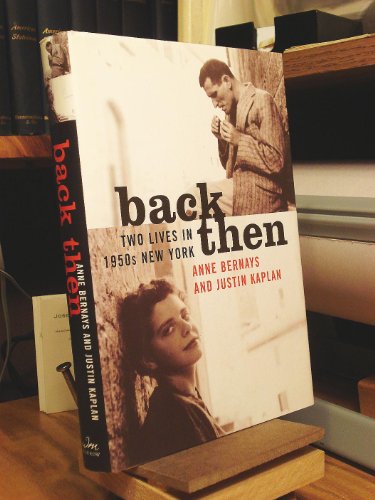
Infused with intelligence and charm, Back Then is an elegant reflection on transformative years in the lives of two young people and New York City. Marked by their youthful passion, this double memoir marries the authors' distinct literary styles with a riveting narrative that captures the density and texture of private, social, and working life in the 1950s.
Novelist Anne Bernays, born in 1930, and biographer Justin Kaplan, born in 1925, both natives of New York, came of age in the 1950s, when the pent-up energies of the Depression years and World War II were at flood tide. Back Then, written in two separate voices, is the candid, anecdotal account of two children of privilege, one from New York's East Side, the other from the West Side, pursuing careers in publishing and eventually leaving to write their own books. They both sought self-knowledge and realization through years of psychoanalysis. They brushed shoulders with celebrities like William Faulkner, Somerset Maugham, Marlene Dietrich, and Anatole Broyard.
Before Bernays and Kaplan met and married, each had enjoyed the sexual and social freedom that, along with the dark shadow of McCarthyism and the Cold War, was among the distinguishing marks of the 1950s. In many other respects, the story they tell could almost as well be about an earlier era.
This vibrant, balanced memoir offers an indelible portrait of postwar New York -- exhilarating, hospitable, and affordable. A striking collaboration by two prominent figures in American letters, Back Then surprises and delights as Bernays and Kaplan recall their youthful pursuits, the merging of their lives, and the city's underlying influence on them.
Die Inhaltsangabe kann sich auf eine andere Ausgabe dieses Titels beziehen.
Über die Autorinnen und Autoren
Anne Bernays, a novelist and writing teacher, is the author of eight novels, including Professor Romeo and Growing Up Rich, as well as two works of nonfiction, including The Language of Names written with Justin Kaplan and What If? written with Pamela Painter. Her articles and essays have appeared in numerous major publications, among them The Nation, the New York Times, Town & Country, and Sports Illustrated. She lives in Cambridge and Truro, Massachusetts with her husband, Justin Kaplan. They have three daughters and six grandchildren.
Justin Kaplan is also the author of Mr. Clemens and Mark Twain, winner of the Pulitzer Prize and National Book Award. He is general editor of Bartlett’s Familiar Quotations and a member of the American Academy of Arts and Letters. He is married to the novelist Anne Bernays. They have three daughters and six grandchildren, and live in Cambridge and Truro, Massachusetts.
Von der hinteren Coverseite
Infused with intelligence and charm, Back Then is an elegant reflection on transformative years in the lives of two young people and New York City. Marked by their youthful passion, this double memoir marries the authors' distinct literary styles with a riveting narrative that captures the density and texture of private, social, and working life in the 1950s.
Novelist Anne Bernays, born in 1930, and biographer Justin Kaplan, born in 1925, both natives of New York, came of age in the 1950s, when the pent-up energies of the Depression years and World War II were at flood tide. Back Then, written in two separate voices, is the candid, anecdotal account of two children of privilege, one from New York's East Side, the other from the West Side, pursuing careers in publishing and eventually leaving to write their own books. They both sought self-knowledge and realization through years of psychoanalysis. They brushed shoulders with celebrities like William Faulkner, Somerset Maugham, Marlene Dietrich, and Anatole Broyard.
Before Bernays and Kaplan met and married, each had enjoyed the sexual and social freedom that, along with the dark shadow of McCarthyism and the Cold War, was among the distinguishing marks of the 1950s. In many other respects, the story they tell could almost as well be about an earlier era.
This vibrant, balanced memoir offers an indelible portrait of postwar New York -- exhilarating, hospitable, and affordable. A striking collaboration by two prominent figures in American letters, Back Then surprises and delights as Bernays and Kaplan recall their youthful pursuits, the merging of their lives, and the city's underlying influence on them.
Auszug. © Genehmigter Nachdruck. Alle Rechte vorbehalten.
Back Then
Two Lives in 1950s New York
By Anne Bernays and Justin Kaplan
William Morrow
Copyright © 2002 Anne Bernays and Justin Kaplan.
All rights reserved.
ISBN: 0-06-019855-9
Chapter One
Where we lived in Manhattan had a lot to do with how my father, the person who made the hefty decisions in our family, chose to be perceived by the world beyond his front door. And this, in turn, had a lot to do with his profound and nervous reluctance to be identified as a Jew. His reluctance was the chain on which many of the beads of daily life chez Bernays were strung. Being Jewish was something we almost never talked about, just as we avoided the contagion of cancer, poor people, and sex. Naturally then, cancer, poor people, and sex took a tenacious hold on my imagination, hung there like a cat halfway up a tree. Oma Hattie, my mother's mother, was one notch less inhibited than my parents about the subject of Jewishness; whenever she wanted to indicate that someone was Jewish she said, sotto voce, "M-O-T" ? Member of the Tribe. It made my father wince whenever she said it. If I read his thoughts correctly, they were saying, "Why do I have to hear this? What does it have to do with me?" Oma Hattie was just as circumspect about malignancy ? she wouldn't say the whole word but whispered its initial: "My friend Bessie was just operated on for C, poor thing." People with C almost invariably died of it.
Each era earns its particular codes and proscriptions, some more demanding and painful than others, depending on the temperament of the times and the moral force of what has preceded it. As I grew up the language I spoke was heavily encoded, a condition due in part to my hothouse upbringing and in part to the period itself. Because my parents were born before the turn of the century (my father in 1891 and my mother in 1892), some of their regulations hung in suspension around us like the smell of something nasty. Not once did I hear my father or my mother say anything more freighted than damn and hell ? and then only when, like Rhett Butler, they found themselves pushed to the limit.
I found it a constant challenge to decipher what someone really meant when they used this coded language, and since I wanted to believe what I heard, I wasn't all that adept at instant understanding. It took me a long time, for example, to understand that "Will you go out to dinner with me?" more often meant "I want to fuck you" than it did "Let's share a meal." When I accepted a dinner invitation I didn't think I owed the man who had extended it any favors; often, he did. "Good friend" or "Great and good friend," a staple of Time magazine euphemism, meant lover or mistress. A "long illness" might have been lengthy but it was also specific: it meant cancer. "Died suddenly" meant a suicide and "he was a confirmed bachelor," homosexuality. "New Yorker" was the equivalent of Jew. When a woman said, "I have to go wash my hands," you knew she was headed for "the little girls' room," another euphemism. As for a girl's periods, they were known by many names: "the curse," "the monthlies," "falling off the roof," and, inexplicably, "grandma's come to visit." Your periods put you in a condition about which boys and men pretended to know nothing. The term "social disease" was code for syphilis or gonorrhea; they were both potential killers and, before antibiotics, often were. On the other hand, it didn't strike us as inconsistent that words like retarded, crippled, foreigner, spinster, and old lady were never disguised but were allowed to emerge starkly, like naked children at a picnic.
Our pervasive language code fortified the pretense that ours was a polite and well-regulated society ? at least at its upper reaches. And along with this, "good manners" were passed more or less intact from one generation to the next, fortified by books of etiquette that changed very little from decade to decade. You knew how to behave in front of and talk to intimate, casual friend, and stranger alike.
When one of my boyfriends, a former sailor, inserted "abso-fucking-lutely" into an otherwise bland conversation, I was dazzled. "What did you say?" He repeated it. "Navy talk," he said.
As a result of these taboos, the shock value of smutty language was as loud as an air raid siren. You could calculate the seriousness of a girl's determination to be "her own man" as much by the words she spoke as by how many guys she had slept with and which substances ? and in what quantities ? she poured, inhaled, or injected into the temple of her body.
If you can say any word any time you feel like it, it loses its bang; if you save it for the exact right moment its going to do its job and rip through your adversary like a dumdum bullet. You tucked your list of precious forbidden words and phrases into your deepest pocket, fingering them as you might someone else's gold coins. And, like Russians under communism, like Aesop, we tended to tell our stories in altered form, hiding the truth in assorted disguises. Self-censorship is supposed to be dehumanizing, and perhaps, ultimately it is. But it forces you to be inventive and sly. You got away with something, you slid the true text past the censors as you sneaked absinthe past Customs; you slipped out the window when they thought you were in bed, sleeping; you had sex when they thought you were at a wedding shower.
My father was a gilded creature, shimmering with a vanity that had as much to do with his forebears as it did his considerable brawn in the world of commerce and celebrity. He was Sigmund Freud's double nephew: a brother and sister, Sigmund Freud and Anna Freud, had married, respectively, a sister and brother, Martha Bernays and Eli...
(Continues...)
Excerpted from Back Then by Anne Bernays and Justin Kaplan. Copyright © 2002 by Anne Bernays and Justin Kaplan. Excerpted by permission. All rights reserved. No part of this excerpt may be reproduced or reprinted without permission in writing from the publisher.
„Über diesen Titel“ kann sich auf eine andere Ausgabe dieses Titels beziehen.
Suchergebnisse für Back Then: Two Lives in 1950s New York

Beispielbild für diese ISBN
Back Then: Two Lives in 1950s New York
Verlag:
William Morrow (edition 1), 2002
ISBN 10: 0060198559
ISBN 13: 9780060198558
Gebraucht
Hardcover
Anbieter: BooksRun, Philadelphia, PA, USA
Verkäuferbewertung 5 von 5 Sternen

Hardcover. Zustand: Very Good. 1. With dust jacket. It's a well-cared-for item that has seen limited use. The item may show minor signs of wear. All the text is legible, with all pages included. It may have slight markings and/or highlighting. Artikel-Nr. 0060198559-11-22-29
Gebraucht kaufen
EUR 5,42
Versand gratis
Versand innerhalb von USA
Versand innerhalb von USA
Anzahl: 1 verfügbar
Beispielbild für diese ISBN
Back Then: Two Lives in 1950s New York
Anbieter: World of Books (was SecondSale), Montgomery, IL, USA
Verkäuferbewertung 5 von 5 Sternen
Zustand: Good. Item in good condition. Textbooks may not include supplemental items i.e. CDs, access codes etc. Artikel-Nr. 00107543592
Gebraucht kaufen
EUR 5,50
Versand gratis
Versand innerhalb von USA
Versand innerhalb von USA
Anzahl: 2 verfügbar
Beispielbild für diese ISBN
Back Then: Two Lives in 1950s New York
Anbieter: ThriftBooks-Atlanta, AUSTELL, GA, USA
Verkäuferbewertung 5 von 5 Sternen
Hardcover. Zustand: As New. No Jacket. Pages are clean and are not marred by notes or folds of any kind. ~ ThriftBooks: Read More, Spend Less. Artikel-Nr. G0060198559I2N00
Gebraucht kaufen
EUR 6,12
Versand gratis
Versand innerhalb von USA
Versand innerhalb von USA
Anzahl: 1 verfügbar
Beispielbild für diese ISBN
Back Then: Two Lives in 1950s New York
Anbieter: ThriftBooks-Atlanta, AUSTELL, GA, USA
Verkäuferbewertung 5 von 5 Sternen
Hardcover. Zustand: Very Good. No Jacket. May have limited writing in cover pages. Pages are unmarked. ~ ThriftBooks: Read More, Spend Less. Artikel-Nr. G0060198559I4N00
Gebraucht kaufen
EUR 6,12
Versand gratis
Versand innerhalb von USA
Versand innerhalb von USA
Anzahl: 1 verfügbar
Beispielbild für diese ISBN
Back Then: Two Lives in 1950s New York
Anbieter: Wonder Book, Frederick, MD, USA
Verkäuferbewertung 5 von 5 Sternen
Zustand: Very Good. Very Good condition. Very Good dust jacket. In protective mylar cover. From the collection of Tom Verlaine. Verlaine was a guitarist, singer, and songwriter who was a founding member of the seminal punk rock band Television. He was known for his innovative guitar playing and songwriting, and he is considered to be one of the most important and influential musicians of the past 50 years. Artikel-Nr. F04A-08382
Gebraucht kaufen
EUR 6,42
Versand gratis
Versand innerhalb von USA
Versand innerhalb von USA
Anzahl: 1 verfügbar
Beispielbild für diese ISBN
Back Then: Two Lives in 1950s New York
Anbieter: WorldofBooks, Goring-By-Sea, WS, Vereinigtes Königreich
Verkäuferbewertung 5 von 5 Sternen
Paperback. Zustand: Very Good. The book has been read, but is in excellent condition. Pages are intact and not marred by notes or highlighting. The spine remains undamaged. Artikel-Nr. GOR014648196
Gebraucht kaufen
EUR 5,63
EUR 6,63 Versand
Versand von Vereinigtes Königreich nach USA
Versand von Vereinigtes Königreich nach USA
Anzahl: 1 verfügbar
Beispielbild für diese ISBN
Back Then: Two Lives in 1950s New York
Anbieter: Roundabout Books, Greenfield, MA, USA
Verkäuferbewertung 4 von 5 Sternen

hardcover. Zustand: Very Good. Condition Notes: Clean, unmarked copy with some edge wear. Good binding. Dust jacket included if issued with one. We ship in recyclable American-made mailers. 100% money-back guarantee on all orders. Artikel-Nr. 1755356
Gebraucht kaufen
EUR 15,13
Versand gratis
Versand innerhalb von USA
Versand innerhalb von USA
Anzahl: 1 verfügbar
Foto des Verkäufers
Back Then: Two Lives in 1950s New York
Verlag:
William Morrow, 2002
ISBN 10: 0060198559
ISBN 13: 9780060198558
Gebraucht
Hardcover
Erstausgabe
Anbieter: Southampton Books, Sag Harbor, NY, USA
Verkäuferbewertung 5 von 5 Sternen
Hardcover. Zustand: Like New. Zustand des Schutzumschlags: Like New. First Edition. First Edition, First Printing (Full Number Line). Not price-clipped ($25.95 price intact). Published by William Morrow, 1999. Octavo. White cloth over white flecked boards stamped in gold. Book is like new with no writing. Sharp corners and spine straight. Binding tight. Dust jacket is like new with light shelf wear. 309 pages. ISBN: 0060198559. 100% positive feedback. 30 day money back guarantee. NEXT DAY SHIPPING! Excellent customer service. Please email with any questions or if you would like a photo. All books packed carefully and ship with free delivery confirmation/tracking. All books come with free bookmarks. Ships from Southampton, New York. Artikel-Nr. 92073
Gebraucht kaufen
EUR 32,14
EUR 4,45 Versand
Versand innerhalb von USA
Versand innerhalb von USA
Anzahl: 1 verfügbar
Beispielbild für diese ISBN
Back Then: Two Lives in 1950s New York
Anbieter: Revaluation Books, Exeter, Vereinigtes Königreich
Verkäuferbewertung 5 von 5 Sternen
Hardcover. Zustand: Brand New. 1st edition. 309 pages. 9.25x6.25x1.00 inches. In Stock. Artikel-Nr. 0060198559
Neu kaufen
EUR 27,10
EUR 14,79 Versand
Versand von Vereinigtes Königreich nach USA
Versand von Vereinigtes Königreich nach USA
Anzahl: 1 verfügbar
Beispielbild für diese ISBN
Back Then: Two Lives in 1950s New York
Verlag:
William Morrow, 2002
ISBN 10: 0060198559
ISBN 13: 9780060198558
Gebraucht
Hardcover
Erstausgabe
Signiert
Anbieter: Ground Zero Books, Ltd., Silver Spring, MD, USA
Verkäuferbewertung 5 von 5 Sternen
Hardcover. 309 p. Illustrations. A married pair of writers--he a biographer and she a novelist--join forces to recall coming of age in mid-20th-century Manhattan. Good in good dust jacket. Signed by author. Signed by both authors. DJ has some wear and soiling. Slightly cocked. First edition. Stated. First printing [stated]. Artikel-Nr. 60245
Gebraucht kaufen
EUR 45,93
EUR 4,46 Versand
Versand innerhalb von USA
Versand innerhalb von USA
Anzahl: 1 verfügbar