
Verwandte Artikel zu Us Against Them: An Oral History of the Ryder Cup
Inhaltsangabe
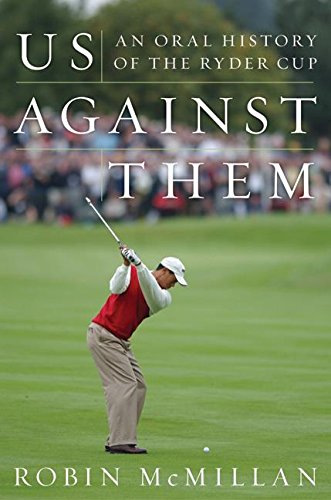
The Only Oral History of the Ryder Cup
Since Its Genesis in 1927
Us Against Them recounts how the Ryder Cup grew from the brink of extinction to become the most compelling and controversial tournament in golf. The popularity of the Ryder Cup, played every other year in the fall (alternately in the United States and in Europe), has soared in the last ten years. Its worldwide television audience is now the largest of any in golf, and the last tournament, in 2002, was viewed by an estimated 100 million fans.
The story of this meteoric rise -- and all the rich history that predated it -- is told in the actual voices of more than forty players and other participants, including Ryder Cup players and captains Curtis Strange, Dave Stockton, Sam Torrance, and Tony Jacklin; American legends Hale Irwin and Billy Casper; U.S. network television commentators Peter Alliss, David Feherty, Peter Oosterhuis, and Jimmy Roberts; Tour players Peter Jacobsen, Tom Lehman, and Brad Faxon; and such names from the past as Dow Finsterwald, Johnny Pott, and Tommy Bolt.More than recalling simply the play-by-play, Us Against Them also goes behind the scenes -- to the Ryder Cup tournament director whose participation almost ended in his own bloody death, to the matches in Britain that nearly ended in blows, to the car crash that some say decided the outcome of one of the matches, to a small plane carrying players that almost fell from the sky, and to the prominent American network golf commentator who introduced himself to a U.S. president while dressed in a large plastic garbage bag!
Die Inhaltsangabe kann sich auf eine andere Ausgabe dieses Titels beziehen.
Über die Autorin bzw. den Autor
Robin McMillan is editor in chief of Golf Magazine's Custom Publishing Division. Scottish by birth, he has lived in New York City for the past twenty-five years. He is married with two children.
Von der hinteren Coverseite
The Only Oral History of the Ryder Cup
Since Its Genesis in 1927
Us Against Them recounts how the Ryder Cup grew from the brink of extinction to become the most compelling and controversial tournament in golf. The popularity of the Ryder Cup, played every other year in the fall (alternately in the United States and in Europe), has soared in the last ten years. Its worldwide television audience is now the largest of any in golf, and the last tournament, in 2002, was viewed by an estimated 100 million fans.
The story of this meteoric rise -- and all the rich history that predated it -- is told in the actual voices of more than forty players and other participants, including Ryder Cup players and captains Curtis Strange, Dave Stockton, Sam Torrance, and Tony Jacklin; American legends Hale Irwin and Billy Casper; U.S. network television commentators Peter Alliss, David Feherty, Peter Oosterhuis, and Jimmy Roberts; Tour players Peter Jacobsen, Tom Lehman, and Brad Faxon; and such names from the past as Dow Finsterwald, Johnny Pott, and Tommy Bolt.More than recalling simply the play-by-play, Us Against Them also goes behind the scenes -- to the Ryder Cup tournament director whose participation almost ended in his own bloody death, to the matches in Britain that nearly ended in blows, to the car crash that some say decided the outcome of one of the matches, to a small plane carrying players that almost fell from the sky, and to the prominent American network golf commentator who introduced himself to a U.S. president while dressed in a large plastic garbage bag!
Auszug. © Genehmigter Nachdruck. Alle Rechte vorbehalten.
Us Against Them
An Oral History of the Ryder CupBy McMillan, RobinHarperCollins Publishers
ISBN: 0060197919Let Play Begin
If the British entertained any thoughts of winning in Worcester -- buoyed perhaps by the thrashing they'd administered at Wentworth -- it took one day's play to change their minds. Led by captain Walter Hagen, the United States won three of four-hole foursomes. The following day, it won six of eight-hole singles matches and halved another (until 1961 the format was always four-hole foursomes followed by eight 36-hole singles matches). Final score: 91/221/2 The British team could have been forgiven had it expressed regret for having shown up.
Truth be told, they nearly didn't. In accepting the invitation to play, the British PGA didn't take into account the cost of sending a team across the Atlantic. To its rescue came Golf illustrated, which launched a drive to raise $3,000. Not only did its editor George Philpot use the magazine to tout the value of subsidizing the team, but he also appealed to each of 1,750 British golf clubs. Only 216 responded. After counting in a few corporate gifts and a $106 donation from Sam Ryder, the appeal came up $500 short, and Philpot and his magazine plugged the gap themselves.
Granted, it was only a few years earlier that club professionals had first been allowed inside many clubhouses, but the threadbare approach to the Ryder Cup would handicap the British sides for decades. The United States, meanwhile, did things with gusto. When the British team docked in New York in May 1927 after a stormy six-day crossing -- minus Abe Mitchell, who'd come down with appendicitis -- they were greeted by a welcome party made up of PGA of America officials and US, captain Walter Hagen. A police escort rushed them across midtown Manhattan to the Biltmore Hotel, where they dropped their luggage before being whisked north to the Westchester Biltmore (which much later became the Westchester Country Club, a longtime stop on the PGA Tour) for a welcome dinner and a floodlit putting tournament! All these arrangements would be quite normal today -- except perhaps the putting tournament -- but to the British this was another world. Even their garb made them look second class next to the flash Yanks -- another trend that would haunt the British for years. As the New York Times noted after the first day's play, "There was a time when the British were anything but fashionable in their dress. They have perked up. But they still have a long way to go to catch up with the Americans, who are Beau Brummels plus."
Same story for the 1929 matches at Moortown, in the north of England. The United States raised a war chest of $10,000 while a second Golf Illustrated fund-raiser gathered £800 and change. But at least Britian won the cup, erasing a one-point deficit after the foursomes by winning five singles matches and halving a sixth.
More important, the matches caught the fans' attention, as a trail of cars waiting to park stretched one mile back from the club, and galleries of up to ten thousand stood ten deep trying to get a glimpse of the golf Reported the Associated Press, "The gallery, which often was entirely out of control of the 200 officials and 50 uniformed policemen, fairly fought to get a close-up of play."
The 1931 matches at Scioto Country Club in Columbus, Ohio, were something of a foregone conclusion when the British had to play without three of their top players. Two were victims of a rule that said team members had not only to be British natives but also residents of Britain.
PETER ALLISS (color commentator for ABC-TV and an eight-time Ryder Cupper): My father, Percy, was picked for the team in 1929 but didn't play. Then in 1931 he wasn't eligible because he was in Berlin. And Aubrey Boomer was in France, so he couldn't play.
Father had gone to Berlin in 1926 or '27, to a new golf club [Wannsee] that was very, very productive. He was making probably $5,000 a year, which in the mid-'20s was an absolute fortune.
I was born in Berlin in 1931, just when Hitler was coming to power. War didn't come for another seven, eight years, but Hitler was already starting his purge on the Jews and closing banks, so in 1932 they decided to get out. But it wasn't so easy. The banks were shut, but we managed to get some money, and Mother stuffed it down her knickers and we got on a train and escaped. But instead of coming here with what then would have been a small fortune, a couple of thousand dollars, we came home with about $300.
Although Henry (later "Sir Henry") Cotton was invited to play, he got into a dispute with the British PGA, who insisted he return to the United Kingdom with the rest of the team when he wanted to stay on and play some exhibition matches, and that every member of the squad would get an equal cut of exhibition-match revenue, when Cotton wanted to conduct his own.
The actual matches ended with a 9-3 victory for the United States, but a meteorological victory for the Brits. Although a brief storm offered temporary respite, the matches were played in Ohio in June, and temperatures approached triple digits.
ALLIS: I've seen a picture of somebody tipping a bucket of cold water over the players' heads; it was so hot.
So hot that the British PGA insisted that, although scheduling the Ryder Cup in June allowed the players to enter the US. Open on the same trip, they would no longer play in the height of summer The Ryder Cup thereafter moved to its familiar autumn dates.
Cotton was the victim of the residents-only rule when the Ryder Cup went to Southport and Ainsdale ...
Continues...Excerpted from Us Against Themby McMillan, Robin Excerpted by permission.
All rights reserved. No part of this excerpt may be reproduced or reprinted without permission in writing from the publisher.
Excerpts are provided by Dial-A-Book Inc. solely for the personal use of visitors to this web site.
„Über diesen Titel“ kann sich auf eine andere Ausgabe dieses Titels beziehen.
Suchergebnisse für Us Against Them: An Oral History of the Ryder Cup

Beispielbild für diese ISBN
Us Against Them
Verlag:
HarperCollins Publishers Inc, 2004
ISBN 10: 0060197919
ISBN 13: 9780060197919
Gebraucht
Hardcover
Anbieter: World of Books (was SecondSale), Montgomery, IL, USA
Verkäuferbewertung 5 von 5 Sternen

Hardback. Zustand: Good. The Only Oral History of the Ryder Cup Since Its Genesis in 1927 Us Against Them recounts how the Ryder Cup grew from the brink of extinction to become the most compelling and controversial tournament in golf. The popularity of the Ryder Cup, played every other year in the fall (alternately in the United States and in Europe), has soared in the last ten years. Its worldwide television audience is now the largest of any in golf, and the last tournament, in 2002, was viewed by an estimated 100 million fans. The story of this meteoric rise -- and all the rich history that predated it -- is told in the actual voices of more than forty players and other participants, including Ryder Cup players and captains Curtis Strange, Dave Stockton, Sam Torrance, and Tony Jacklin; American legends Hale Irwin and Billy Casper; U.S. network television commentators Peter Alliss, David Feherty, Peter Oosterhuis, and Jimmy Roberts; Tour players Peter Jacobsen, Tom Lehman, and Brad Faxon; and such names from the past as Dow Finsterwald, Johnny Pott, and Tommy Bolt.More than recalling simply the play-by-play, Us Against Them also goes behind the scenes -- to the Ryder Cup tournament director whose participation almost ended in his own bloody death, to the matches in Britain that nearly ended in blows, to the car crash that some say decided the outcome of one of the matches, to a small plane carrying players that almost fell from the sky, and to the prominent American network golf commentator who introduced himself to a U.S. president while dressed in a large plastic garbage bag! Artikel-Nr. 00104378455
Gebraucht kaufen
EUR 5,12
Versand gratis
Versand innerhalb von USA
Versand innerhalb von USA
Anzahl: 2 verfügbar
Beispielbild für diese ISBN
Us Against Them: An Oral History of the Ryder Cup
Verlag:
HarperCollins (edition First Edition), 2004
ISBN 10: 0060197919
ISBN 13: 9780060197919
Gebraucht
Hardcover
Erstausgabe
Anbieter: BooksRun, Philadelphia, PA, USA
Verkäuferbewertung 5 von 5 Sternen
Hardcover. Zustand: Very Good. First Edition. With dust jacket. It's a well-cared-for item that has seen limited use. The item may show minor signs of wear. All the text is legible, with all pages included. It may have slight markings and/or highlighting. Artikel-Nr. 0060197919-11-1-29
Gebraucht kaufen
EUR 5,56
Versand gratis
Versand innerhalb von USA
Versand innerhalb von USA
Anzahl: 1 verfügbar
Beispielbild für diese ISBN
Us Against Them: An Oral History of the Ryder Cup
Anbieter: ThriftBooks-Phoenix, Phoenix, AZ, USA
Verkäuferbewertung 5 von 5 Sternen
Hardcover. Zustand: Good. No Jacket. Pages can have notes/highlighting. Spine may show signs of wear. ~ ThriftBooks: Read More, Spend Less. Artikel-Nr. G0060197919I3N00
Gebraucht kaufen
EUR 6,63
Versand gratis
Versand innerhalb von USA
Versand innerhalb von USA
Anzahl: 1 verfügbar
Beispielbild für diese ISBN
Us Against Them: An Oral History of the Ryder Cup
Anbieter: ThriftBooks-Dallas, Dallas, TX, USA
Verkäuferbewertung 5 von 5 Sternen
Hardcover. Zustand: Good. No Jacket. Pages can have notes/highlighting. Spine may show signs of wear. ~ ThriftBooks: Read More, Spend Less. Artikel-Nr. G0060197919I3N00
Gebraucht kaufen
EUR 6,64
Versand gratis
Versand innerhalb von USA
Versand innerhalb von USA
Anzahl: 1 verfügbar
Beispielbild für diese ISBN
Us Against Them: An Oral History of the Ryder Cup
Anbieter: ThriftBooks-Dallas, Dallas, TX, USA
Verkäuferbewertung 5 von 5 Sternen
Hardcover. Zustand: As New. No Jacket. Pages are clean and are not marred by notes or folds of any kind. ~ ThriftBooks: Read More, Spend Less. Artikel-Nr. G0060197919I2N00
Gebraucht kaufen
EUR 6,64
Versand gratis
Versand innerhalb von USA
Versand innerhalb von USA
Anzahl: 1 verfügbar
Beispielbild für diese ISBN
Us Against Them : An Oral History of the Ryder Cup
Verlag:
HarperCollins Publishers, 2004
ISBN 10: 0060197919
ISBN 13: 9780060197919
Gebraucht
Hardcover
Erstausgabe
Anbieter: Better World Books, Mishawaka, IN, USA
Verkäuferbewertung 5 von 5 Sternen
Zustand: Fine. 1ST. Used book that is in almost brand-new condition. May contain a remainder mark. Better World Books: Buy Books. Do Good. Artikel-Nr. 57715058-6
Gebraucht kaufen
EUR 10,35
Versand gratis
Versand innerhalb von USA
Versand innerhalb von USA
Anzahl: 1 verfügbar
Beispielbild für diese ISBN
Us Against Them: An Oral History of the Ryder Cup
Verlag:
HarperCollins, New York, 2004
ISBN 10: 0060197919
ISBN 13: 9780060197919
Gebraucht
Hardcover
Erstausgabe
Anbieter: Abacus Bookshop, Pittsford, NY, USA
Verkäuferbewertung 5 von 5 Sternen
hardcover. Zustand: Fine copy in fine dust jacket. Illus. with photos (illustrator). 1st. 8vo, 287 pp. Artikel-Nr. 035360
Gebraucht kaufen
EUR 9,17
EUR 3,56 Versand
Versand innerhalb von USA
Versand innerhalb von USA
Anzahl: 1 verfügbar
Beispielbild für diese ISBN
Us Against Them: An Oral History of the Ryder Cup
Anbieter: WorldofBooks, Goring-By-Sea, WS, Vereinigtes Königreich
Verkäuferbewertung 5 von 5 Sternen
Paperback. Zustand: Very Good. The book has been read, but is in excellent condition. Pages are intact and not marred by notes or highlighting. The spine remains undamaged. Artikel-Nr. GOR002624676
Gebraucht kaufen
EUR 19,67
EUR 6,72 Versand
Versand von Vereinigtes Königreich nach USA
Versand von Vereinigtes Königreich nach USA
Anzahl: 4 verfügbar
Beispielbild für diese ISBN
Us Against Them: An Oral History of the Ryder Cup
Anbieter: BennettBooksLtd, Los Angeles, CA, USA
Verkäuferbewertung 5 von 5 Sternen
hardcover. Zustand: New. In shrink wrap. Looks like an interesting title! Artikel-Nr. Q-0060197919
Neu kaufen
EUR 70,90
EUR 6,19 Versand
Versand innerhalb von USA
Versand innerhalb von USA
Anzahl: 1 verfügbar