
Verwandte Artikel zu Spanglish: The Making of a New American Language
Inhaltsangabe
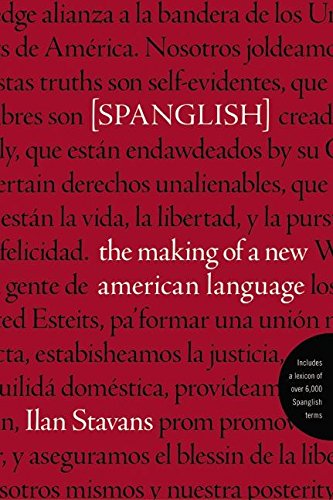
In exploring the formation of Spanglish, award-winning essayist Ilan Stavans reflects on, andalso codifies, the most transforming linguisticphenomena in America in the last one hundredyears -- one that may predict our future as a nation and that of our entire hemisphere.
No tool is more useful in understanding the changes inculture than language. In today's America, communicationis built around inclusion and efficiency, and this is no more apparent than in the blending of the two most spoken languages in the United States: English and Spanish.
Spanish, the nation's unofficial second language, isimmediately obvious and audible on airwaves and mediascreens, streets and classrooms, from one coast to the other. But el español has not spread on this side of the Atlantic in its unadulterated Iberian form. Instead it is metastasizing into something altogether new: an astonishingly creative code of communication known as Spanglish, which in large part is the result of sweeping demographic changes, globalization, and the newly emergent "Latin Fever" that is sweeping the country. It is used predominantly by people of Hispanic descent but is also embraced by others in the United States, the Americas as a whole, and even Spain.
Naturally controversial, Spanglish outrages English-language-only proponents, who seek to ban all languages other than English north of the Rio Grande. Equal in their outrage are Spanish-language purists and the supporters of the Royal Academy of the Spanish Language in Madrid, as they deem Spanglish a cancer to their precious and centuries-old tongue. With elegance and erudition, Ilan Stavans reflects on the verbal rift that has given birth to Spanglish. He fascinatingly shows the historical tensions between the British and Spanish Empires, and how in 1588, with the sinking of the grand Spanish Armada, the rivalry between the two empires was solidified, and to this day, the differences in religion and culture continue their fight linguistically.
He ponders major historical events, such as the Guadalupe Hidalgo Treaty of 1848 and the Spanish-American War fifty years later, as agents of radical linguistic change, although, as he rightly states, it is in the second half of the twentieth century that Spanglish sped into our daily reality.
Stavans also points out the similarities and differencesSpanglish has with Yiddish, so thoroughly blending intothe American vocabulary, and the much-debated Ebonics, which made headlines in the early 1990s as a uniquelyAfrican American blend of proper English and urban slang.Ultimately, Stavans deftly proves that the manner in whicha language stays alive is through mutation and that itssurvival doesn't depend on academies but on the averageperson's need for expression. This explains why it is increasingly used not only in kitchens and school but in music, TV, film, and literature, all expressions of the American collective soul.
Coupled with Stavans's insights is a substantial lexicon that shows the breadth and ingenuity of this growing vocabulary -- at times, semantically obvious, then also surprisingly inventive. An ingenious translation into Spanglish of the first chapter of Don Quixote de La Mancha comes as a bonus. The added impact proves that Spanglish is more than a language -- it is the perfect metaphor for an America that is a hybrid, a sum of parts.
Die Inhaltsangabe kann sich auf eine andere Ausgabe dieses Titels beziehen.
Über die Autorin bzw. den Autor
Ilan Stavans is Lewis-Sebring Professor in Latin American and Latino Culture and Five College–40th Anniversary Professor at Amherst College.
Ilán Stavans nació en México, en 1961. Cursó estudios de posgrado en la Universidad de Columbia, y ahora tiene la cátedra Lewis-Sebring de cultura latina y latinoamericana en Amherst College.
Von der hinteren Coverseite
In exploring the formation of Spanglish, award-winning essayist Ilan Stavans reflects on, andalso codifies, the most transforming linguisticphenomena in America in the last one hundredyears -- one that may predict our future as a nation and that of our entire hemisphere.
No tool is more useful in understanding the changes inculture than language. In today's America, communicationis built around inclusion and efficiency, and this is no more apparent than in the blending of the two most spoken languages in the United States: English and Spanish.
Spanish, the nation's unofficial second language, isimmediately obvious and audible on airwaves and mediascreens, streets and classrooms, from one coast to the other. But el español has not spread on this side of the Atlantic in its unadulterated Iberian form. Instead it is metastasizing into something altogether new: an astonishingly creative code of communication known as Spanglish, which in large part is the result of sweeping demographic changes, globalization, and the newly emergent "Latin Fever" that is sweeping the country. It is used predominantly by people of Hispanic descent but is also embraced by others in the United States, the Americas as a whole, and even Spain.
Naturally controversial, Spanglish outrages English-language-only proponents, who seek to ban all languages other than English north of the Rio Grande. Equal in their outrage are Spanish-language purists and the supporters of the Royal Academy of the Spanish Language in Madrid, as they deem Spanglish a cancer to their precious and centuries-old tongue. With elegance and erudition, Ilan Stavans reflects on the verbal rift that has given birth to Spanglish. He fascinatingly shows the historical tensions between the British and Spanish Empires, and how in 1588, with the sinking of the grand Spanish Armada, the rivalry between the two empires was solidified, and to this day, the differences in religion and culture continue their fight linguistically.
He ponders major historical events, such as the Guadalupe Hidalgo Treaty of 1848 and the Spanish-American War fifty years later, as agents of radical linguistic change, although, as he rightly states, it is in the second half of the twentieth century that Spanglish sped into our daily reality.
Stavans also points out the similarities and differencesSpanglish has with Yiddish, so thoroughly blending intothe American vocabulary, and the much-debated Ebonics, which made headlines in the early 1990s as a uniquelyAfrican American blend of proper English and urban slang.Ultimately, Stavans deftly proves that the manner in whicha language stays alive is through mutation and that itssurvival doesn't depend on academies but on the averageperson's need for expression. This explains why it is increasingly used not only in kitchens and school but in music, TV, film, and literature, all expressions of the American collective soul.
Coupled with Stavans's insights is a substantial lexicon that shows the breadth and ingenuity of this growing vocabulary -- at times, semantically obvious, then also surprisingly inventive. An ingenious translation into Spanglish of the first chapter of Don Quixote de La Mancha comes as a bonus. The added impact proves that Spanglish is more than a language -- it is the perfect metaphor for an America that is a hybrid, a sum of parts.
„Über diesen Titel“ kann sich auf eine andere Ausgabe dieses Titels beziehen.
Suchergebnisse für Spanglish: The Making of a New American Language

Beispielbild für diese ISBN
Spanglish: The Making of a New American Language
Verlag:
HarperCollins Publishers Inc, 2003
ISBN 10: 0060087757
ISBN 13: 9780060087753
Gebraucht
Hardcover
Anbieter: World of Books (was SecondSale), Montgomery, IL, USA
Verkäuferbewertung 5 von 5 Sternen

Hardback. Zustand: Good. Complete with over 6,000 entries, this marvelous linguistic guide by award-winning author Ilan Stavans explains why the emergence of Spanglish is a viable and important marker of the Latino community's influence on American culture. Artikel-Nr. 00096072523
Gebraucht kaufen
EUR 5,23
Versand gratis
Versand innerhalb von USA
Versand innerhalb von USA
Anzahl: 1 verfügbar
Beispielbild für diese ISBN
Spanglish: The Making of a New American Language (Spanish Edition)
Anbieter: BooksRun, Philadelphia, PA, USA
Verkäuferbewertung 5 von 5 Sternen
Hardcover. Zustand: Very Good. 1. With dust jacket. It's a well-cared-for item that has seen limited use. The item may show minor signs of wear. All the text is legible, with all pages included. It may have slight markings and/or highlighting. Artikel-Nr. 0060087757-11-1-29
Gebraucht kaufen
EUR 5,24
Versand gratis
Versand innerhalb von USA
Versand innerhalb von USA
Anzahl: 1 verfügbar
Beispielbild für diese ISBN
Spanglish : The Making of a New American Language
Verlag:
HarperCollins Publishers, 2003
ISBN 10: 0060087757
ISBN 13: 9780060087753
Gebraucht
Hardcover
Erstausgabe
Anbieter: Better World Books, Mishawaka, IN, USA
Verkäuferbewertung 5 von 5 Sternen
Zustand: Good. 1st. Former library copy. Pages intact with minimal writing/highlighting. The binding may be loose and creased. Dust jackets/supplements are not included. Includes library markings. Stock photo provided. Product includes identifying sticker. Better World Books: Buy Books. Do Good. Artikel-Nr. 5311288-20
Gebraucht kaufen
EUR 6,34
Versand gratis
Versand innerhalb von USA
Versand innerhalb von USA
Anzahl: 1 verfügbar
Beispielbild für diese ISBN
Spanglish: The Making of a New American Language (Spanish Edition)
Anbieter: Wonder Book, Frederick, MD, USA
Verkäuferbewertung 5 von 5 Sternen
Zustand: Very Good. Very Good condition. Very Good dust jacket. A copy that may have a few cosmetic defects. May also contain light spine creasing or a few markings such as an owner's name, short gifter's inscription or light stamp. Artikel-Nr. D06F-02318
Gebraucht kaufen
EUR 6,41
Versand gratis
Versand innerhalb von USA
Versand innerhalb von USA
Anzahl: 1 verfügbar
Beispielbild für diese ISBN
Spanglish: The Making of a New American Language (Spanish Edition)
Anbieter: Wonder Book, Frederick, MD, USA
Verkäuferbewertung 5 von 5 Sternen
Zustand: As New. Like New condition. Very Good dust jacket. A near perfect copy that may have very minor cosmetic defects. Artikel-Nr. D12A-02516
Gebraucht kaufen
EUR 6,41
Versand gratis
Versand innerhalb von USA
Versand innerhalb von USA
Anzahl: 1 verfügbar