
Verwandte Artikel zu The Agile Gene: How Nature Turns on Nurture: How Nature...
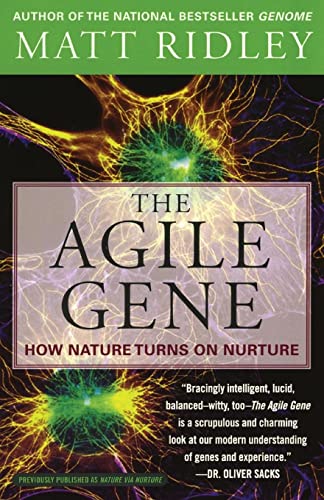
The Agile Gene: How Nature Turns on Nurture: How Nature Turns on Nurture – Free Will, the Human Genome, and Behavior - Softcover
Inhaltsangabe
Armed with extraordinary new discoveries about our genes, acclaimed science writer Matt Ridley turns his attention to the nature-versus-nurture debate in a thoughtful book about the roots of human behavior.
Ridley recounts the hundred years' war between the partisans of nature and nurture to explain how this paradoxical creature, the human being, can be simultaneously free-willed and motivated by instinct and culture. With the decoding of the human genome, we now know that genes not only predetermine the broad structure of the brain, they also absorb formative experiences, react to social cues, and even run memory. They are consequences as well as causes of the will.
Die Inhaltsangabe kann sich auf eine andere Ausgabe dieses Titels beziehen.
Über die Autorin bzw. den Autor
Matt Ridley's books―including The Red Queen, Genome, The Rational Optimist, The Evolution of Everything, How Innovation Works, and most recently, Viral: the Search for the Origin of Covid-19 (with Alina Chan)―have sold over a million copies, been translated into 31 languages, and won several awards. He sat in the House of Lords from 2013 and 2021, and was founding chairman of the International Centre for Life in Newcastle. He created the “Mind and Matter” column in the Wall Street Journal in 2010, and was a columnist for the Times. He is a fellow of the Royal Society of Literature and of the Academy of Medical Sciences, and a foreign honorary member of the American Academy of Arts and Sciences. He lives in Northumberland.
Von der hinteren Coverseite
Armed with extraordinary new discoveries about our genes, acclaimed science writer Matt Ridley turns his attention to the nature-versus-nurture debate in a thoughtful book about the roots of human behavior.
Ridley recounts the hundred years' war between the partisans of nature and nurture to explain how this paradoxical creature, the human being, can be simultaneously free-willed and motivated by instinct and culture. With the decoding of the human genome, we now know that genes not only predetermine the broad structure of the brain, they also absorb formative experiences, react to social cues, and even run memory. They are consequences as well as causes of the will.
Auszug. © Genehmigter Nachdruck. Alle Rechte vorbehalten.
The Agile Gene
How Nature Turns on NurtureBy Ridley, MattPerennial
ISBN: 006000679XChapter One
The Paragon of Animals
Is man no more than this? Consider him well: Thou owest the worm no silk, the beast no hide, the sheep no wool, the cat no perfume: -- Ha! here's three of us are sophisticated! -- Thou art the thing itself: unaccommodated man is no more but such a poor, bare, forked animal as thou art. King Lear
Similarity is the shadow of difference. Two things are similar by virtue of their difference from another; or different by virtue of one's similarity to a third. So it is with individuals. A short man is different from a tall man, but two men seem similar if contrasted with a woman.So it is with species. A man and a woman may be verydifferent, but by comparison with a chimpanzee, it is their similarities that strike the eye -- the hairless skin, the upright stance, the prominent nose. A chimpanzee, in turn, is similar to a human being when contrasted with a dog: the face, the hands, the 32 teeth, and so on. And a dog is like a person to the extent that both are unlike a fish. Difference is the shadow of similarity.
Consider, then, the feelings of a naive young man, as he stepped ashore in Tierra del Fuego on 18 December 1832 for his first encounter with what we would now call hunter-gatherers, or what he would call "man in a state of nature." Better still, let him tell us the story:
It was without exception the most curious & interesting spectacle I ever beheld. I would not have believed how entire the difference between savage & civilized man is. It is much greater than between a wild & domesticated animal, in as much as in man there is greater power of improvement ... [I] believe if the world was searched, no lower grade of man could be found.
The effect on Charles Darwin was all the more shocking because these were not the first Fuegian natives he had seen. He had shared a ship with three who had been transported to Britain, dressed in frocks and coats, and taken to meet the king. To Darwin they were just as humanas any other person. Yet here were their relatives, suddenly seeming so much less human. They reminded him of ... well, of animals. A month later, on finding the campsite of a single Fuegian limpet hunter in an even more remote spot, he wrote in his diary: "We found the place where he had slept -- it positively afforded no more protection than the form of a hare. How very little are the habits of such a being superior to those of an animal." Suddenly, Darwin is writing not just about difference (between civilized and savage man) but about similarity -- the affinity between such a man and an animal. The Fuegian is so different from the Cambridge graduate that he begins to seem similar to an animal.
Six years after his encounter with the Fuegian natives, in the spring of 1838, Darwin visited London zoo and there for the first time saw a great ape. It was an orangutan named Jenny, and she was the second ape to be brought to the zoo. Her predecessor, Tommy, a chimpanzee, had been exhibited at the zoo for a few months in 1835 before he died of tuberculosis. Jenny was acquired by the zoo in 1837, and like Tommy she caused a small sensation in London society. She seemed such a human animal, or was it such a beastly person? Apes suggested uncomfortable questions about the distinction between people and animals, between reason and instinct. Jenny featured on the cover of the Penny Magazine of the Society for the Diffusion of Useful Knowledge; an editorial reassured readers that "extraordinary as the Orang may be compared with its fellows of the brute creation, still in nothing does ittrench upon the moral or mental provinces of man." Queen Victoria, who saw a different orangutan at the zoo in 1842, begged to differ. She described it as "frightful and painfully and disagreeably human."
After his first encounter with Jenny in 1838, Darwin returned to the zoo twice more a few months later. He came armed with a mouth organ, some peppermint, and a sprig of verbena. Jenny seemed to appreciate all three. She seemed "astonished beyond measure" at her reflection in a mirror. He wrote in his notebook: "Let man visit Ouranoutang in domestication ... see its intelligence ... and then lethim boast of his proud preeminence ... Man in his arrogance thinks himself a great work, worthy the interposition of a deity. More humble and I believe true to consider him created from animals." Darwin was applying to animals what he had been taught to apply to geology: the uniformitarian principle that the forces shaping the landscape today are the same as those that shaped the distant past. Later thatSeptember, while reading Malthus's essay on population, he had his sudden insight into what we now know as natural selection.
Jenny had played her part. When she took the mouth organ from him and placed it to her lips, she had helped him realize how high above the brute some animals could rise, just as the Fuegians had made him realize how low beneath civilization some humans could sink. Was there a gap at all?
He was not the first person to think this way. Indeed, a Scottish judge, Lord Monboddo, had speculated in the 1790s that orangutans could speak -- if educated. Jean-Jacques Rousseau was only one of several Enlightenment philosophers who wondered if apes were not continuous with "savages." But it was Darwin who changed the way human beings think of their own nature. Within his lifetime, he saw educated opinion come to accept that human bodies were those ofjust another ape modified by descent from a common ancestor.
But Darwin had less success in persuading his fellow human beings that the same argument could apply to the mind ...
Continues...Excerpted from The Agile Geneby Ridley, Matt Excerpted by permission.
All rights reserved. No part of this excerpt may be reproduced or reprinted without permission in writing from the publisher.
Excerpts are provided by Dial-A-Book Inc. solely for the personal use of visitors to this web site.
„Über diesen Titel“ kann sich auf eine andere Ausgabe dieses Titels beziehen.
Suchergebnisse für The Agile Gene: How Nature Turns on Nurture: How Nature...

Beispielbild für diese ISBN
The Agile Gene How Nature Turn
Anbieter: World of Books (was SecondSale), Montgomery, IL, USA
Verkäuferbewertung 5 von 5 Sternen

Zustand: Good. Item in good condition. Textbooks may not include supplemental items i.e. CDs, access codes etc. Artikel-Nr. 00043649538
Gebraucht kaufen
EUR 3,66
Versand gratis
Versand innerhalb von USA
Versand innerhalb von USA
Anzahl: 17 verfügbar
Beispielbild für diese ISBN
The Agile Gene How Nature Turn
Anbieter: World of Books (was SecondSale), Montgomery, IL, USA
Verkäuferbewertung 5 von 5 Sternen
Zustand: Very Good. Item in very good condition! Textbooks may not include supplemental items i.e. CDs, access codes etc. Artikel-Nr. 00100661532
Gebraucht kaufen
EUR 3,66
Versand gratis
Versand innerhalb von USA
Versand innerhalb von USA
Anzahl: 2 verfügbar
Beispielbild für diese ISBN
The Agile Gene : How Nature Turns on Nurture
Verlag:
HarperCollins Publishers, 2004
ISBN 10: 006000679X
ISBN 13: 9780060006792
Gebraucht
Softcover
Anbieter: Better World Books: West, Reno, NV, USA
Verkäuferbewertung 5 von 5 Sternen
Zustand: Good. Reprint. Pages intact with minimal writing/highlighting. The binding may be loose and creased. Dust jackets/supplements are not included. Stock photo provided. Product includes identifying sticker. Better World Books: Buy Books. Do Good. Artikel-Nr. 4497313-6
Gebraucht kaufen
EUR 6,09
Versand gratis
Versand innerhalb von USA
Versand innerhalb von USA
Anzahl: 2 verfügbar
Beispielbild für diese ISBN
The Agile Gene : How Nature Turns on Nurture
Verlag:
HarperCollins Publishers, 2004
ISBN 10: 006000679X
ISBN 13: 9780060006792
Gebraucht
Softcover
Anbieter: Better World Books, Mishawaka, IN, USA
Verkäuferbewertung 5 von 5 Sternen
Zustand: Good. Reprint. Pages intact with minimal writing/highlighting. The binding may be loose and creased. Dust jackets/supplements are not included. Stock photo provided. Product includes identifying sticker. Better World Books: Buy Books. Do Good. Artikel-Nr. 4497313-6
Gebraucht kaufen
EUR 6,09
Versand gratis
Versand innerhalb von USA
Versand innerhalb von USA
Anzahl: 1 verfügbar
Beispielbild für diese ISBN
The Agile Gene: How Nature Turns on Nurture
Anbieter: Wonder Book, Frederick, MD, USA
Verkäuferbewertung 5 von 5 Sternen
Zustand: Very Good. Very Good condition. A copy that may have a few cosmetic defects. May also contain light spine creasing or a few markings such as an owner's name, short gifter's inscription or light stamp. Artikel-Nr. D04B-02314
Gebraucht kaufen
EUR 6,33
Versand gratis
Versand innerhalb von USA
Versand innerhalb von USA
Anzahl: 3 verfügbar
Beispielbild für diese ISBN
The Agile Gene: How Nature Turns on Nurture
Anbieter: Wonder Book, Frederick, MD, USA
Verkäuferbewertung 5 von 5 Sternen
Zustand: Good. Good condition. A copy that has been read but remains intact. May contain markings such as bookplates, stamps, limited notes and highlighting, or a few light stains. Artikel-Nr. M05F-02548
Gebraucht kaufen
EUR 6,33
Versand gratis
Versand innerhalb von USA
Versand innerhalb von USA
Anzahl: 1 verfügbar
Beispielbild für diese ISBN
The Agile Gene: How Nature Turns on Nurture
Anbieter: ThriftBooks-Atlanta, AUSTELL, GA, USA
Verkäuferbewertung 5 von 5 Sternen
Paperback. Zustand: Very Good. No Jacket. May have limited writing in cover pages. Pages are unmarked. ~ ThriftBooks: Read More, Spend Less. Artikel-Nr. G006000679XI4N00
Gebraucht kaufen
EUR 6,33
Versand gratis
Versand innerhalb von USA
Versand innerhalb von USA
Anzahl: 1 verfügbar
Beispielbild für diese ISBN
The Agile Gene: How Nature Turns on Nurture
Anbieter: ThriftBooks-Dallas, Dallas, TX, USA
Verkäuferbewertung 5 von 5 Sternen
Paperback. Zustand: Very Good. No Jacket. May have limited writing in cover pages. Pages are unmarked. ~ ThriftBooks: Read More, Spend Less. Artikel-Nr. G006000679XI4N00
Gebraucht kaufen
EUR 6,33
Versand gratis
Versand innerhalb von USA
Versand innerhalb von USA
Anzahl: 1 verfügbar
Beispielbild für diese ISBN
The Agile Gene: How Nature Turns on Nurture
Anbieter: ThriftBooks-Phoenix, Phoenix, AZ, USA
Verkäuferbewertung 5 von 5 Sternen
Paperback. Zustand: Very Good. No Jacket. May have limited writing in cover pages. Pages are unmarked. ~ ThriftBooks: Read More, Spend Less. Artikel-Nr. G006000679XI4N00
Gebraucht kaufen
EUR 6,33
Versand gratis
Versand innerhalb von USA
Versand innerhalb von USA
Anzahl: 1 verfügbar
Beispielbild für diese ISBN
The Agile Gene: How Nature Turns on Nurture
Anbieter: ThriftBooks-Reno, Reno, NV, USA
Verkäuferbewertung 5 von 5 Sternen
Paperback. Zustand: Very Good. No Jacket. May have limited writing in cover pages. Pages are unmarked. ~ ThriftBooks: Read More, Spend Less. Artikel-Nr. G006000679XI4N00
Gebraucht kaufen
EUR 6,33
Versand gratis
Versand innerhalb von USA
Versand innerhalb von USA
Anzahl: 1 verfügbar