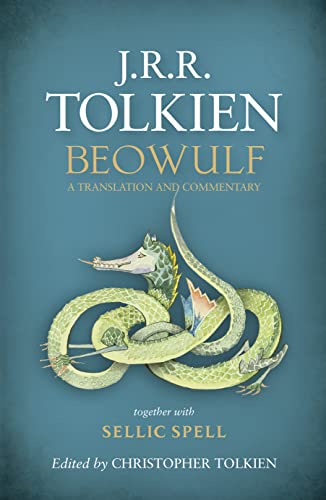
Inhaltsangabe
The translation of Beowulf by J.R.R. Tolkien was an early work, very distinctive in its mode, completed in 1926: he returned to it later to make hasty corrections, but seems never to have considered its publication.
This edition is twofold, for there exists an illuminating commentary on the text of the poem by the translator himself, in the written form of a series of lectures given at Oxford in the 1930s; and from these lectures a substantial selection has been made, to form also a commentary on the translation in this book.
From his creative attention to detail in these lectures there arises a sense of the immediacy and clarity of his vision. It is as if he entered into the imagined past: standing beside Beowulf and his men shaking out their mail-shirts as they beached their ship on the coast of Denmark, listening to the rising anger of Beowulf at the taunting of Unferth, or looking up in amazement at Grendel’s terrible hand set under the roof of Heorot.
But the commentary in this book includes also much from those lectures in which, while always anchored in the text, he expressed his wider perceptions. He looks closely at the dragon that would slay Beowulf ‘snuffling in baffled rage and injured greed when he discovers the theft of the cup’; but he rebuts the notion that this is ‘a mere treasure story’, ‘just another dragon tale’. He turns to the lines that tell of the burying of the golden things long ago, and observes that it is ‘the feeling for the treasure itself, this sad history’ that raises it to another level. ‘The whole thing is sombre, tragic, sinister, curiously real. The “treasure” is not just some lucky wealth that will enable the finder to have a good time, or marry the princess. It is laden with history, leading back into the dark heathen ages beyond the memory of song, but not beyond the reach of imagination.’
Sellic Spell, a ‘marvellous tale’, is a story written by Tolkien suggesting what might have been the form and style of an Old English folk-tale of Beowulf, in which there was no association with the ‘historical legends’ of the Northern kingdoms.
Die Inhaltsangabe kann sich auf eine andere Ausgabe dieses Titels beziehen.
Über die Autorin bzw. den Autor
J.R.R. Tolkien is best known for The Hobbit and The Lord of the Rings, selling 150 million copies in more than 60 languages worldwide. He died in 1973 at the age of 81.
Christopher Tolkien, born on 21 November 1924, was the third son of J.R.R. Tolkien. During the Second World War he served in the Royal Air Force and the Fleet Air Arm as a pilot. At the end of the war he returned to Oxford University and became a Fellow and Tutor, lecturing on early English and northern literature. He devoted himself after his father’s death in 1973 to the editing of his unpublished writings, notably The Silmarillion, Unfinished Tales, the twelve volumes of The History of Middle-earth, and The Children of Húrin, Beren and Lúthien and The Fall of Gondolin. In 1975 he moved with his wife Baillie to live in France. He died in 2020 at the age of 95.
„Über diesen Titel“ kann sich auf eine andere Ausgabe dieses Titels beziehen.
Weitere beliebte Ausgaben desselben Titels

Suchergebnisse für Beowulf: A Translation and Commentary, Together with...

Beispielbild für diese ISBN
Beowulf: A Translation and Commentary, together with Sellic Spell
Anbieter: AwesomeBooks, Wallingford, Vereinigtes Königreich
Verkäuferbewertung 5 von 5 Sternen

Paperback. Zustand: Very Good. Beowulf: A Translation and Commentary, together with Sellic Spell This book is in very good condition and will be shipped within 24 hours of ordering. The cover may have some limited signs of wear but the pages are clean, intact and the spine remains undamaged. This book has clearly been well maintained and looked after thus far. Money back guarantee if you are not satisfied. See all our books here, order more than 1 book and get discounted shipping. . Artikel-Nr. 7719-9780008116583
Gebraucht kaufen
EUR 6,94
Versand:
EUR 5,70
Von Vereinigtes Königreich nach USA
Anzahl: 1 verfügbar
Beispielbild für diese ISBN
Beowulf: A Translation and Commentary, together with Sellic Spell
Verlag:
HarperCollins 21/05/2015, 2015
ISBN 10: 000811658X
ISBN 13: 9780008116583
Gebraucht
Paperback
Anbieter: Bahamut Media, Reading, Vereinigtes Königreich
Verkäuferbewertung 5 von 5 Sternen
Paperback. Zustand: Very Good. Shipped within 24 hours from our UK warehouse. Clean, undamaged book with no damage to pages and minimal wear to the cover. Spine still tight, in very good condition. Remember if you are not happy, you are covered by our 100% money back guarantee. Artikel-Nr. 6545-9780008116583
Gebraucht kaufen
EUR 6,94
Versand:
EUR 7,97
Von Vereinigtes Königreich nach USA
Anzahl: 1 verfügbar